
Your needs, this model
Does it fit your priorities?
Does the Basic show the stud center?
It signals edges, not a center indicator. Its manual says to mark both edges and use their midpoint as an estimate; check the marks again at another height before relying on the line.
Explore this need in the finder →What does its 3/4-inch maximum mean in the finder?
The manual states up to 3/4 inch (19 mm). The minimum-depth control advances by 0.1 inch, so 0.7 inch can fit this documented ceiling but 0.8 inches is above it. The nominal maximum does not guarantee detection in a particular wall.
Explore this need in the finder →Can the Basic find studs through lath and plaster or warn about live wires?
The manufacturer does not recommend lath-and-plaster use, and the exact product page and manual do not document a live-wire warning feature. Those are not capabilities to infer from a related Zircon model.
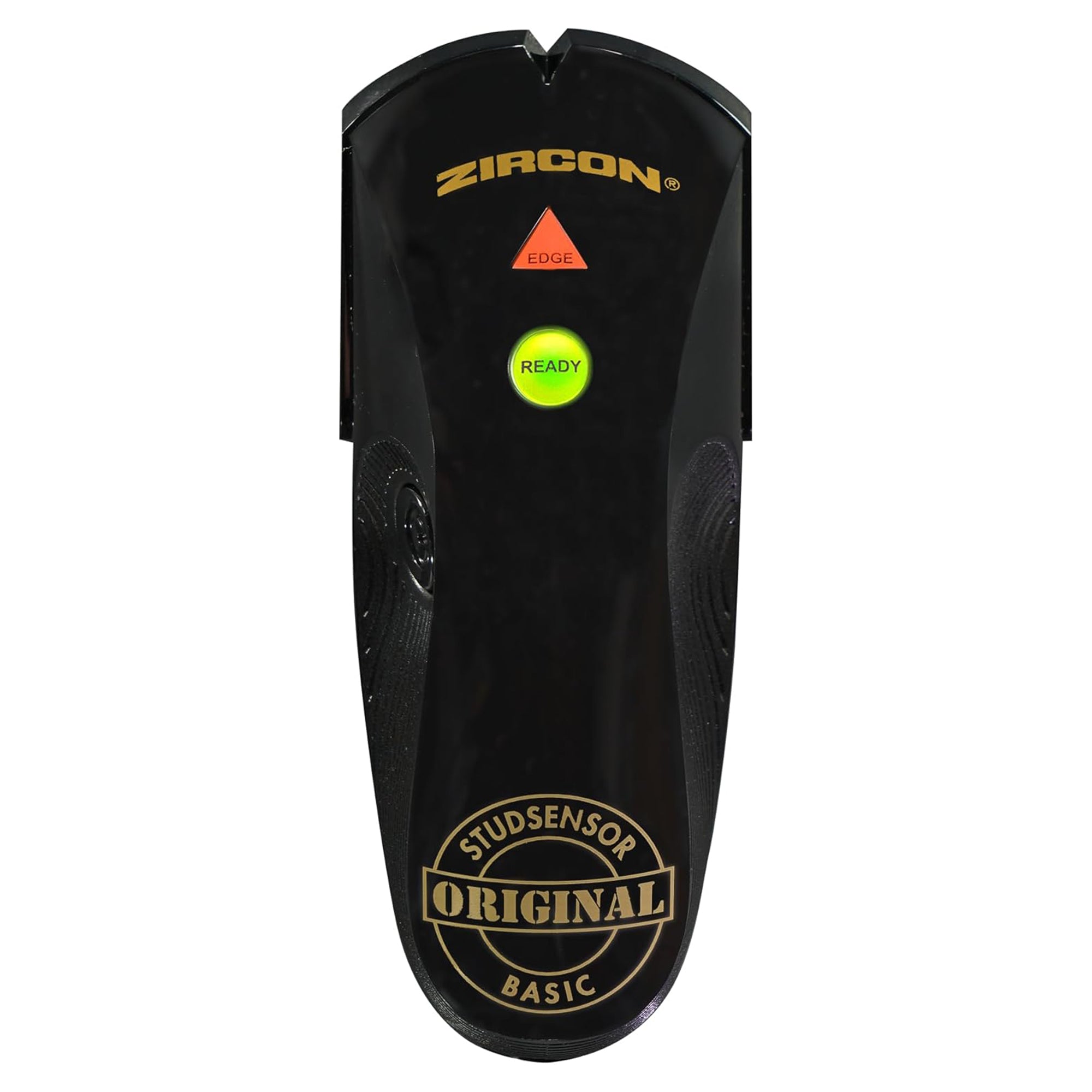
Explore this need in the finder →The StudSensor Basic is a single-mode electronic edge finder for interior drywall projects. Zircon says it can locate wood and metal stud edges up to 3/4 inch (19 mm) behind the scanned surface. The tool signals the edge with an LED and sound, and a SpotLite pointer projects the marking location. Those are useful features for a simple layout, but they do not make the Basic a center-and-edge scanner, a deep-wall tool, or an electrical warning device. This assessment follows the exact StudSensor Basic page and its current Basic manual, rather than assuming that another StudSensor model works the same way.
Its useful answer is an edge, not a center
The manual's name for the instrument is “Edge-Finding Stud Finder.” For setup, hold it flat and still against the wall while pressing and holding the power button; the green READY light indicates that calibration is complete. Zircon says not to move it during that process. Then continue to hold the button and slide slowly. When the red EDGE light and SpotLite pointer appear, mark the point. Continue until the indicators turn off, reverse direction, and mark the opposite edge. The midpoint between those two marks is the user's estimate of center—the device does not display a separate center indication.
The instructions also warn about starting directly over a stud: a continuous beep means to restart from another location. Mapping more than one height is a useful check because a pipe or another object may create a response that does not continue vertically like a stud. The manufacturer's page reports typical position-accuracy figures for wood and metal studs when using the dual-scan-and-mark procedure. Those are manufacturer specifications, not measurements from this review, and they do not override the need to repeat a doubtful reading.
The 3/4-inch limit is a real screening boundary
The product page and manual state a maximum of 3/4 inch, or 19 mm. In the site's finder, depth requirements advance by tenths of an inch: 0.7 inches is below that documented maximum, but the next selection, 0.8 inches, is above it. That comparison is a screening rule, not a promise that a particular stud will be detectable at the nominal limit. Wall thickness, material density, moisture, texture and paint can alter sensing. Do not borrow a greater depth figure from the A200 or from another model merely because both are sold by Zircon.
The Basic uses one 9V alkaline battery, and the manufacturer states it is not included. It has no separate scan mode described on the exact page, and the reviewed Basic sources do not document a live-wire meter. The green READY light indicates calibration readiness, while the red EDGE light signals an edge; neither is a live-wire alert. Keep electrical and other utility checks separate from the stud-finding routine.
Respect the material restrictions
Zircon describes ordinary drywall use and specifically says the Basic is not recommended for lath and plaster because plaster thickness varies. The manual also cautions against metallic foil or fibers in wallpaper and says fresh paint may need a week or longer to dry. For a very uneven surface, it describes using thin cardboard as a shim. These are model-specific limitations, not a general guarantee for plaster, tile, exterior cladding, or other dense wall assemblies. The manual says to use the scanner indoors and to check at several heights for repeatable readings.
These limits make the Basic different from the magnetic StudScout 2-Pack. The StudScout has no battery or electronic calibration but locates ferrous fasteners rather than sensing density or signaling edges. The MultiScanner A200 offers both center and edge indicators, a deeper DeepScan stud mode, a separate metal mode and WireWarning, but takes more deliberate mode selection and uses a 9V cell. Those comparisons help clarify the decision; they do not prove that one model will work better on every actual wall.
Where the Basic fits
The Basic is a plausible option if the task is to mark both sides of a stud on a dry interior drywall wall, then estimate a centerline from the paired marks. It is less suitable when you need a direct center cue, a depth threshold above 3/4 inch, documented support through lath and plaster, or a warning about live wiring. The edge-by-edge routine also takes care: mark both boundaries, repeat the scan, and look for a coherent line at another height before mounting anything heavy.
Before buying, confirm the exact “StudSensor Basic” name and SKU 73574 rather than treating it as the unnamed StudSensor or StudSensor Center. The official page says the 9V battery is not included; check any retailer-specific package details separately. Read the current Basic manual for the calibration and material instructions, and do not rely on the finder alone before drilling. No physical testing, ownership, hands-on measurement, customer experience, price or availability claim is made here. Its appeal is a straightforward edge signal for a narrow drywall use case, paired with an unusually clear depth cutoff that should shape the shortlist.
Key specifications
Key details at a glance
| Maximum stated stud depth | 0.75 in |
|---|---|
| Depth qualification | Zircon's exact page and manual state up to 3/4 inch (19 mm); the manual separately gives a typical position accuracy figure. Neither statement guarantees a particular wall result. |
| Documented scan modes | ['Edge finding'] |
| Center and edge indication | No |
| Live-wire meter | No |
| Battery requirement | One 9V alkaline battery |
Use the exact model’s instructions for operating limits, supplied equipment and version differences.
Sources for this review
Sources for this assessment
Check this model against your wall
Use the finder to compare documented surface limits, center/edge indications and other requirements. A match is not a safety certification.