
Your needs, this model
Does it fit your priorities?
What does a single StudScout locate?
Its magnet attaches to ferrous nails or screws that may be fastened to a stud. Zircon recommends marking several points and checking whether they form a consistent vertical line; one magnetic catch does not identify a stud by itself.
Explore this need in the finder →Is the single StudScout a battery-free alternative to an electronic edge finder?
It needs no battery or electronic calibration, but it follows ferrous fasteners rather than sensing density changes or indicating stud edges. It is a different method, not a battery-free version of the electronic StudSensor.
Explore this need in the finder →Does StudScout report a depth or warn about live wiring?
The exact product page and quick-start guide publish no numeric stud-detection depth or live-wire warning. Use other wall information and separate utility checks before penetrating a surface.
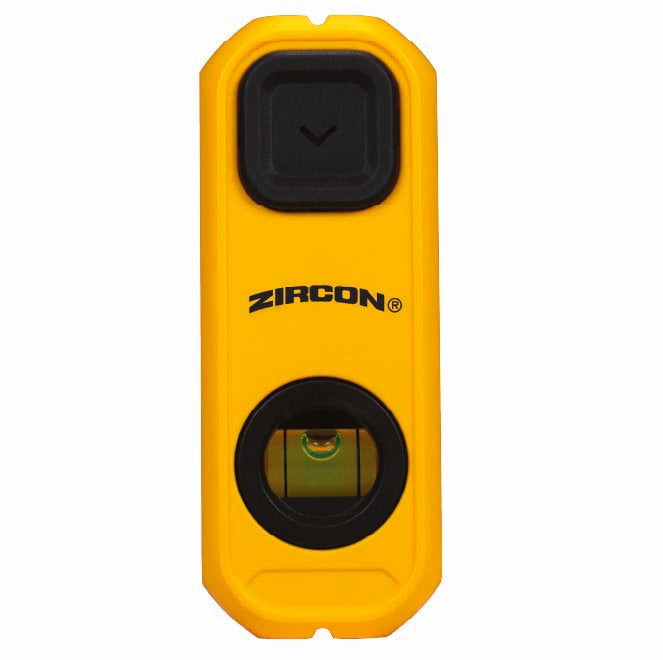
Explore this need in the finder →The Zircon StudScout is not an electronic density scanner. It is a small magnetic finder that attaches to ferrous nails, screws and other surface-mounted magnetic material that may be fastened to a stud. Its single-unit U.S. listing is SKU 75306; the manufacturer also lists a separate StudScout 2-Pack, SKU 75621. The package count differs, but the single tool's magnetic method is the point to understand before choosing either offer.
It follows fasteners, not the stud body
The quick-start guide describes a broad zig-zag sweep across an interior wall until the rare-earth magnet sticks to a nail or screw. The Easy-Mark button marks that spot. Then the instructions have the user move vertically to find additional fasteners, check for a consistent column and compare the pattern with ordinary stud spacing. If the positions or spacing look irregular, Zircon says to try another vertical line and avoid areas crowded with closely spaced fasteners. This is a pattern-based inference: one magnetic attraction can be a fastener that is not useful evidence of a stud.
That method can be convenient when drywall has a repeated line of ferrous screws and the task is to mark an approximate mounting line. There is no battery to install, no calibration sequence, no electronic scan mode and no indicator display to interpret. The product page also lists an integrated marking button, rotating bubble level and wrist lanyard. The level helps align a separate project; it does not make the fastener pattern more certain. The manufacturer gives no numeric stud-detection depth and does not say the tool locates a stud's edges or center.
Compare the single tool with the 2-Pack honestly
The official collection shows both a standalone StudScout and a StudScout 2-Pack. The single item has SKU 75306 and the two-piece configuration has SKU 75621. The product pages share the same operating guide and describe the same per-tool magnet, Easy-Mark button and rotating level. That makes the package quantity a real buying distinction, but not a wider sensing area or a different detection mode. A two-pack is useful only if two identical tools are wanted; there is no evidence that two units combine to scan a wall more accurately.
Against the electronic StudSensor, the StudScout avoids batteries and calibration but depends on a line of ferrous fasteners and has no depth figure. The StudSensor senses a density change and marks edges, but its own 3/4-inch ceiling and dry-wall restrictions apply. The StudSensor Center has electronic edge and center cues and two documented stud modes; that capability comes with a battery, a calibration routine and its own material limits. These approaches solve related but not identical layout problems.
Surface, magnetic and electrical limits
Zircon identifies drywall as the ideal surface and says not to use the StudScout on lath and plaster. It recommends indoor use. More fundamentally, the device can only respond to ferrous targets it can magnetically reach; a wall without suitable fasteners or with a confusing distribution gives it no reliable stud pattern to map. The manufacturer does not state a distance through the surface, a supported tile or exterior use, or a metal-mesh capability. Those omissions should remain unknown, not be filled in from the larger magnet or a related scanner.
The manual says not to rely exclusively on the tool before penetrating a surface. It recommends other information such as construction plans, visible pipe and wire entry points and standard spacing. The StudScout has no documented live-wire warning, so a magnetic attachment is not an electrical check. It cannot tell whether wiring, plumbing or an unrelated metal item lies behind a point. Turn off utilities before drilling or cutting, and use appropriate independent checks when the consequences matter.
The magnet also has a specific handling warning. Zircon instructs users to keep it at least 12 inches (30 cm) from pacemakers, implantable cardioverter defibrillators and other medical implants, as well as credit cards and magnetic storage media. Anyone for whom that warning matters should follow the current manufacturer instructions and appropriate medical-device guidance. No hands-on test, ownership, measured performance or customer experience is claimed in this research-based assessment.
What to verify before buying
Check that the listing is the single StudScout, SKU 75306, rather than the separately listed 2-Pack, SKU 75621. The source page describes a wrist lanyard, rotating bubble level and Easy-Mark button, but seller-specific package details should still be checked if the exact contents matter. Read the current safety instructions, particularly the magnetic separation warning and the fastener-pattern confirmation steps.
Choose the StudScout when a battery-free magnet for locating and marking a plausible line of ferrous drywall fasteners fits the task. Look elsewhere when the wall lacks fasteners, a stated depth is essential, a direct edge or center indication is required, or a live-wire meter is a must. In those cases an electronic finder may answer a different question, but no consumer scanner should be treated as proof that a wall is safe to penetrate.
Key specifications
Key details at a glance
| Depth qualification | The maker does not state a stud-detection depth; the device locates ferrous fasteners rather than sensing the stud body through a numeric depth. |
|---|---|
| Documented scan modes | ['Magnetic fastener location'] |
| Center and edge indication | No |
| Live-wire meter | No |
| Built-in bubble level | Yes |
| Battery requirement | No batteries required |
Use the exact model’s instructions for operating limits, supplied equipment and version differences.
Sources for this review
Sources for this assessment
Check this model against your wall
Use the finder to compare documented surface limits, center/edge indications and other requirements. A match is not a safety certification.