
Your needs, this model
Does it fit your priorities?
What does the M90 show when locating a stud?
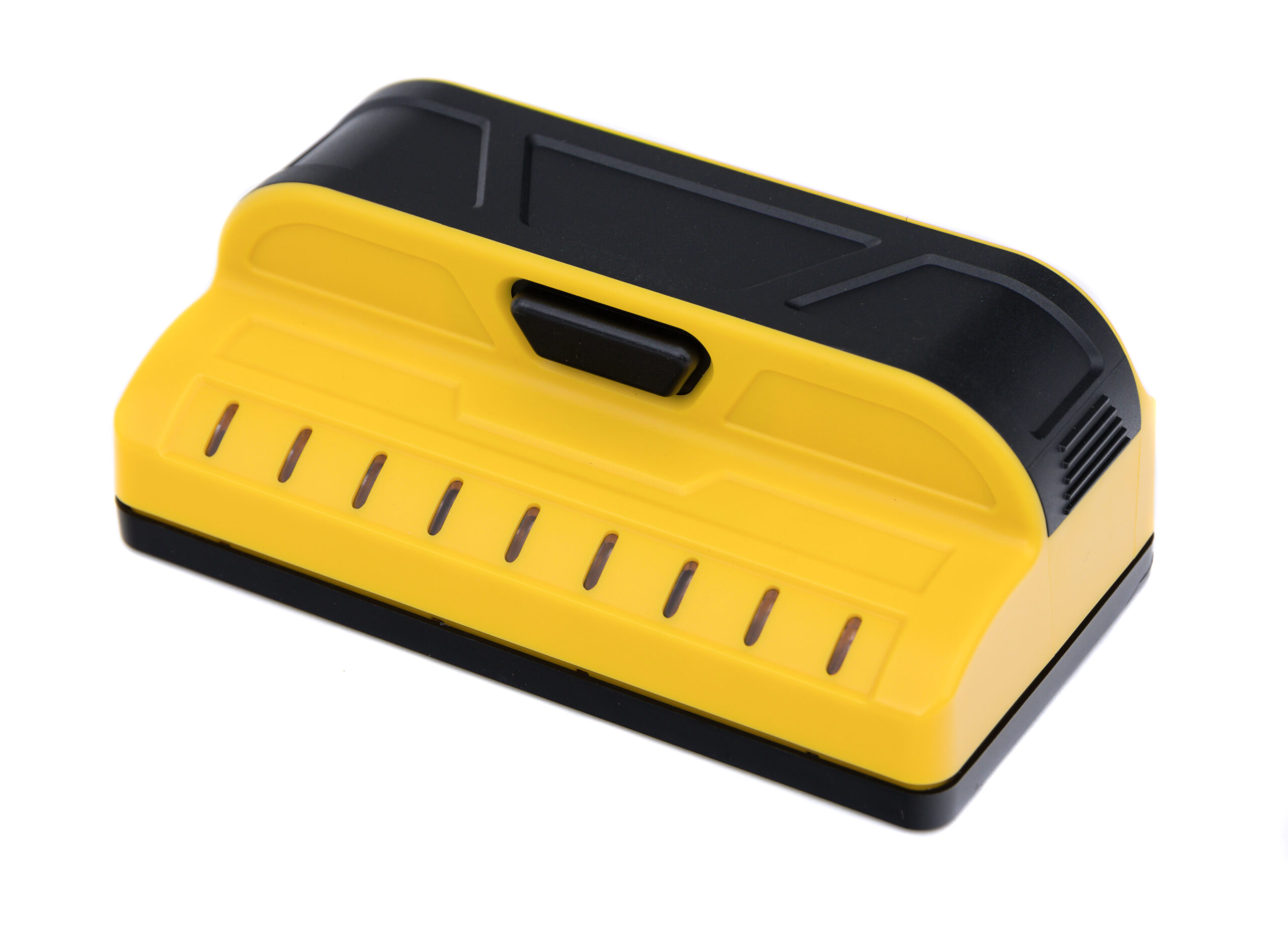
Franklin lists nine sensors and nine LEDs, and the current M90-family manual says its LEDs track stud center and edges together. These are density cues, not proof that the hidden object is wood; compare the pattern on repeat passes and check utilities separately.
Explore this need in the finder →Can the M90 scan through lath and plaster?
Its current manual says the ProSensor can see through most lath-and-plaster walls up to 1.5 inches, but irregular plaster thickness or construction beyond that can defeat detection and metal mesh may block it. This is a conditional use, not a guarantee for an old wall.
Explore this need in the finder →Does the M90 meet a 1.6-inch minimum depth or a live-wire-meter requirement?
No. The exact M90 page states 1.5 inches, and its manual identifies a separate Live Electrical Warning only on M150 and X990. The M90 has no documented dedicated meter; the 1.5-inch figure is a comparison ceiling and not a wall guarantee.
Explore this need in the finder →Short answer: The ProSensor M90 is Franklin’s nine-sensor, nine-light model with a published 1.5-inch maximum and simultaneous center-and-edge indications. That makes it a paper candidate for ordinary interior wall scanning when that depth ceiling is enough. It is not the deeper M210/MAX class, and its own sources do not establish a green center cue or dedicated live-wire meter.
Nine sensors, but not the M150’s 15-light display
The exact M90 page lists nine sensors and nine LEDs. Its linked instructions say the lights track stud center and edges at the same time, so a user can compare a span of indications rather than relying on one isolated point. That is a different display arrangement from the M150: both pages list nine sensors, but the M150 page lists 15 LEDs and makes a full-width/double-stud display claim. I would not transfer that claim to the M90 merely because the model names share a family. More indicators do not make the M90 an object-identification instrument. Franklin’s manual says the LEDs react to density changes and may light for a pipe, wire, beam, surface irregularity or other hidden feature. A persistent pattern across repeat passes can be more useful than a brief flicker, but it remains a clue to investigate—not a verified wood stud. This is documentary research from the model page and instructions, not a hands-on test or measured comparison.The stated depth is a ceiling, not a promise
Franklin gives the M90 a maximum detection depth of 1.5 inches. Treat that number as a threshold for filtering a shortlist, not as a guarantee that a particular wall, finish or stud will be detected at that depth. The manufacturer’s current manual says ordinary wall surfaces should be clean and dry. It also warns that foil-backed insulation can cause inconsistent results, metallic wallpaper can block the signal and major temperature changes call for the sensing surface to acclimate before use. The manual does discuss lath and plaster: it says the ProSensor can see through most such walls within 1.5 inches, while warning that irregular plaster thickness or construction beyond that range removes the assurance. Metal-mesh reinforcement may prevent detection. That is conditional guidance, not a blanket claim that the M90 handles all old walls. The same instructions say detection through tile, flooring, roofing and exterior materials is not guaranteed. If your project depends on an unusual wall assembly, compare the exact manual and seek a tool whose manufacturer specifically supports that assembly.Start scanning without calibration, then verify the pattern
The M90 manual calls for two AAA batteries and says not to use rechargeable cells. It explains that the user can press the button on or off the wall and begin scanning without a calibration routine. Keep a hand on the handle, hold the button through the pass and keep fingers away from the sensor area. When a signal is ambiguous, the manual recommends continuing to scan up and down; changing surface texture or a nearby wire can also produce a response. Those are operating instructions, not proof that setup is foolproof. The available product page does not state whether batteries are included in every offer. It also does not establish an exact standalone retail SKU, a case in the box, a ruler, bubble level or pencil caddy. Confirm the exact model name and package contents before purchase rather than assuming that another Franklin listing’s accessories apply here.Do not mistake a generic light cue for a specific feature
The M90 page repeats Franklin’s qualified phrase that the center LED turns green in “certain models.” The linked family manual uses the same conditional wording without naming M90 as one of those models. I therefore treat the M90’s center-light color as unknown. Its manual is more explicit about the separate electrical-warning feature: the section is labeled for M150 and X990 only. M90 is not documented as having either that warning symbol or a dedicated live-wire meter. This matters if a meter is a required buying condition: the M90 does not pass the site’s documented-meter filter. Nor would a meter, symbol or quiet display make a drilling location safe. The instructions say to turn off gas, water and electric power before penetrating a wall. Use independent checks for utilities and do not treat a stud-finder reading as clearance.Who might shortlist the M90?
It is a reasonable documentary candidate when a buyer has a straightforward, dry interior wall, wants a nine-light center/edge pattern and can work within the stated 1.5-inch maximum. Its manual gives a route for carefully checking most lath-and-plaster walls, but only with the stated thickness and mesh limitations in mind. It is a poor fit if you need a verified green center cue, a dedicated live-wire meter, a higher stated depth threshold or guaranteed tile/exterior performance. For a seven-sensor alternative with a three-inch display, compare the M70; for a 9-sensor model with a different LED arrangement and a warning symbol, compare the M150. Read the official M90 page and its current 07/25 operating and safety instructions for the exact limits. No ownership, performance testing, price or retailer stock is claimed here.Key specifications
Key details at a glance
| Sensing points | 9 |
|---|---|
| Indicator lights | 9 |
| Maximum stated stud depth | 1.5 in |
| Depth qualification | The exact M90 page states a 1.5-inch detection maximum. This is an upper comparison limit, not a promised reading through every wall. |
| Center and edge indication | Yes |
| Live-wire meter | No |
| Battery requirement | 2 AAA; use fresh alkaline cells and do not use rechargeables or mix old/new cells or chemistries |
Use the exact model’s instructions for operating limits, supplied equipment and version differences.
Sources for this review
Sources for this assessment
Check this model against your wall
Use the finder to compare documented surface limits, center/edge indications and other requirements. A match is not a safety certification.