
Your needs, this model
Does it fit your priorities?
How should I interpret the M155 live-wire meter?
The exact manual says the meter runs while the button is held and its yellow segments respond as electrical strength increases; it suggests scanning in both directions repeatedly. The maker also warns that the device may not detect every live wire and optimizes the cue for wires on or near studs. Shut off utilities and use an independent service check before penetrating the wall.
Explore this need in the finder →Does the M155's green center light identify a wood stud?
No. Franklin says the middle LED turns green to indicate the stud's center, and the manual describes the display as responding to hidden objects and density changes. A green light is a center-marking cue inside a detected pattern, not material identification. Check both edges and repeat the scan; verify the structure separately.
Explore this need in the finder →Is the M155 a fit when I need a stated 1.6-inch depth?
The exact M155 page and comparison chart state a 1.5-inch maximum, so it does not meet a 1.6-inch minimum in this comparison. Its extra live-wire and green-center cues do not extend the depth figure. Compare the exact model limits and wall conditions rather than assuming its 15 LEDs promise greater reach.
Explore this need in the finder →The M155 is the only newly reviewed model in this small Franklin group whose exact page pairs a dedicated live-wire meter with an explicit green center cue. It has 9 sensors, 15 LEDs and a manufacturer-stated 1.5-inch maximum. That combination may suit a homeowner who wants a visible stud pattern plus a separate warning signal, but neither feature identifies every hidden object or makes a wall safe to drill. This is a source-based assessment, not a personal-use or measured-performance review.
What the M155’s indicators mean
Franklin’s M155 page says the middle LED turns green to indicate the stud’s center. Its description also says the display shows the full width of studs and can show double or irregular configurations. The manufacturer comparison chart lists a 4.25-inch display width, 9 sensors and 15 LEDs. Those are the maker’s specifications, not an independent measurement of the width or accuracy of a real stud. The 15 lights may make the signal span easier to read, but the manual still explains that the device senses density differences. A light pattern can come from a pipe, wire, texture or other change; it does not identify which material is behind the wall.
The current M155/X995 instructions say no calibration is required. Hold the tool only by its handle and press and hold the button throughout a scan. The manual suggests repeating a potential live-wire reading in both directions and scanning more than once; it says the meter segments strengthen as electrical signal strength rises. If a stud pattern is unclear, repeat across the same area and consider a vertical scan. A steady display is a useful clue, not a verified stud finding.
The wire meter is an added cue, not permission to drill
The exact manual says the live electrical warning works while the button is depressed and that its meter is optimized for wires on or near studs. It also warns that the M155 may fail to detect all live wires or hidden objects. A positive meter response calls for caution; a negative response does not clear the wall. The instructions say to turn off electrical, gas and water supplies before drilling or penetrating a surface. For a critical installation or unknown wiring route, use appropriate independent checks or ask a qualified professional rather than leaning on the M155 alone.
This distinction matters because the stud display and live-wire meter answer different questions. The green center light helps mark the center of the detected pattern; it does not mean that the object is wood. The wire meter provides a warning about some energized conductors; it is not a complete wiring map. Keep the two features separate when choosing a model and when planning a safe hole.
Depth and surface are separate questions
The M155 page and its comparison matrix state a 1.5-inch maximum. That is lower than the reviewed M210’s 1.7-inch figure, even though both models have a documented live-wire meter and center-and-edge indicators. If a 1.6-inch threshold is essential, the M155 does not meet that numeric comparison; more LEDs do not extend its stated limit. As with any maximum, the number does not promise a result through a particular finish, texture or hidden target.
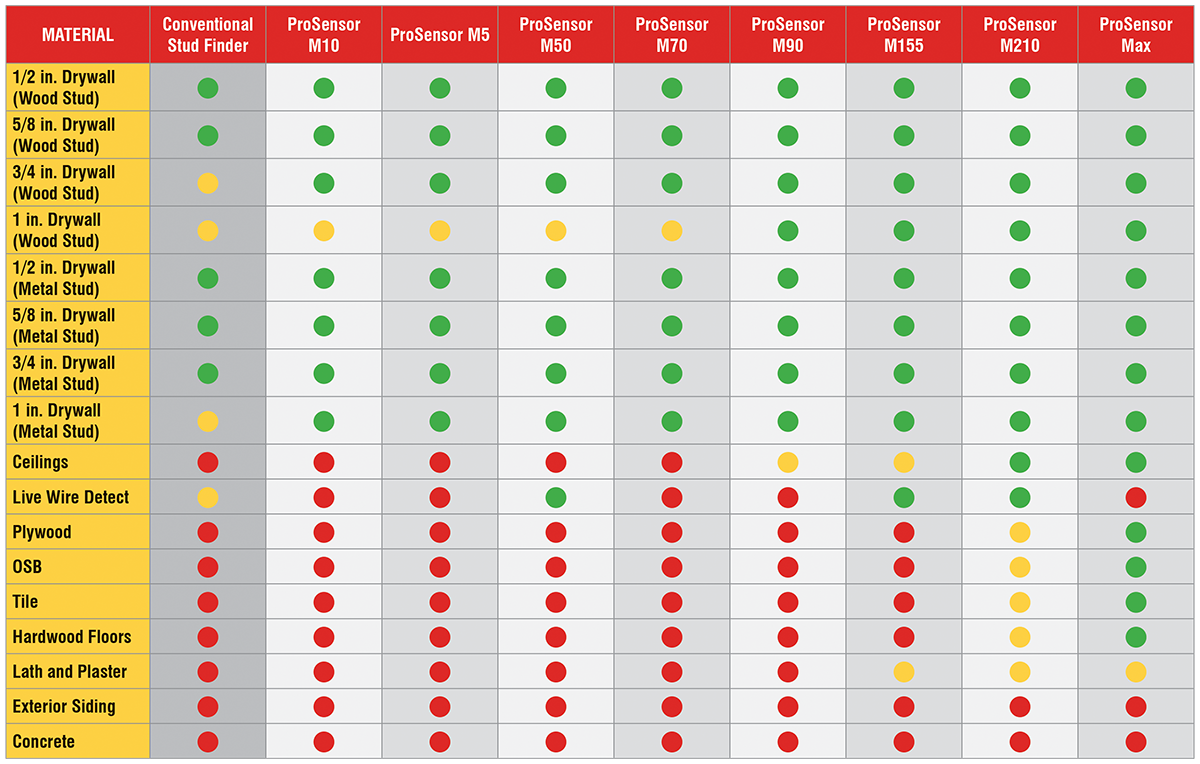
The M155 manual favors a clean, dry surface and warns that foil-backed insulation may produce inconsistent readings while metallic wallpaper can block the signal. It says tile, roofing and exterior materials are not guaranteed because their thickness and density vary. The exact M155 operating manual does not give a lath-and-plaster depth or a plaster mode. A manufacturer M-Series chart includes a colored mark for lath and plaster, but the image captured with the product materials does not show a legend explaining that mark. I do not treat that unexplained symbol as a documented compatible setup. If plaster is your wall, ask the manufacturer about the exact construction and do not substitute the M155’s drywall maximum for a plaster rating.
Compare what each exact model offers
The M210 is a useful contrast: its exact page lists 13 sensors, 21 LEDs and a 1.7-inch maximum, and its manual documents a live-wire meter. M155’s distinct advantage in the present evidence is its explicit green center cue, while its published depth is lower. The X1100 instead adds a bubble level and pencil caddy but has no dedicated meter established in the sources reviewed here. These feature differences can narrow a choice, but they are not laboratory performance rankings. Read the separate M210 and X1100 reviews against the task you actually have.
The manual requires two AAA batteries and cautions against mixing old and new cells or different battery types. It does not establish that batteries come in a specific seller package. The exact materials reviewed do not confirm a retail SKU, case, accessory bundle, ruler or built-in level, so verify the model label and package before purchase. Do not treat the similarly named M150 or a compatible case as the M155.
Bottom line: the M155 is a document-supported candidate for dry interior drywall when a green center indication and an added live-wire warning are useful and a 1.5-inch stated maximum is adequate as a comparison limit. Its meter may miss wires, its LEDs do not identify objects, and plaster support remains unestablished from the exact manual. Read the official M155 page, current M155 operating instructions and manufacturer comparison matrix.

Key specifications
Key details at a glance
| Sensing points | 9 |
|---|---|
| Indicator lights | 15 |
| Maximum stated stud depth | 1.5 in |
| Depth qualification | The exact M155 page and manufacturer comparison matrix state a 1.5-inch maximum; it is a stated ceiling, not a guaranteed result through a particular wall. |
| Center and edge indication | Yes |
| Live-wire meter | Yes |
| Battery requirement | 2 AAA; use matching cells and do not mix old/new or battery chemistries |
Use the exact model’s instructions for operating limits, supplied equipment and version differences.
Sources for this review
Sources for this assessment
- ProSensor M155 — official U.S. model page
- Franklin Sensors X995/M155 operating and safety instructions (05/25)
- Franklin Sensors ProSensor M155 comparison matrix (manufacturer chart)
- Franklin Sensors M-Series surface matrix (manufacturer chart, 10/28/26)
- Franklin Sensors U.S. product directory
- Franklin Sensors instructions and quick-start index
Check this model against your wall
Use the finder to compare documented surface limits, center/edge indications and other requirements. A match is not a safety certification.