
Your needs, this model
Does it fit your priorities?
Does the CMHT77621 reach 1.5 inches for both wood and metal studs?
No. The shared manual specifies up to 1.0 inch for wood and 1.5 inches for metal through drywall. A numeric-only finder match at 1.5 can use the metal-stud plan, so confirm that plan matches the wall framing you intend to scan.
Explore this need in the finder →Can I get both edge and center indications from CMHT77621?
The exact model's manual describes a center LED and directional approach LEDs, not separate left/right edge readings. If both instrument indications are essential, use a model whose manual explicitly documents both cues rather than deriving them from movement.
Explore this need in the finder →Is its live-AC alert a clearance to drill?
No. The manual says shielded wires, metal conduit or dense/metalized walls may not be detected, and that the tool is not a voltmeter. Verify separately and switch off power before any wall penetration.
Explore this need in the finder →This review separates the exact CRAFTSMAN CMHT77621 from the similar CMHT77620 using the shared U.S. manual’s target-by-target specification table. No hands-on test or measured wall reading was performed.
The “1-1/2-inch” name needs a target check
CMHT77621 is a center-indicating electronic stud finder with a separate live-AC warning. The product title emphasizes a 1-1/2-inch depth, but the manual makes an important distinction: it lists wood-stud detection through up to 1.0 inch (25 mm) of drywall and metal-stud detection through up to 1.5 inches (38 mm). Those are different supported plans, not one universal wood-and-metal maximum. If the wall framing is wood and the surface build-up exceeds one inch, the larger headline does not solve that limitation.
The tool is otherwise close in operation to the CMHT77620: both identify a stud center with an LED, directional cues, a longer tone and a marking hole. The 77621’s distinction is its deeper metal-stud limit; it does not document separate edge readouts. If your job needs a device that indicates both stud edges and center, do not treat the approach arrows as edge boundaries. The CMHT77633 provides an edge signal instead, then requires the user to mark both edges to estimate a midpoint.
Center-first workflow
The shared instructions call for two AAA batteries. Hold the sensor flat and still against the wall, press and hold the center button until the calibration lights clear, then scan slowly while continuing to hold it. Directional LEDs help steer toward the stud; the center LED and longer tone signal a center mark. This is a simple output to interpret, but a calibration error, incompatible wall or rushed pass can produce a misleading or missing cue. The maker’s instructions, not the sensor’s appearance, determine the proper setup.
For the two electronic stud modes, the maximums are 1.0 inch for wood and 1.5 inches for metal. The same manual gives a separate live-AC warning through up to two inches of drywall, typically indicated from six to eighteen inches away. Keep those numbers distinct: the two-inch AC specification is not an extra-deep stud mode. The manual also gives a ±1/4-inch center accuracy figure over specified drywall thickness ranges; it is a controlled maker specification, not an estimate of what a particular patched wall will return.
Surface and warning limitations
Drywall is the documented operating surface. The manual says the tool will not work on concrete, mortar, block, brickwork, plaster, carpeting, foil-faced material, metallic surfaces or ceramic tile. It recommends a smooth surface and lists 35–55% relative humidity; its operating-temperature range is 32–122°F. Do not extrapolate a drywall limit to lath-and-plaster, tile, an exterior wall or metal mesh.
The live-AC signal is useful only as an added warning. CRAFTSMAN cautions that shielded wire, metal conduits/casings, metalized walls and thick or dense construction may prevent detection; static charge may also spread the apparent alert. The manual says the device is not a measuring instrument or substitute for a voltmeter, and the indicator is not solely reliable for identifying hazardous voltage. Verify independently, use other evidence of wiring routes and turn power off before opening or drilling a wall. A missing alert cannot clear a location.
Package, warranty and comparison checks
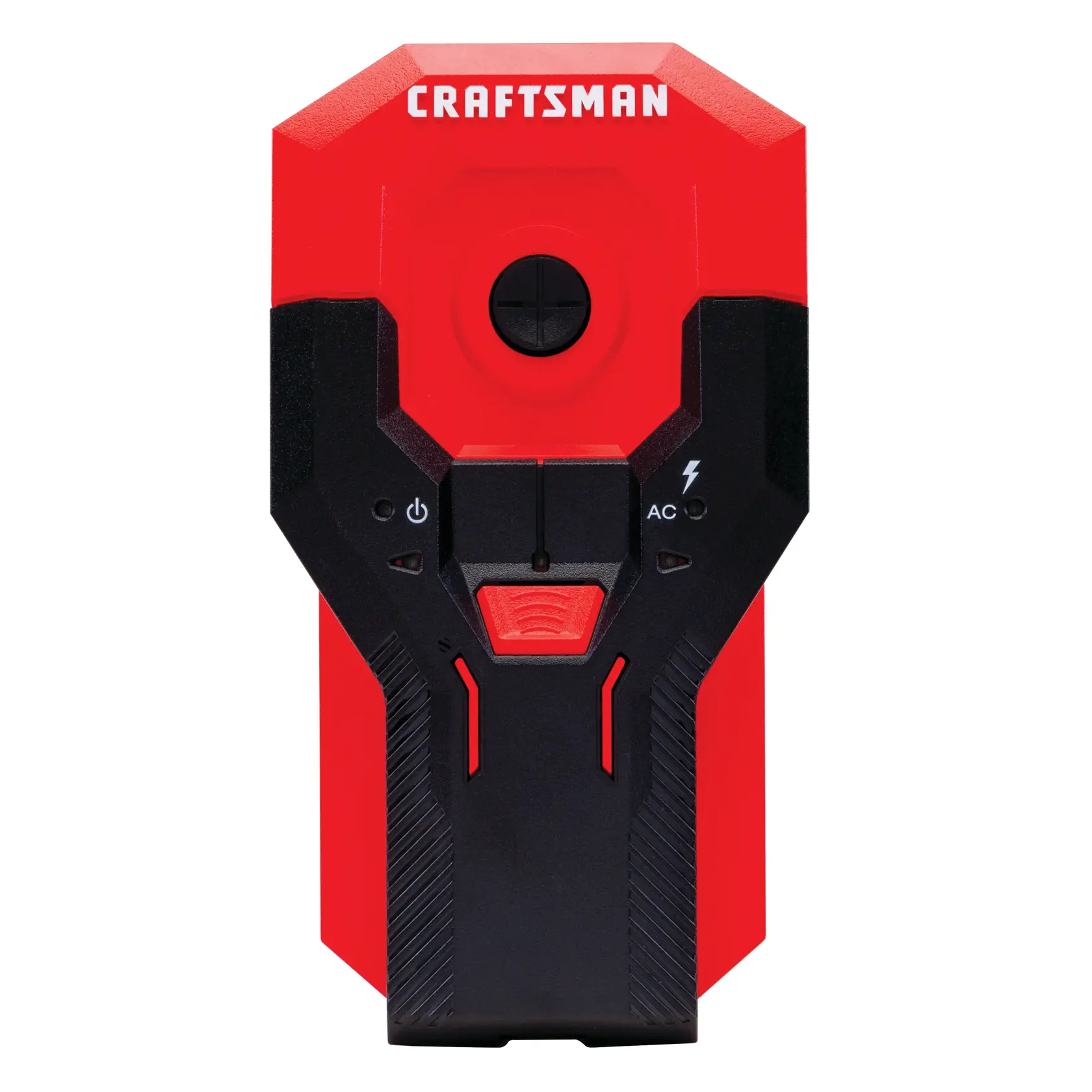
The exact product page describes the model as a single tool, and the picture shows the CMHT77621 unit. Its shared manual requires two AAA cells, but the product-page wording about included batteries is not specific enough to confirm the exact seller package. Check the offered box contents. The product page uses full-lifetime warranty wording; the shared manual describes one year and shortens coverage in commercial/rental situations. Ask CRAFTSMAN for the applicable current terms.
For a shallow wood-stud job with the same center/AC interface, the 77620’s 3/4-inch ceiling may be enough. For a metal stud, the 77621 is the one of the pair with a manual-backed 1.5-inch limit. For a wood stud, stop at one inch. No present stock, offer, price, or test result is implied by this review; confirm the printed model number, wall construction, battery package and operating instructions before making a choice.
Key specifications
Key details at a glance
| Maximum stated stud depth | 1.5 in |
|---|---|
| Depth qualification | The shared manual's specification table separates targets: wood studs up to 1.0 inch (25 mm), metal studs up to 1.5 inches (38 mm), through drywall. Its general product-page 1.5-inch title must not be read as a 1.5-inch wood-stud rating. Live AC to 2 inches is separate. |
| Documented scan modes | ['Wood stud center detection', 'Metal stud center detection', 'Live AC warning'] |
| Center and edge indication | No |
| Live-wire meter | Yes |
| Battery requirement | Two AAA 1.5 V batteries |
Use the exact model’s instructions for operating limits, supplied equipment and version differences.
Sources for this review
Sources for this assessment

Check this model against your wall
Use the finder to compare documented surface limits, center/edge indications and other requirements. A match is not a safety certification.