
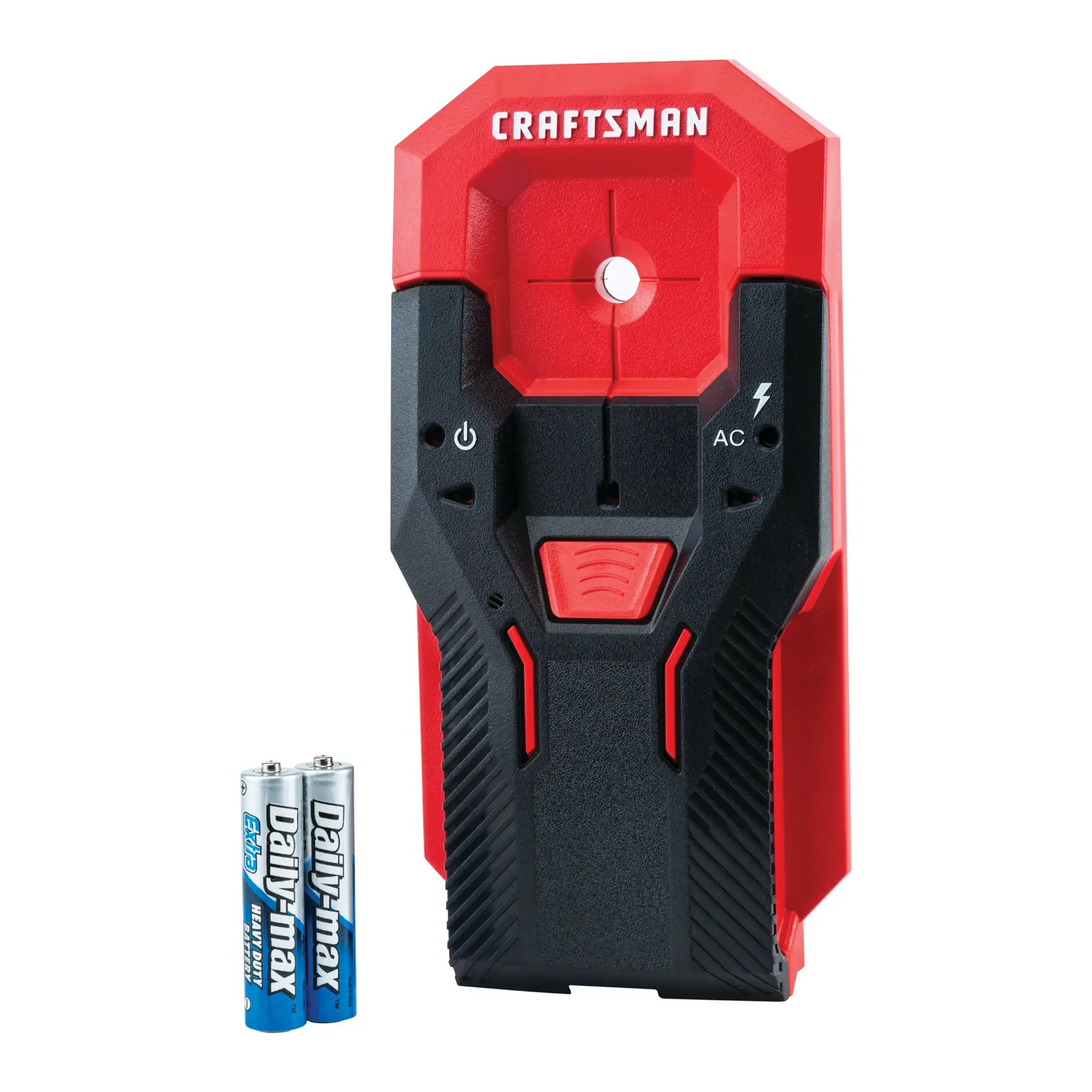
Your needs, this model
Does it fit your priorities?
Does CMHT77620 give a center point or separate stud edges?
The maker calls it a center finder: the shared manual describes a center LED, long tone and marking hole after one pass. Directional LEDs guide the approach; distinct left and right stud-edge output is not documented.
Explore this need in the finder →Can CMHT77620 meet a 0.8-inch stud-depth minimum?
No. Its manual lists up to 3/4 inch (19 mm) for both wood and metal studs. The separate live-AC detection distance is up to two inches and cannot be used as stud depth.
Explore this need in the finder →Does the AC indicator prove the wall is safe to drill?
No. CRAFTSMAN warns that shielded wiring, metal conduit, metalized or thick/dense walls may hide voltage and static charge may spread an alert. Treat the AC LED only as a warning cue, verify independently and switch off power before penetration.
Explore this need in the finder →This is an evidence-based review of the exact U.S. CMHT77620. It is not a hands-on trial; I use the shared model-specific manual to distinguish the 3/4-inch version from its similar-looking, deeper 77621 sibling.
A shallow center finder with a separate AC cue
The CMHT77620 is listed as a center-finding stud finder with AC detection. Its shared manual identifies a center LED, a longer tone and a marking hole when it locates the center of a wood or metal stud. Directional LEDs help guide the scan toward that center, but the documents do not describe separate left and right edge readings. If your layout relies on an electronic edge-to-edge indication, this is not the same interface as the edge-focused CMHT77633, and it does not satisfy a requirement for both center and edge indications as a single plan.
The selection is narrow and clear: ordinary drywall with studs no deeper than the model’s documented ceiling, and a preference for a center mark. The manual gives the CMHT77620 a maximum of 3/4 inch (19 mm) through drywall for both wood and metal studs. That is a stated upper comparison limit, not a promise through a textured, wet, repaired or layered surface. The two-inch AC figure described elsewhere in the same manual applies to live-wire warning detection, not to studs.
How the documented scan works
Install two AAA batteries, hold the unit flat against the wall, press and hold its center control without moving during the reset/calibration step, then keep the button down while scanning slowly to either side. When the center cue appears, stop and use the marking opening if you want to transfer the point. The directions ask the user to hold the tool in its handle area, make firm surface contact, and maintain a suitable orientation. A fast sweep or a calibration position directly over a stud can undermine the procedure.
The manual calls out smooth surfaces and a relative-humidity range of 35–55% in its specifications. It explicitly says the tool will not detect through concrete, mortar, block, brickwork, plaster, carpeting, foil-faced materials, metallic surfaces or ceramic tile. That rules out any assumption that a drywall rating automatically covers lath-and-plaster or a difficult tiled/exterior wall. If the indicator fails to reset or the wall is outside the named conditions, treat the result as unknown rather than loosening the category limits.
The live-wire warning is not electrical clearance
CMHT77620 adds an AC LED and a sequence of short alternating beeps distinct from its stud-center signal. The manual gives up to two inches (50.8 mm) of drywall for live-AC detection, with a typical response from six to eighteen inches away under its instructions. That range is not a sensitivity guarantee. Shielded wires, metal conduit or casings, metalized walls and thick or dense walls may prevent detection; static charge on drywall can spread the warning over a broader area than the actual wire.
For that reason, the added cue may be useful as one warning in a cautious process, but the manual explicitly says the tool is not a voltmeter and warns against relying on it alone. A quiet display does not establish that no wire is present. Use appropriate independent electrical verification, consult visible wiring routes and switch off power before working near a suspected conductor. Do not treat a stud-finder result as permission to drill.
Where the 77620 differs from the 77621
The two center-finding tools share an interface and manual, but they are not a single depth configuration. The CMHT77620 has a 3/4-inch wood and metal stud ceiling. The CMHT77621 is separately specified for wood to one inch and metal to 1.5 inches. If the task is a metal stud behind a thicker drywall layer, the 77621 is the relevant sibling; if you only need a center on conventional thinner drywall, its extra metal-depth headline may not be useful. Neither model’s deeper stud rating should be inferred from its AC warning distance, and the reviewed sources do not give them a drywall-penetration range for plaster or tile.
The two AAA requirement is clear; the package page’s “batteries” inclusion text does not establish quantity or seller-specific contents. Confirm the box before purchase. Warranty language is also inconsistent: the U.S. product page says limited lifetime, while the shared instructions state a one-year limited warranty. Confirm current terms with CRAFTSMAN rather than relying on either line in isolation.
Practical fit
Choose this configuration when a direct center indication, a marking hole and a separate live-AC alert suit a dry drywall project within 3/4 inch. Choose another model if edge boundaries, plaster support, a deeper wood-stud range or a safety-grade electrical check is essential. The assessment is based on the exact product page and shared instructions, not measured performance, customer reports, or personal use. Before scanning, inspect the exact model label and use the manual’s reset and slow-pass sequence; before buying, verify batteries, warranty and the edition shown in the package listing.
Key specifications
Key details at a glance
| Maximum stated stud depth | 0.75 in |
|---|---|
| Depth qualification | The exact shared manual lists wood and metal studs up to 3/4 inch (19 mm) through drywall for CMHT77620. The separate two-inch AC-wire figure is not stud depth. |
| Documented scan modes | ['Wood stud center detection', 'Metal stud center detection', 'Live AC warning'] |
| Center and edge indication | No |
| Live-wire meter | Yes |
| Battery requirement | Two AAA 1.5 V batteries |
Use the exact model’s instructions for operating limits, supplied equipment and version differences.
Sources for this review
Sources for this assessment

Check this model against your wall
Use the finder to compare documented surface limits, center/edge indications and other requirements. A match is not a safety certification.