
Your needs, this model
Does it fit your priorities?
What is the GMS 120’s stated stud depth?
The exact GMS 120 manual lists a maximum of 1½ inches (38 mm) for wood substructures or studs. The separate 4¾-inch ferrous-metal, 3⅛-inch copper and 2-inch energized-wire numbers describe other targets, not wood studs. The maker notes that results depend on the object and wall construction.
Explore this need in the finder →Can I require both center and edge marks?
The page describes an automatic center finder, and the manual shows a CENTER indicator at the maximum signal. The reviewed GMS 120 documents no dedicated stud-edge indication, so it should not be selected when both edge and center cues are essential.
Explore this need in the finder →Is the GMS 120 supported for lath and plaster?
Not as a direct stud-scanning plan in this comparison. Bosch says uneven plaster thickness makes wood-mode stud detection difficult and suggests metal mode may make it easier to locate the nails holding lath to studs. That is an indirect fastener clue, not direct stud identification or a depth-rated plaster plan.
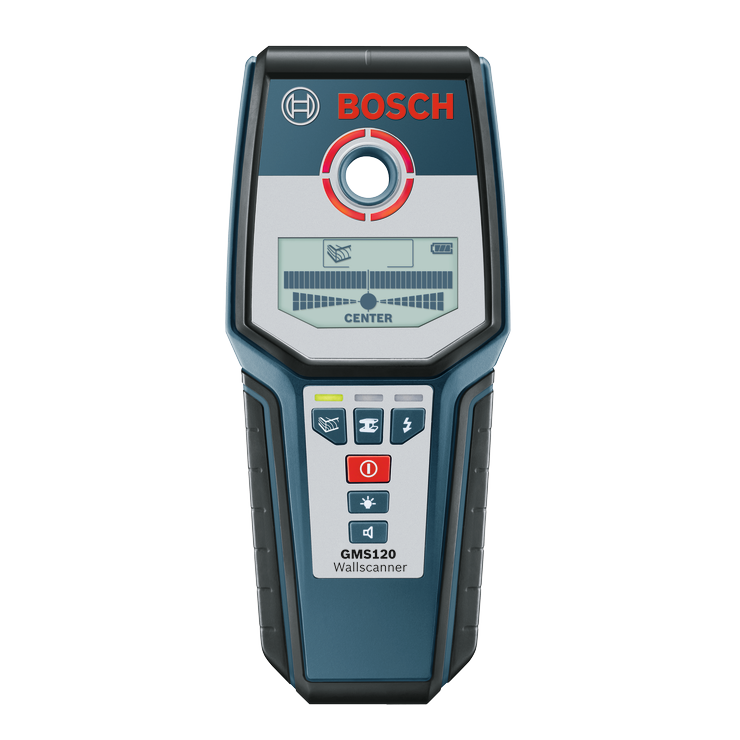
Explore this need in the finder →The Bosch GMS 120 is a three-mode wall scanner that combines wood/metal detection, a dedicated metal mode and live-wire sensing. Its useful stud comparison is not the deep metal number: the exact instructions give a maximum of 1 1/2 inches (38 mm) for wood substructures. The current U.S. page identifies SKU 0601081010, lists a hand strap, 9V battery and pouch, and links a manual whose article number is 3 601 K81 010. This review weighs those official claims and operating limits; it does not describe ownership or testing.
Read the display as a signal, then confirm the object
The GMS 120’s display identifies the selected mode and shows a changing detection scale; the illuminated ring is green when no object is found, orange as the tool approaches and red when it is over a detected object. Bosch’s U.S. page calls the feature an automatic center finder for detected wood or metal objects. The instructions say the strongest reading and CENTER indication occur approximately over the object’s center in wood or metal modes. This can help mark a center point, but it is not an edge-and-center indication system: the manual does not document a separate stud-edge cue comparable to an explicit edge light. Its opening is a marking aid, not an identification test.
The manual recommends scanning in the wood mode, but it cautions that this mode can also respond to metal and other dense materials, including water-filled pipes. It suggests first scanning in metal mode and marking those detections, then using wood mode; a response only in wood mode may be wood, but “may” is important. A sensor response is not proof that the hidden object is a stud.
Depth is target- and mode-specific
Bosch lists 1 1/2 inches (38 mm) as the maximum scanning depth for wood substructures or studs. In the same table, ferrous metals are listed to 4 3/4 inches, non-ferrous copper to 3 1/8 inches, and live 110/230 V wires to 2 inches. These figures describe different materials, not alternative stud depths. The manual says the actual result depends on object size, material and structural condition; wires that are not live have less scanning depth. Do not borrow the steel or wire value to meet a wood-stud depth requirement.
For a straightforward drywall comparison, the GMS 120 has a center-oriented wood/metal plan with a 1.5-inch published ceiling. It does not document a stud-edge signal that would meet a request for edge marks or both center and edges. The LED ring, signal scale, tone and center display make a different style of feedback from a broad multi-LED face.
Lath and plaster has a limited nail-finding workaround
The exact manual says uneven plaster thickness makes wood studs difficult to detect in wood mode. It says it may be easier to switch to metal mode and locate the nails that hold the lath to the studs. That is a practical clue, not a maker-supported direct stud plan through plaster: the metal mode locates fasteners, and a nail response may be missing, misplaced or unrelated to the stud boundary. For that reason, this assessment does not count the GMS 120 as a match for the finder’s lath-and-plaster surface choice. If the wall is lath, use the nail route only as a separately verified workaround, and do not translate the drywall 1.5-inch stud depth or center indication to that task.
The instructions give a similar fastener-based suggestion for drywall over plywood and wood flooring. They also say the GMS 120 cannot detect wood studs through carpeting, although metal mode might locate nails or screws used to attach flooring to joists. Again, a metal fastener search is not the same as identifying the framing member itself.
Wire alerts and the normal scanning routine
Bosch lists a dedicated AC-wire selection and a 2-inch (50 mm) maximum for energized 110/230 V conductors. The manual says live wires are also indicated in all operating modes, which is why the warning can coexist with a drywall stud plan. Its maximum is conditional: the manual notes less range for non-live conductors, and the meter can be affected by moisture, foil-faced or conductive materials, metal construction, nearby electromagnetic fields and other conditions. An alert does not map every cable; no alert does not mean the wall is safe.
For the wood-mode routine, the manual calls for all contact pads to remain against the surface, a slow, straight scan without changing pressure, and avoiding contact between the other hand and the wall. It describes automatic calibration and center indication, but proper technique cannot eliminate false signals. It recommends using other information sources before penetrating the surface. The included 9V battery and pouch are explicitly listed on the current product page; check a particular offer against that exact GMS 120 SKU and package list.
Where it fits in a shortlist
The GMS 120 is most defensible when a buyer wants one instrument for a modest-depth wood/metal center scan plus a separate metal and live-wire mode, without requiring dedicated edge cues. Its lath workaround is an exception rather than broad plaster compatibility. Compare the EXPERT D-tect18V-200-17C for recorded multi-view radar scans and a 38 mm drywall-wood limit, or the D-TECT120 for a larger stated Drywall-mode range and center-cross display. The latter figures are also target-specific, so compare the manuals rather than the scanners’ maximum metal/object headlines.
Sources and verification
Primary evidence: Bosch’s GMS 120 U.S. product page and the directly linked GMS 120 operating and safety instructions, which identify article number 3 601 K81 010.
Key specifications
Key details at a glance
| Maximum stated stud depth | 1.5 in |
|---|---|
| Depth qualification | The manual gives 1½ inches (38 mm) specifically for wood substructures/studs; it separately lists 4¾ inches ferrous, 3⅛ inches copper and 2 inches energized 110/230 V wiring. Those other target figures do not raise the stud depth. |
| Documented scan modes | ['Wood (wood/metal)', 'Metal', 'Live/AC wiring'] |
| Center and edge indication | No |
| Live-wire meter | Yes |
| Battery requirement | One 9V alkaline-manganese battery; U.S. page lists one in the exact package |
Use the exact model’s instructions for operating limits, supplied equipment and version differences.
Sources for this review
Sources for this assessment

Check this model against your wall
Use the finder to compare documented surface limits, center/edge indications and other requirements. A match is not a safety certification.