
Your needs, this model
Does it fit your priorities?
Which depth should I use for a drywall stud comparison?
The D-TECT120 manual lists 2.36 inches (60 mm) for Drywall mode, which the manual says is suitable for joists, metal supports and electrical/cable detection. The larger 4.75-inch figure belongs to Concrete mode or other material targets; do not use it as the drywall stud figure. The limit varies with object size and base material.
Explore this need in the finder →Does the D-TECT120 indicate both stud center and edges?
It can show arrows and a center cross when there is sufficient signal, and the manual describes using the center signal to locate an object. The reviewed D-TECT120 manual does not establish a dedicated stud-edge cue, so it does not meet a both-center-and-edges requirement.
Explore this need in the finder →Does a live-wire cue rule out wires when there is no alert?
No. The manual says energized conductors are indicated in any operating mode, but cable classification is limited above 50% relative humidity and metalized, conductive, wet or metal-conduit conditions can obscure a live wire. It also warns that three-phase wiring may not be identified as live. Use independent utility information before drilling.
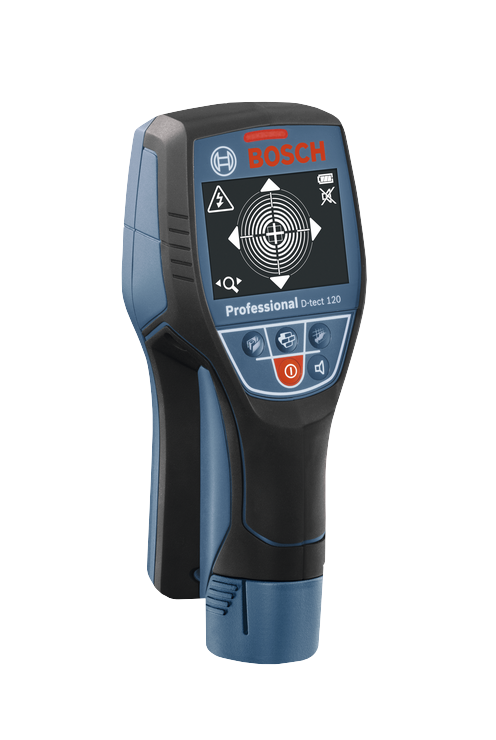
Explore this need in the finder →The Bosch D-TECT120 is a radar wall/floor scanner with three selectable modes, calibration-free startup and a center-cross display. It may look like a deep-range stud finder in broad product summaries, but the manual’s target-specific limit matters: Drywall mode is listed to 2.36 inches (6 cm) for joists, metal supports, electrical lines and cables, and water-filled plastic pipes. The separate 4.75-inch maximum belongs to Concrete mode and different target/material conditions. This assessment uses Bosch’s current U.S. page and the directly linked instructions; it is not a hands-on test.
Use Drywall mode for the stud-finding comparison
The U.S. product page identifies SKU 0601081311 and describes Drywall, Universal and Concrete modes. In the exact manual, Drywall mode is suitable for detecting joists, metal supports and electrical lines or cables in drywall. Bosch also says water-filled plastic pipes are indicated and empty plastic pipes are normally not. The maximum measuring depth in that mode is 2.36 inches (60 mm). Universal mode has its own material rules, and Concrete mode’s up-to-4.75-inch metal/radar claim should not be substituted for a stud-depth figure.
The center cross and orientation arrows help locate the center of a detected object when signal strength is sufficient. The manual explains that the object center is at the point of maximum indicator deflection; it does not document a dedicated pair of stud-edge marks. Thus the D-TECT120 can suit a buyer who wants a displayed center cue, but the reviewed evidence does not establish a stud-edge or both-cue arrangement.
Calibration-free and Spot Detection are workflow features
Bosch describes the D-TECT120 as ready to use after switching it on without calibration. Spot Detection can indicate an object when the tool is placed on the surface, which can help in a narrow space or at an initial point. The manual still recommends attention to its measurement procedure and all displayed signals; it says unfavorable surface quality can reduce both accuracy and scanning depth. “No calibration” is not the same as “no setup” or “no false response.” When an object has not been detected on placement, the instructions describe moving across the surface until the movement indication disappears and then reading the color, center-cross and direction cues. A slow, steady pass remains useful for mapping where a signal changes.
The product page’s “up to 4 3/4 inches” statement covers multiple materials and target tasks; it is not a universal wall depth. The manual lists Drywall mode at 60 mm, Universal at 60 mm and Concrete at 120 mm, with object-specific limitations in those modes. The title claim and manual table can both be true because they refer to different operating arrangements.
The wire indication is separate from a safety decision
Bosch lists live-wire detection as a product function. The manual says energized conductors are indicated in any operating mode, so the added warning can accompany a drywall scan. It also warns that conductors behind metalized or conductive surfaces, metal conduit or high-moisture material may not be detected with certainty; three-phase wiring may not register as live, and unenergized wire may be read as metal or missed. The manual gives a 50% relative-humidity ceiling for classification of power cables. Treat the wire result as an extra warning, not a cable map or proof that a location is clear.
Surface conditions and the kit to check
The manual cautions that moisture, metallic building material, foil-backed insulation, conductive wallpaper or tile, nearby electromagnetic fields, and inconsistent plaster/lath thickness can affect detection. It explicitly says the tool alone should not be relied on to locate hidden items and recommends other information sources before drilling, sawing or routing. The product page lists four AA batteries and a hard carry case with the scanner. The instructions specify alkaline AA cells, so check the exact package and keep the battery types consistent when replacing them.
Although Bosch product imagery describes an application behind tile, the material-specific manual does not establish a general tile/exterior/metal-mesh stud-finding plan for the broad difficult-surface choice used by this site. A Concrete mode or metal target capability does not make that broad compatibility claim. Tile composition, backing, moisture and reinforcement can change the signal, so retain the actual material question and use another verified method if the model instructions do not cover the wall.
Compare it by its own job, not its largest number
The D-TECT120 is a logical candidate for a buyer who values quick startup, a spot response and center-cross guidance for wood joists in dry drywall, with a documented 2.36-inch mode ceiling and live-wire indication. Its major tradeoff is that it is a multi-material detector with mode-specific limits, not an edge-marking stud finder. The reading can vary with object size and base material, and the signal does not identify the target with certainty. For a more object-mapping and documentation-oriented scanner, compare the EXPERT D-tect18V-200-17C; for a center-focused wood/metal model with a 1.5-inch stud figure, compare the GMS 120. Each number comes from a different mode and model manual; none is a test result.
Sources and verification
Primary evidence: Bosch’s D-TECT120 U.S. product page and its directly linked D-TECT120 operating and safety instructions, article number 3 601 K81 310.
Key specifications
Key details at a glance
| Maximum stated stud depth | 2.36 in |
|---|---|
| Depth qualification | The exact manual lists 2.36 inches/60 mm for Drywall mode, which includes joists and metal supports. The 4.75-inch overall/Concrete-mode claim is for other targets/materials and is not the stud-finding ceiling. |
| Documented scan modes | ['Drywall', 'Universal', 'Concrete'] |
| Center and edge indication | No |
| Live-wire meter | Yes |
| Battery requirement | Four alkaline AA batteries; exact U.S. page includes four batteries |
Use the exact model’s instructions for operating limits, supplied equipment and version differences.
Sources for this review
Sources for this assessment

Check this model against your wall
Use the finder to compare documented surface limits, center/edge indications and other requirements. A match is not a safety certification.