
Your needs, this model
Does it fit your priorities?
What stud depth should I use for this model on drywall?
For wooden beams in dry walls, the exact D-tect18V-200-17C manual states a maximum of 38 mm, about 1.496 inches. The U.S. page’s up-to-7½-inch claim is for multiple object/material tasks, including deeper concrete-metal detection; it is not this model’s drywall wood-stud rating. The listed maximum is not a guaranteed reading through a particular wall.
Explore this need in the finder →Does Object View show a center and object edges?
The manual describes nearest-edge detection for objects transverse to travel and a center line/cross when signal is sufficient. In Drywall mode it covers timber joists, but the display does not prove that a response is a stud; filled plastic pipe and wood can look alike. Use a repeated crosswise scan and independent wall information.
Explore this need in the finder →Does its live-material indication make drywall safe to drill?
No. Bosch lists live wires and the manual describes live-material classification, but that classification is limited above 50% relative humidity and three-phase wiring may not be identified as live. It is an added warning only; use other utility information and safeguard the area before penetrating a wall.
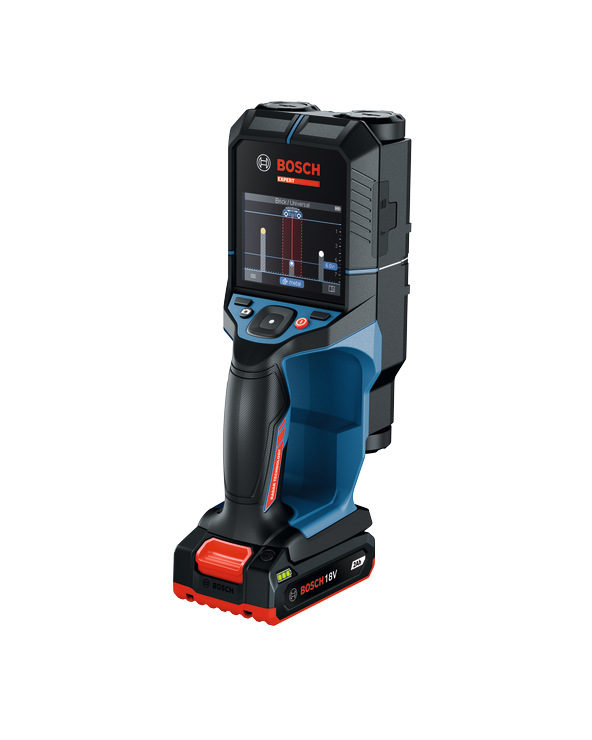
Explore this need in the finder →The Bosch EXPERT D-tect18V-200-17C is a radar wall scanner whose most useful stud-finder distinction is that Bosch gives a specific wood-beam depth for drywall: 38 mm. That is a much narrower claim than the product page’s “up to 7 1/2 inches” overall-object headline, which spans other materials and targets. The U.S. product page identifies SKU 0601081612 and describes the 17C package; its linked 2025 manual names the same model and provides the mode-by-mode limits. This is a document-based assessment, not a hands-on test.
Keep the 17C package and manual edition straight
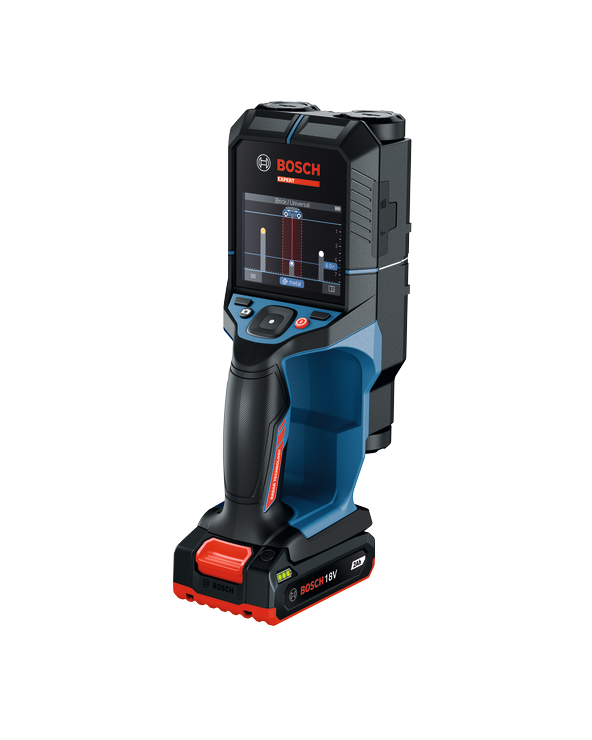
The model name printed in the instructions is D-tect18V-200-17C, while the U.S. page styles it as D-TECT18V-200-17C EXPERT. The manual’s article number is 3 601 K81 601; that is distinct from the page’s order/SKU number 0601081612. The page lists a GBA18V-20 2 Ah battery, GAL18V-20 charger, reusable 3D-imaging poster, USB-C cable and carrying case. That matters to a buyer comparing a complete kit with a different bare-tool listing: confirm that the 17C code and supplied items are present rather than assuming every D-TECT18V offer is the same bundle.
The wood-stud number is not the headline depth
Bosch’s product description advertises detection of objects up to 7 1/2 inches deep across drywall, concrete, brick and other structures. The manual breaks that statement into target and material classes: dry-concrete metal objects are listed to 200 mm, other dry-concrete objects to 80 mm, early-age-concrete metal to 60 mm, and wooden beams in drywall to 38 mm. For choosing a stud finder, the drywall wood-beam number is the relevant comparison—about 1.496 inches—not the larger concrete metal figure or an unqualified conversion of the 7 1/2-inch headline. Even 38 mm is a maker-stated maximum, not a promise that every stud will register through a particular finish, depth, patch or wall assembly.
Within dry interior drywall, the manual says the Drywall wall type is suitable for timber joists and metal supports as well as electrical and other cables. It also warns that filled plastic pipes and wooden beams appear alike in that view, while empty plastic pipes are not recognized. That distinction is more useful than treating a radar response as automatic wood identification.
Object View supports locating a center and nearest edges
The manual calls Object View its best possible measuring view and says it detects the nearest edges of objects that run across the scan direction. The screen can show the object between two dashed lines, a center line, and—when signal is sufficient—a center cross. Bosch also describes the four available views as Object View, Spot View, 2D signal and signal view. In Object View, the instructions ask for a slow straight scan with the wheels kept in contact and a path of at least 40 cm for optimum results; the result may appear after a shorter minimum path. Reverse scanning helps place and mark the detected object. These are genuine layout aids, but they describe a detected object, not a verified stud identity or safe fastening zone.
Spot View is a different task: it can display a result before the tool has travelled over the surface, which the manual says is useful in narrow spaces, but locating timber joints or plastic pipes is particularly limited without movement. A spot response should therefore not be substituted for a careful pass when identifying a likely stud. The U.S. page also highlights 3D imaging, screenshots, internal memory and USB-C or SD transfer. Those documentation features may matter for repeated inspection or record keeping, but they do not increase the stated drywall wood depth.
Live-material identification has a humidity condition
The product page lists live wires among the targets; the instructions describe material identification and mark a detected live object separately. The manual gives a maximum relative humidity of 50% for live-material classification, even though the broader maximum humidity for object measurement is higher. It also warns that three-phase mains wiring may not be detected as live. This makes the live-wire indication a useful additional signal only within its stated conditions, not a meter that can clear a wall. A positive or negative result cannot establish that a drilling point is free of wiring, plumbing or other hazards.
The same caution applies to the product page’s AI-assisted processing and “reliable” marketing language: Bosch says its processing helps improve scan results, but its own manual cautions that display representations can differ from the actual object and that object type may remain uncertain. Use construction plans and other independent information before penetrating a wall.
Who should compare this scanner?
The D-tect18V-200-17C is a plausible comparison for someone who wants an 18V radar tool with multiple views, recorded screenshots, a center cross and object-edge locating in a drywall arrangement, and who values the included battery, charger and 3D poster. The key tradeoff is price-independent and technical: its specific wood-beam-in-drywall ceiling is 38 mm, not the broad overall-object maximum. The deeper concrete and metal claims answer other inspection jobs. The manual also notes that scan depth and accuracy vary with target size, base material and condition, and it warns against relying on the detector alone before drilling.
Compare the exact 17C bundle and its dedicated 2025 instructions with the Bosch GMS 120, whose manual gives a 1 1/2-inch wood-stud maximum and a compact three-mode interface, and the D-TECT120, whose Drywall mode is stated to 2.36 inches for joists and other targets but shows a center cross rather than an explicit edge cue. The numbers come from different target/mode specifications and should not be read as a head-to-head performance test.
Sources and verification
Primary evidence: Bosch’s U.S. EXPERT D-tect18V-200-17C product page and its linked D-tect18V-200-17C operating and safety instructions, edition 1 609 92A C6E (August 2025). The page’s general depth claim and the manual’s drywall-wood figure are kept separate here.
Key specifications
Key details at a glance
| Maximum stated stud depth | 1.5 in |
|---|---|
| Depth qualification | The exact manual lists wooden beams in dry walls to 38 mm (about 1.496 in); 200 mm applies to metal objects in dry concrete, and Bosch’s up-to-7½-inch overall-object product-page claim is not a drywall wood-stud rating. |
| Documented scan modes | ['Object View', 'Spot View', 'Signal View 2D', 'Signal View'] |
| Center and edge indication | Yes |
| Live-wire meter | Yes |
| Battery requirement | Bosch 18V rechargeable battery; current U.S. 17C page includes GBA18V-20 2 Ah battery and GAL18V-20 charger |
Use the exact model’s instructions for operating limits, supplied equipment and version differences.
Sources for this review
Sources for this assessment
Check this model against your wall
Use the finder to compare documented surface limits, center/edge indications and other requirements. A match is not a safety certification.