
Your needs, this model
Does it fit your priorities?
What extra task does LASER-MARK add to the magnetic search?
Kreg describes two magnets for screws or nails plus a separate laser line that projects the located position down the wall. This helps layout after a candidate point is found; it is not a laser stud scanner or a center/edge display.
Explore this need in the finder →How deep is the KMM1000LZ documented to find a fastener?
Its exact Q&A gives a 0.150-in maximum fastener burial from the wall surface, while other answers mention about 3/8 in under sheetrock mud without identifying a maximum. Because the page does not reconcile these statements, this assessment keeps the explicit 0.150-in maximum; it falls below the 0.7-in minimum offered by the finder.
Explore this need in the finder →Does the laser or magnet make the wall safe to drill?
No. Kreg's page says the model does not differentiate its fastener finding from live electrical lines, conduit or plumbing, and the laser is a layout function. Use independent utility checks and do not treat a magnetic catch or absent response as clearance.
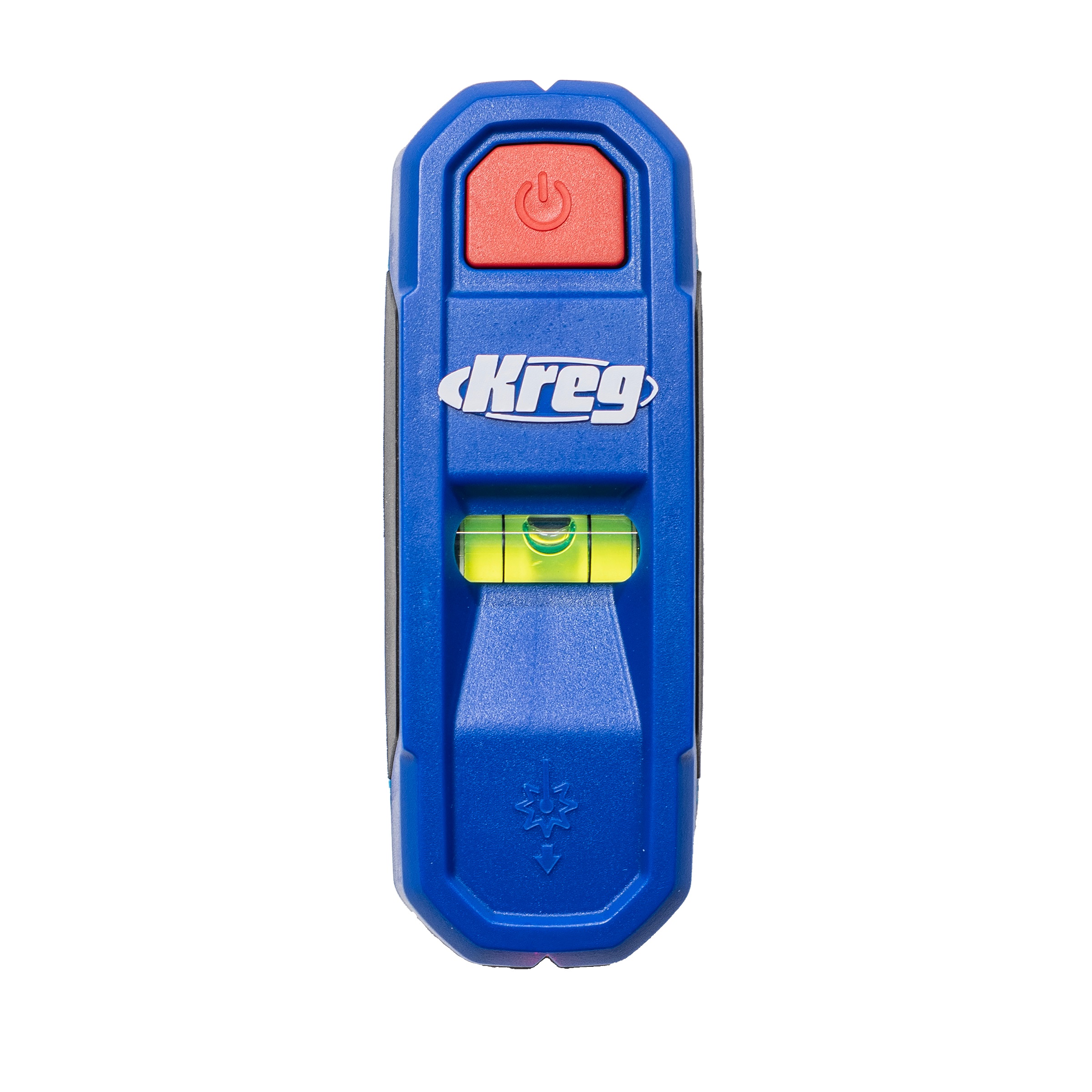
Explore this need in the finder →The Kreg KMM1000LZ combines a magnetic fastener-point search with a separate laser layout line. The two rare-earth magnets are the finding mechanism: Kreg says they locate screws and nails used to fasten drywall to wood or metal framing. The LASER-MARK feature is for carrying a located position down the wall. It is not a laser scanner that detects hidden studs, and it does not replace the magnetic method with an electronic edge or center display.
Separate the sensor from the layout aid
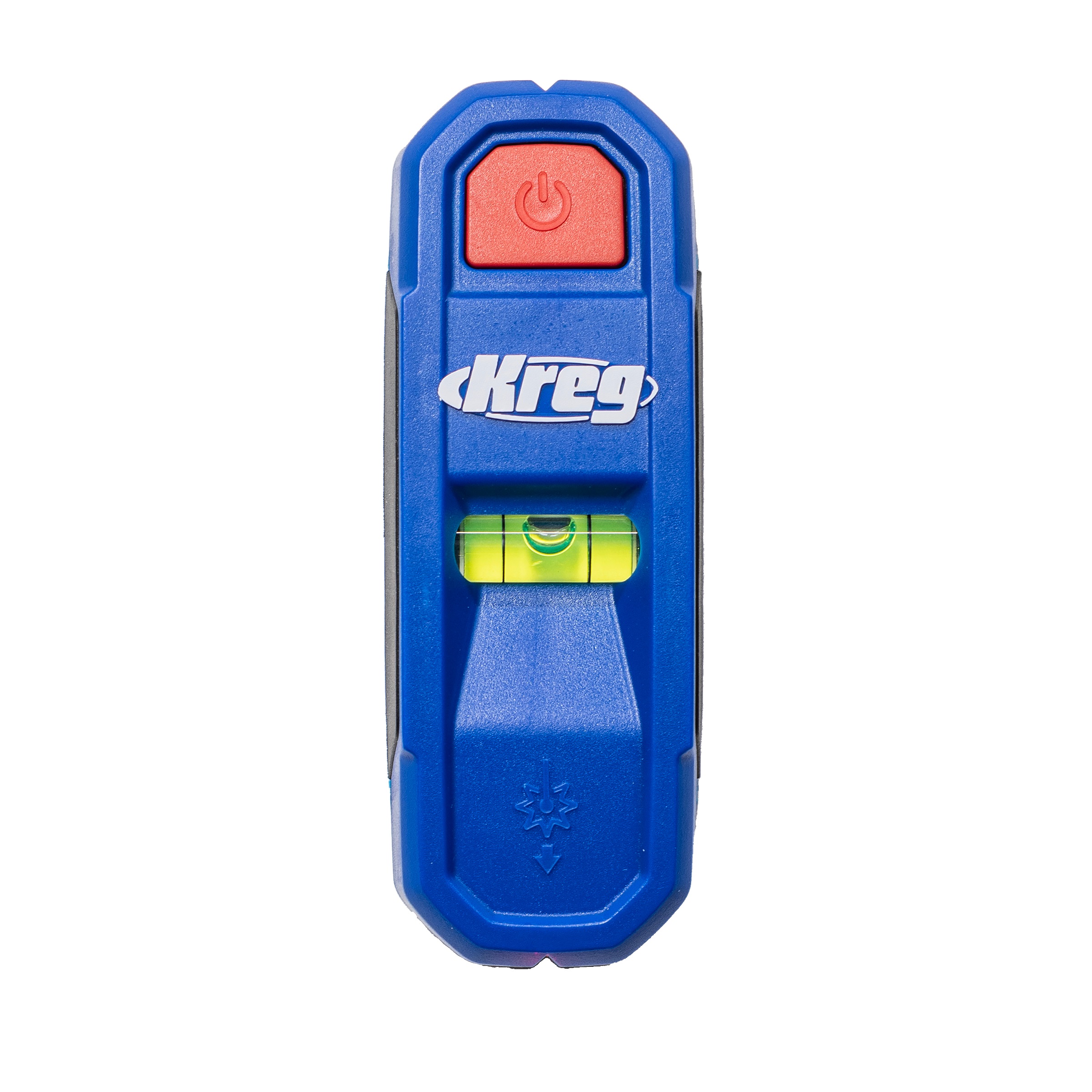
The exact KMM1000LZ product page lists two magnets for screws and nails, hands-free wall holding, a bubble level and precision centered marking notches. It also says the LASER-MARK feature projects the stud location. Kreg’s KMM1000 Q&A directly describes the laser version as marking a located position down the wall with a line. Taken together, the documented sequence is magnetic location first, layout projection second.
That split is easy to overlook in a product name that includes “laser.” The magnets respond to ferrous fasteners; the laser helps extend a candidate mark visually after the tool has found one. Neither the level vial nor the notch measures the stud’s edges. The projected line should not be mistaken for proof of a full stud centerline, and a single detected screw does not establish the framing’s width or suitability for an anchor. The LZ’s added function is line transfer, not more complete sensing.
Battery use belongs to the laser feature
Kreg lists two AAA batteries in the KMM1000LZ package and says the tool may be used with or without batteries. The product page’s Q&A clarifies that the magnets find studs without power while the batteries run the laser line. This is a more layered setup than the basic KMM1000, whose documented magnetic operation is battery-free and which has no listed laser feature. Keep the two configurations distinct when checking an offer; a package that includes batteries is not evidence of extra sensing depth.
The bubble level and centered marking notch are layout aids on both model pages. They can help carry a mark onto a level line, but they do not report a sensed edge, center or live-wire condition. If the task specifically requires electronic stud boundaries, this magnetic/laser combination is a different kind of tool.
Read the maker’s depth answers cautiously
The KMM1000LZ page contains a useful but internally uneven Q&A. One answer states an explicit maximum of 0.150 inch for a fastener buried from the wall surface and gives 0.035–0.050 inch as typical for drywall fasteners. Elsewhere, answers describe finding a nail or screw about 3/8 inch under sheetrock mud, without calling that a maximum. The page does not reconcile these statements. This assessment records the explicit 0.150-inch maximum conservatively and does not treat the separate 3/8-inch wording as a repeatable limit or guaranteed wall performance.
That conservative comparison still has a clear consequence for this finder: 0.150 inch is below the questionnaire’s lowest stated-depth threshold of 0.7 inch. The same drywall-plus-0.7-inch case should exclude the KMM1000LZ. The laser does not change that comparison because it lays out a point found by the magnets rather than detecting a deeper fastener. A maximum fastener burial distance is also not the same thing as a guaranteed reading through every finish, patch, texture or multi-layer wall.
Surface and electrical limits remain important
Kreg’s exact KMM1000LZ Q&A says the tool will not work through tile and cement board in a shower. Its lath-and-plaster answers are not a clear support statement: one answer repeats a sheetrock-mud example, and another explains that success depends on fastener burial depth without establishing an operating plan for lath construction. Accordingly, the reviewed evidence supports a dry drywall plan only; it does not justify a lath/plaster or difficult-surface match.
The same page answers that the finder does not distinguish screws and nails from live electrical lines, conduit or plumbing. That is a stronger warning than merely omitting a wire-meter feature: the magnetic response is not a utility detector. Do not use the KMM1000LZ’s silence, attraction, bubble vial or projected laser line to decide that a drilling location is safe. Review the same drywall-plus-live-wire-meter finder condition for tools with a documented separate warning cue, and treat those warnings as limited rather than as safety clearance.
Who should compare it—and what to verify
The LZ is most distinctive when a user wants a visual layout line after locating a likely fastener and also values the built-in level and centered marking notch. The basic KMM1000 offers the same broad magnet-and-level approach without the laser/battery package; the KMM1000 review separates those capabilities. Neither product is a substitute for a density-scanning finder when the requested signal is direct edges, electronic center or a larger published depth range.
Before choosing an offer, verify the exact KMM1000LZ model number, one-tool configuration and the inclusion of two AAA batteries if the laser layout function matters. Review the current seller description and return terms; manufacturer listings do not guarantee every reseller package. Kreg’s product-manual index returned HTTP 403 during this research, so no separate manual was verified. The product page and its Q&A are the available model-specific evidence, and this assessment does not claim hands-on use, testing, current price, retailer availability or customer experience.
Key specifications
Key details at a glance
| Maximum stated stud depth | 0.15 in |
|---|---|
| Depth qualification | The exact KMM1000LZ Q&A includes an explicit maximum of 0.150 in for a fastener buried from the wall surface. Other answers on the same page describe approximately 3/8 in below sheetrock mud without calling that a maximum; these statements are not reconciled. The fact uses the explicit maximum conservatively and does not present 3/8 in as a reliable or universal limit. Both values are below the questionnaire's 0.7-in numeric minimum. |
| Documented scan modes | ['Unpowered magnetic fastener-point location', 'Battery-powered laser layout projection after locating a candidate point'] |
| Center and edge indication | No |
| Live-wire meter | No |
| Built-in bubble level | Yes |
| Battery requirement | Two AAA batteries power the laser layout feature; magnetic fastener finding works with or without batteries |
Use the exact model’s instructions for operating limits, supplied equipment and version differences.
Sources for this review
Sources for this assessment
- Kreg U.S. Measuring category listing
- Kreg exact KMM1000LZ LASER-MARK Magnetic Stud Finder page, including model-specific Q&A
- Kreg KMM1000 page's direct comparison answer for the LASER-MARK layout model
- Kreg exact KMM1000LZ official product image
- Kreg product manuals index (retrieval limitation recorded)
Check this model against your wall
Use the finder to compare documented surface limits, center/edge indications and other requirements. A match is not a safety certification.