
Your needs, this model
Does it fit your priorities?
What does the KMM1000 sense behind drywall?
Kreg describes two rare-earth magnets that locate screws or nails fastening drywall to wood or metal framing. A magnetic catch is a likely fastener point, not a density scan or full stud-edge reading.
Explore this need in the finder →Can the KMM1000 meet a stated-depth requirement?
The exact model Q&A gives a maximum fastener burial of 0.150 in from the wall surface. That is below the questionnaire's 0.7-in lower endpoint, and it is not a guaranteed wall-specific result; the KMM1000 does not meet any positive numeric threshold offered here.
Explore this need in the finder →Does its notch mark a stud center or provide an AC warning?
The page describes a precision-centered marking notch and a bubble level as layout features; it does not describe sensed stud edges or center. A separate live-wire meter is not documented, so use independent utility-safety checks rather than interpreting a magnetic catch as clearance.
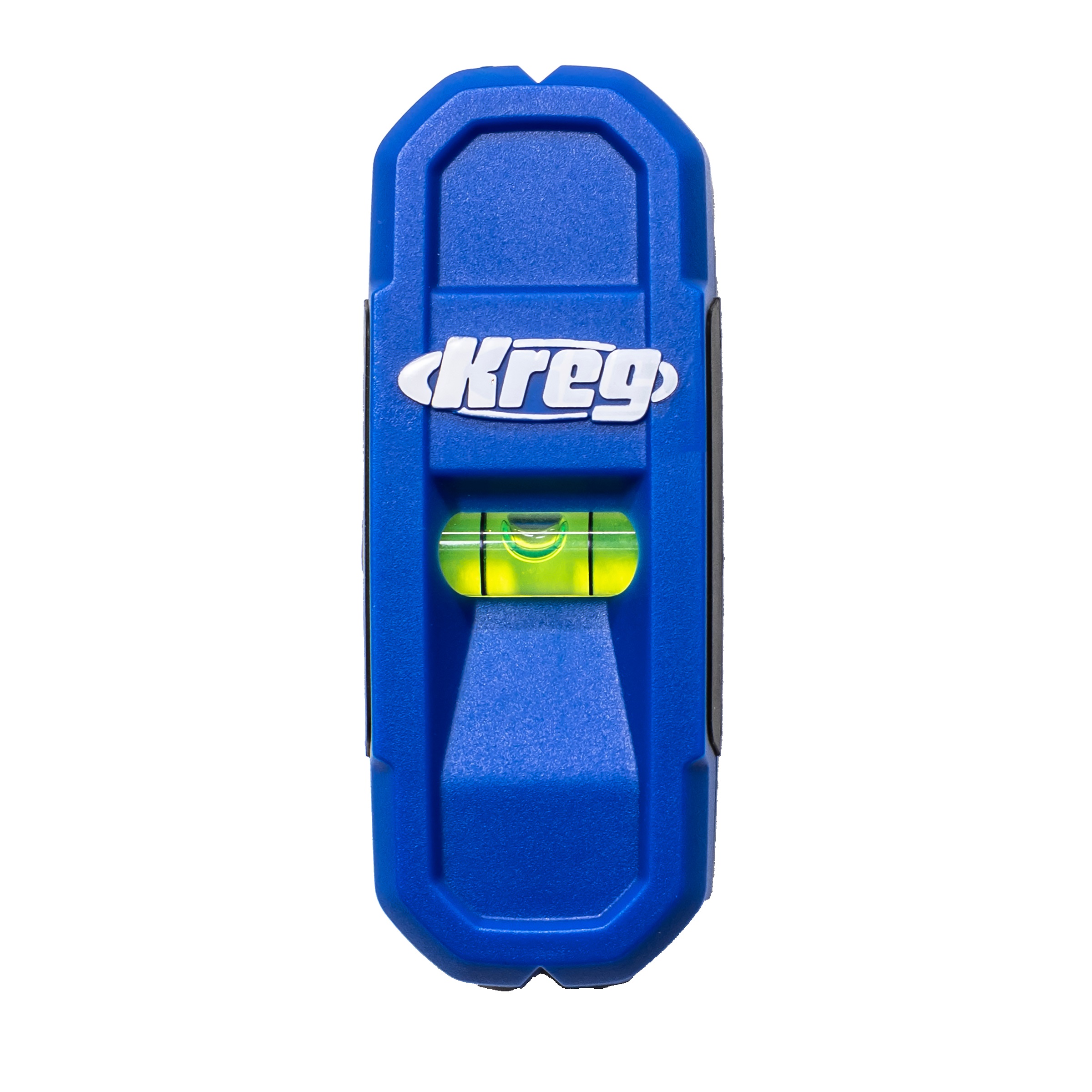
Explore this need in the finder →The Kreg KMM1000 is a magnetic fastener finder with a narrow, useful job: help locate screws or nails that attach drywall to framing. It does not measure wood density or display a stud boundary. Kreg describes two rare-earth magnets, a bubble level, a hands-free wall hold and a centered marking notch. That combination makes it a simple layout tool, but the signal is still a likely ferrous fastener point rather than an electronic “stud found” reading.
Know what a magnetic catch means
The exact KMM1000 product page says the two magnets find screws and nails and describes the tool as useful on wood and metal studs. In practical terms, the tool is attracted to a fastener that is connected to framing. It does not detect the stud material directly, and one magnetic response does not establish the stud’s full width, centerline, contents or structural suitability for a particular load.
A centered notch is a marking feature in the body, not an electronic center cue. Likewise, the green bubble vial helps align a line after the user has chosen a candidate point; it is not a sensor output. This distinction matters when comparing a small magnet with an electronic finder whose instructions define separate edge and center signals. Those instruments answer different questions even if both are sold as stud finders.
The published number is about the fastener
Kreg’s model-specific Q&A gives a maximum buried-fastener distance of 0.150 inch from the wall surface. The answer also gives 0.035–0.050 inch as a typical drywall-fastener burial depth. These numbers concern how far the ferrous fastener sits below the surface; they are not a promised reading through every wall assembly, a stud-width measurement, or a guarantee for paint, compound, layered finishes or wall texture. In this guide’s finder, the lowest numeric request is 0.7 inch, so the KMM1000’s stated 0.150-inch limit does not meet any offered numeric threshold. The same drywall-plus-0.7-inch finder case should therefore exclude it rather than round the smaller figure upward.
The maker’s manual-index page returned an access-denied response during this research, so I could not verify a separate model-specific manual. That limitation is not evidence that no manual exists. The published product page and its KMM1000 Q&A are the accessible first-party sources used for this assessment.
Use the level for layout, not detection
Kreg lists one KMM1000 in the package and calls out the high-visibility bubble level and precision centered notch. After identifying a candidate fastener, those features can help transfer a pencil mark or align a line for a shelf or cabinet. They do not turn the tool into a width scanner. A conservative layout uses more than one plausible point and checks whether those points form a coherent pattern before treating them as a stud line. That is an editorial verification principle, not a claim that the product itself verifies the structure.
The manufacturer calls this model battery-free. There is no electronic calibration screen, scan-mode menu or listed battery requirement for the magnetic finder. The simple setup is an advantage when the intended task is a fastener clue and a mark. It is also a limitation if the job depends on an electronic edge tone, a direct center display or a numerical wall-thickness range.
Do not stretch the surface claim
Kreg’s exact Q&A says its magnetic finders are designed to find screws and nails behind drywall and other wall coverings, but the same page ties success to how deeply the fastener is buried. The source does not give a specific approved operating plan for lath and plaster, tile, exterior cladding or metal mesh. Those are not interchangeable with ordinary drywall, and this assessment does not infer compatibility from a broad “other wall coverings” phrase. The KMM1000 belongs in the drywall-only finder result; its same-condition drywall result keeps that claim narrow.
The page does not describe a live-wire meter, AC-warning signal or utility-detection function. Do not use a magnet’s presence or absence as an electrical check. A fastener point can be near wiring or plumbing, and no consumer stud finder should be treated as clearance to drill. Consult the relevant plans and use appropriate independent safety checks before penetrating a wall.
How it differs from the LASER-MARK model
Kreg separately lists the KMM1000LZ, a model with the same two-magnet fastener-finding concept plus a powered laser layout feature and two included AAA batteries. That is a meaningful package/function difference, so the two model numbers remain separate assessments. The laser carries a located point down the wall; it does not add a documented depth mode or electronic edge-and-center detection. The basic KMM1000 has no corresponding laser feature in the reviewed page. If a laser layout line is central to the project, compare the KMM1000LZ assessment; if a published depth at or above 0.7 inch or direct edge cues are essential, the KMM1000 is not supported by the evidence for that task.
Check the exact model before ordering
Confirm that an offer is the KMM1000 Magnetic Stud Finder and not the distinct KMM1000LZ LASER-MARK package. The product page lists one finder, a level and a centered notch; no separate marker set, additional battery or electronic display is part of the documented KMM1000 configuration. Check package identity, seller terms and return conditions at purchase time. This review is based on current manufacturer material, not hands-on use or wall testing, and makes no claim about current price, reseller stock or customer experience.
Key specifications
Key details at a glance
| Maximum stated stud depth | 0.15 in |
|---|---|
| Depth qualification | Kreg's exact KMM1000 Q&A says the magnets can detect a fastener buried to a maximum of 0.150 in from the wall surface and gives 0.035–0.050 in as a typical drywall-fastener burial depth. This is a fastener-depth limit, not a promise of reading through every wall assembly; it is below the questionnaire's 0.7 in minimum slider value. |
| Documented scan modes | ['Unpowered magnetic fastener-point location'] |
| Center and edge indication | No |
| Built-in bubble level | Yes |
| Battery requirement | None; magnetic finding is unpowered |
Use the exact model’s instructions for operating limits, supplied equipment and version differences.
Sources for this review
Sources for this assessment

Check this model against your wall
Use the finder to compare documented surface limits, center/edge indications and other requirements. A match is not a safety certification.