
Your needs, this model
Does it fit your priorities?
Does the DW0150 provide both center and edge cues?
The manual documents directional LEDs, a center LED and a marking hole, not an independent edge mode. If you need both boundary readings, choose a model whose own instructions explicitly show both cues.
Explore this need in the finder →Is the DW0150 a 1-1/2-inch choice for wood studs?
The product-page headline is 1-1/2 inches, but its exact manual table lists wood studs through one inch and metal studs through 1-1/2 inches. Use the one-inch limit for wood framing and do not transfer the metal-stud figure.
Explore this need in the finder →What does its live-AC warning establish?
It is an added warning signal under the manual's stated drywall and conductor conditions, not a voltmeter or a safe-to-drill clearance. Shielded wiring and dense/metallic wall layers can defeat detection, so verify electrical hazards independently and de-energize before work.
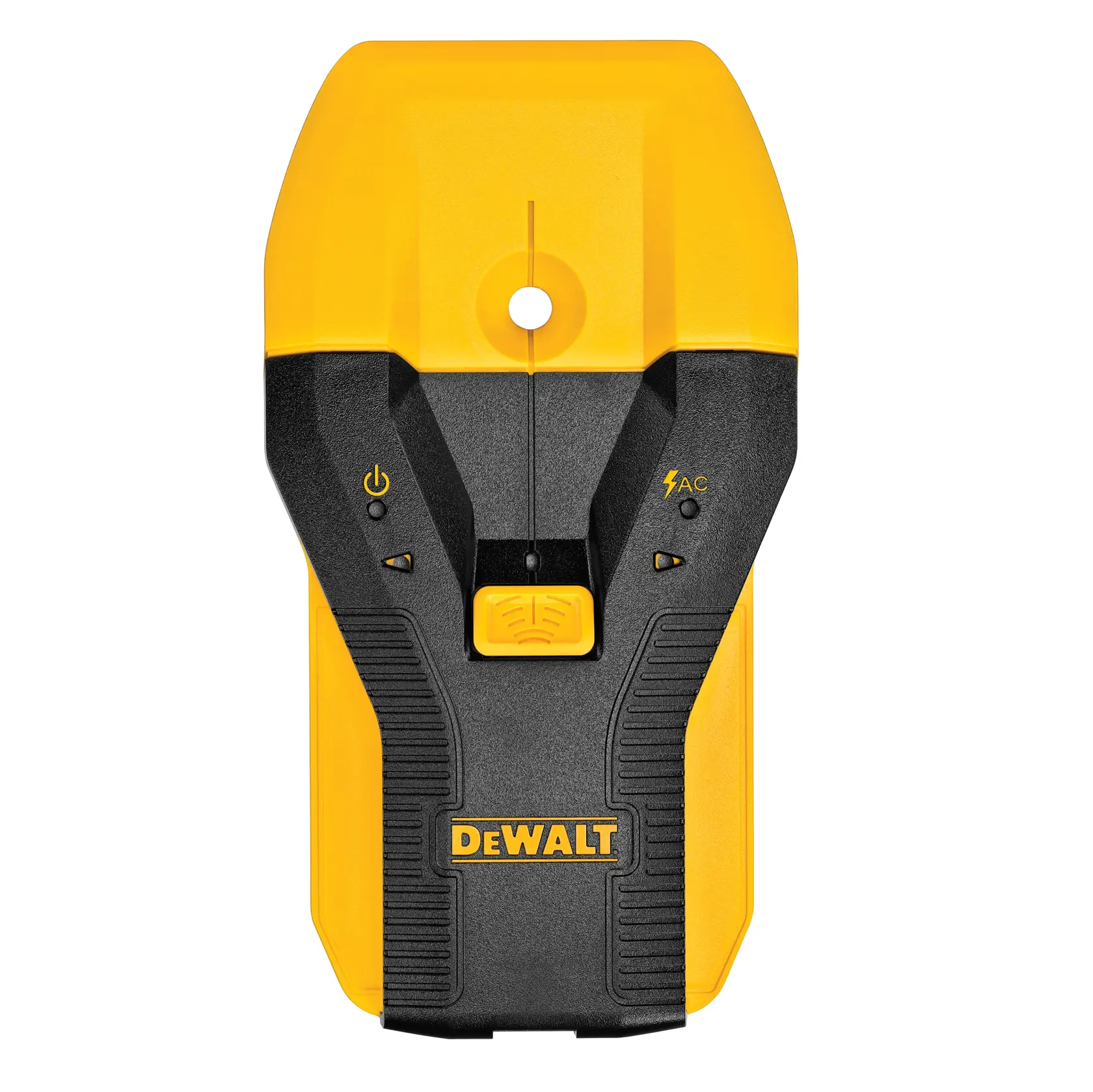
Explore this need in the finder →The DEWALT DW0150 is a center-finding electronic stud sensor with a wider stated range than the DW0100. Its official U.S. product page calls it the 1-1/2-inch model and lists the DW0100/DW0150 manual. The detailed manual table, however, separates wood from metal: it gives wood studs a one-inch drywall ceiling and metal studs a 1-1/2-inch ceiling. That target distinction is essential to an honest comparison, so this review uses the manual's specific figures rather than repeating the page headline as if it applied identically to both materials.
Its output is a center cue
The manual describes a center LED, a longer beep and a marking hole for recording the stud center. Directional lights help steer the scan toward the target, but the cited instructions do not describe separate edge markers or an on-screen width. A project that requires two independently located boundaries should use a documented edge-finding method instead. The DW0150 may be useful when a center mark is the desired output; it is not a substitute for a tool that specifically provides both center and edges.
As with any density-based finder, a signal is not a structural inspection. The manual says the device locates wood or metal studs and live AC behind drywall; it does not identify every hidden object or guarantee that a response represents the framing member you intend to anchor into. A repeated vertical response and a location that makes sense relative to doors or windows are checks, not proof. If the result is inconsistent or the consequences of a mistaken hole are serious, stop and consult construction records or a qualified professional.
Wood and metal have different depth ceilings
The DW0150 product page promotes detection to 1 1/2 inches for wood and metal, while the model-specific manual's specifications table is more discriminating: wood studs are listed up to one inch (25 mm) through drywall; metal studs are listed up to 1 1/2 inches (38 mm). The same manual reports center accuracy figures within stated drywall thickness ranges, but accuracy figures are not proof that the instrument will detect every target at the limit. For a wood-framed wall, use the one-inch table entry as the conservative comparison point. The larger figure belongs to metal studs under the maker's stated conditions.
This distinction matters to the online finder too: a 1.5-inch threshold can match a documented metal-stud plan, but it must not be read as a universal wood-stud promise. The related DW0100 provides the same center-focused style with a 3/4-inch ceiling for both wood and metal. A separate deep mode is not described for either model, so there is no deeper selection to use when the first signal is uncertain.
Use the setup sequence and check the wall
DEWALT's instructions call for two new AAA batteries, inserted with the correct polarity; the official product page says AAA batteries are included. Hold the sensor flat and vertically against the wall, ideally parallel to a nearby door or window. Keep it still while pressing and holding the center button until the other LEDs go out, then move it slowly while continuing to hold the control. Watch and listen for the directional cue, the center LED and the longer center tone. Stop at the signal and mark through the center hole. Repeat from a new starting point and compare at another height rather than treating one sweep as conclusive.
The manual specifically excludes concrete, mortar, block, brickwork, plaster, carpeting, foil-faced materials, metallic surfaces and ceramic tile. It also cautions that shielded wiring, metal conduit, metalized walls and thick or dense walls may block an AC indication. A general manufacturer phrase such as “common building materials” does not override those explicit restrictions. For lath-and-plaster, tile or mesh-reinforced construction, the sources reviewed do not establish a supported plan for this product.
The live-AC signal is not an electrical safety test
The manual lists live AC detection through up to two inches of drywall and an indicator range commonly six to eighteen inches from the wire. This is a different target and different depth from the stud figures. The instructions explain that static charge on a wall can spread the indicated area, and that shielded or enclosed conductors may not be detected. DEWALT cautions that the sensor is not a voltmeter and its symbol must not be the sole method for identifying hazardous voltage or confirming a de-energized state.
Keep the tool in the specified handle area and follow the manual's technique for minimizing static effects. Treat a positive alert as a reason for caution and a negative result as inconclusive. Turn off power when working near wiring and use an independent method to verify electrical conditions; do not drill based on the DW0150 alone.
When its added reach is worth comparing
The DW0150's strongest documented advantage over the DW0100 is not a new display mode but a larger model-specific detection envelope, especially for metal studs. It may belong on a shortlist for a dry interior drywall task where the target material and finish are known, a center indication is acceptable, and the manual's depth limit covers the job. A 1.5-inch limit should not be used to promise detection through a wood-stud wall; use the one-inch wood entry instead. Wall composition and target geometry can still make a real reading differ from the nominal maximum.
If a project depends on finding both stud edges, handling plaster, ceramic tile or other difficult surfaces, or mapping hidden services, choose an instrument whose own instructions support that exact task. The DW0150's AC warning does not solve those needs, and there is no claim here of hands-on testing, measured accuracy, ownership, current seller stock or customer experience.
Offer and package checks
Verify the DW0150 model name, SKU and its 1-1/2-inch product page, rather than accepting a listing that uses only the DW0100/DW0150 shared-manual filename. The product listing identifies UPC 885911555715 and says AAA batteries are included. Confirm the actual offer's battery count and condition, read the current manual, and compare the wall type and stud material with its table. DEWALT lists a three-year limited warranty; the exact seller and purchase terms are not established here.
In short, the DW0150 is a center-oriented drywall sensor with live-AC indication and a manual-documented difference between wood and metal reach. The extended metal-stud limit is useful only when that is the relevant target. For wood, plaster, tile or a need for explicit edge readings, the smaller print in the manual matters more than the broad headline.
Primary references: DEWALT's DW0150 U.S. product page and the shared DW0100/DW0150 instruction manual.
Key specifications
Key details at a glance
| Maximum stated stud depth | 1.5 in |
|---|---|
| Depth qualification | The product page headline describes a 1-1/2-inch finder. The more specific N596253 table distinguishes targets: wood studs up to 1 inch (25 mm) through drywall; metal studs up to 1-1/2 inches (38 mm). Live AC is a separate up-to-2-inch signal, not stud depth. |
| Documented scan modes | ['Wood/metal stud center detection', 'Live AC warning indication'] |
| Center and edge indication | No |
| Live-wire meter | Yes |
| Battery requirement | Two AAA 1.5 V batteries |
Use the exact model’s instructions for operating limits, supplied equipment and version differences.
Sources for this review
Sources for this assessment

Check this model against your wall
Use the finder to compare documented surface limits, center/edge indications and other requirements. A match is not a safety certification.