
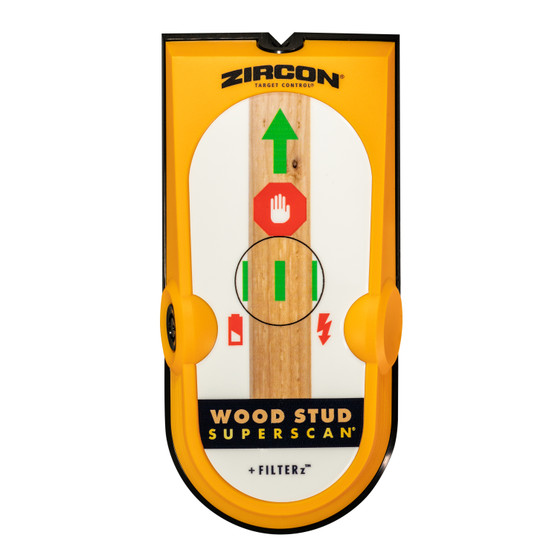
Your needs, this model
Does it fit your priorities?
Can this model find both center and edges of a wood stud?
Yes in Auto on the documented shallow plan: the manual describes center and both edge indicators to 3/4 inch and filters metal in that mode. Edge mode reports edges only, while DeepScan has a separate center cue without the wood-selective filtering.
Explore this need in the finder →What does its 1-1/2-inch DeepScan limit add?
It adds a deeper center-only plan for wood and metal stud targets. It is not the same plan as Auto's filtered center-and-edge reading, and the instructions caution that deep signals may not be studs.
Explore this need in the finder →Should I use it on lath-and-plaster or rely on WireWarning?
No for lath-and-plaster: the model-specific instructions say the scanner is not designed for that surface. WireWarning is a limited added alert for some unshielded live AC wires and may miss deeper or obstructed wiring, so it cannot establish a safe location.
Explore this need in the finder →A wood-focused tool with three distinct plans
Wood Stud SuperScan is not a finish variant of the SuperScan W2. The Zircon-owned U.S. shop lists it as SKU 73241, and its product-specific instructions are labelled P/N 73190, revision A from March 2023. The model uses a yellow-and-black housing with a simple set of indicator lights rather than the W2's ColorTrip LCD. More important than appearance, its three scan arrangements make a specific trade: Auto and Edge are wood-selective and shallow; DeepScan adds a deeper center signal but switches off that wood-filtering behavior.
This review is a reading of the manufacturer's exact product page, U.S. datasheet and model-specific manual, not an account of using the tool. No real-wall sample, detection accuracy or independent test was measured. The source describes limits and a procedure; only a scan of the actual wall, corroborated with other information, can resolve a project-specific location.
Auto and Edge: useful separation of center and edges
In Auto, the WSS instructions describe a wood-stud workflow that indicates both the center and the two edges up to ¾ inch (19 mm). This is the mode to consider when a layout depends on both the stud's span and a center reference. Hold the tool flat and still while it calibrates, then move it slowly. The manual says the center and edge indicators change as the tool passes a stud; repeat readings and map the wall at several heights rather than treating a single signal as confirmation.
Edge mode supplies the two edges, but not a center cue, to the same stated ¾-inch limit. Target Control and +FILTERz are engaged in Auto and Edge to reduce metal and weak-signal targets, including examples such as PEX or plastic pipe. This can be useful if the task is identifying wood framing while avoiding some non-wood signals. It does not make the device an object-identification camera, and it cannot promise that every competing material will be rejected. A neighboring metal pipe, a dense wall or inconsistent construction can still complicate an interpretation.
The maker's Trust-but-Verify method uses the pattern of fasteners along a likely stud as another clue. The manual notes that an ordinary pipe may not have the same fastener pattern. That may improve a manual cross-check, but it is not a safe-drilling certificate: absent screws do not prove that plastic plumbing, wiring or another hazard is absent.
DeepScan is center-only and changes the filtering tradeoff
DeepScan has its own maximum: up to 1½ inches (38 mm) for a center indication on wood or metal studs, according to the exact instructions and datasheet. The manual warns that this setting can detect objects farther behind a wall that may not be studs. It also states that Target Control filtering is off in DeepScan. So the larger number is not simply a longer-range version of Auto. It is a different operating plan: the deeper center cue is available, but it does not give the paired edges used for an Auto layout, and it no longer suppresses metal in the same way.
This difference matters when choices interact. If both edges and a center are essential, the source supports Auto only at its shallower limit. If the depth threshold is more important, DeepScan's documented center-only plan can qualify while the edge requirement does not. The finder should therefore screen the combined requirement, not add Auto's edge function to DeepScan's greater depth. Metal signals in DeepScan can be particularly ambiguous; Zircon says the Stop indicator changes when metal is detected, but that warning does not identify which object produced the signal.
Wall limits and the live-wire alert
The WSS instructions explicitly say the tool is not designed to scan over lath and plaster. They also exclude scanning for wood studs or joists through carpet and padding. Wallpaper or fabric may be compatible only under the listed dry, nonmetallic conditions; fresh paint may need time to dry. A highly textured surface or acoustic ceiling requires following the instructions' separate accommodation, not assuming the normal wall method applies. The ¾-inch and 1½-inch ceilings are maximums, and performance can vary with moisture, wall texture, material consistency and calibration.
WireWarning is described as active in all scan modes for some live, unshielded AC wiring, with a stated reach typically up to 2 inches (50 mm). The instructions name cases where it may not detect a conductor, including excessive depth, conduit, concrete, metallic coverings or moisture. This is a caution light, not a wire-finding guarantee or a safe-drill test. Turn off utilities before penetrating a surface and consult construction plans, visible entry points and other evidence.
Setup and exact-package checks
The manufacturer lists two AA alkaline batteries, not included. Press and release the power button, select the desired arrangement, hold the unit flat and still through calibration, then scan slowly with the recommended grip. The manual says not to touch the wall with the other hand during calibration or scanning; movement, grip and contact can change readings. Before buying, verify the Wood Stud SuperScan name and SKU 73241, confirm whether both AA cells are supplied, and inspect the actual condition, package and return terms. Do not confuse this 2-AA wood-focused tool with the 9V W2, its screen and conventional mode. This assessment is a model reference, not a live offer or price check. For a shallow wood layout, the center-plus-edges Auto plan is the key use case; for a deeper scan, understand that DeepScan returns to a center cue and can respond to metal or other objects.
Key specifications
Key details at a glance
| Maximum stated stud depth | 1.5 in |
|---|---|
| Depth qualification | Auto finds wood-stud center and edges up to 3/4 inch (19 mm); Edge identifies edges to the same limit. DeepScan provides a center cue for wood and metal studs to a separate 1-1/2 inches (38 mm), with TC filtering off; the manufacturer's guide says deeper signals may or may not be studs. It does not provide both center and edge in the deeper plan. |
| Documented scan modes | ['Auto', 'Edge', 'DeepScan'] |
| Center and edge indication | Yes |
| Live-wire meter | Yes |
| Battery requirement | Two AA alkaline batteries |
Use the exact model’s instructions for operating limits, supplied equipment and version differences.
Sources for this review
Sources for this assessment

Check this model against your wall
Use the finder to compare documented surface limits, center/edge indications and other requirements. A match is not a safety certification.