
Your needs, this model
Does it fit your priorities?
What does L30 add over a basic edge finder?
Its defining documented addition is continuous WireWarning detection for live, unshielded AC voltage, alongside the same 3/4-inch edge-finding StudScan ceiling. The warning is limited and does not establish that a location is safe.
Explore this need in the finder →Does L30 indicate the stud center?
No direct center indication is documented for this exact model. It marks one edge; reverse scanning marks the other, and a midpoint is a separate layout calculation.
Explore this need in the finder →Is L30 a deep-scan model?
The exact L30 instructions describe a single StudScan arrangement with a maximum of 3/4 inch (19 mm). The separate 1-1/2-inch modes belong to other L-series models, not this L30 configuration.
Explore this need in the finder →The Zircon StudSensor L30 combines an edge-finding signal with WireWarning for live, unshielded AC. The exact U.S. product record identifies SKU 72187, and the page links model-specific instructions marked P/N 71891, Rev A, December 2020. The L30 is distinct from the L20: the exact sources document an added electrical warning, not a deeper stud range or a center-finding mode. This is a source-based assessment, not a hands-on test.
The added warning does not add stud depth
For studs, the L30's stated maximum is 3/4 inch (19 mm) in its single StudScan arrangement. It is an edge finder: red arrows approach the boundary, the EDGE light and SpotLite pointer indicate the edge, and an audio tone accompanies the target. To estimate a centerline, follow the manual's two-boundary procedure and mark both sides. There is no separate center cue, and the L30 has no named DeepScan mode. The midpoint is your measurement from two marks, not a second reading displayed by the tool.
The practical step up from the L20 is WireWarning. Zircon describes a continuous alert for live, unshielded AC wiring, with a stated reach up to 2 inches (50 mm) under suitable conditions. The instructions warn that wiring deeper than 2 inches, shielded or conduit-enclosed conductors, metal coverings, or moisture may prevent or alter detection. The warning is a limited indicator, not a map of every wire and not a clearance for drilling. Even when the display is quiet, utilities may still be present.
Keep the two signals separate
WireWarning does not identify a stud, and an edge response does not prove that the target is wood. Zircon explains that pipes, wires, and other dense objects near the surface may be detected in a similar way. Treat the electrical cue and the stud cue as separate information, compare a suspected stud at more than one height, and consult construction plans or visible service routes before penetrating a wall. Shut off power when working near wiring and use independent safety checks.
The L30's single stud mode is narrower than the L40 and L50. Those models have a second DeepScan arrangement whose instructions explicitly describe edge finding up to 1-1/2 inches (38 mm); the L30 stops at the 3/4-inch StudScan limit. The L70 offers center and edge indications in its shallow StudScan, while its deeper response is not the same paired-edge layout. If deeper reach, direct center indication, or both are essential, compare those models rather than assuming WireWarning makes the L30 a more capable stud scanner.
Calibration and wall contact are part of the method
The manual's sequence is simple but specific: place the tool flat on the wall, press and hold the power button, wait about one to two seconds for the READY light, then move slowly without lifting or rotating the finder. A scan begun over a stud may trigger an over-the-stud warning, in which case the instructions say to start again elsewhere. For a broad object, irregular response, or an unexpected signal, repeat at another height instead of treating one beeping point as confirmation.
Zircon does not recommend the L30 for lath and plaster because uneven plaster thickness can interfere with scanning. Its manual also excludes or cautions against dense materials, ceramic tile, carpet or padding, metallic wallpaper, foil-backed board, and damp or freshly painted surfaces. Dry, nonmetallic wallpaper may be scanned, but the sensing limit still varies with moisture, texture, and wall consistency. The normal plan in this review is dry interior drywall; it is not a claim that all surfaces are supported.
Battery and package checks
The exact instructions call for a new alkaline 9V battery and describe how to orient it in the compartment. The reviewed source materials do not establish that a particular retail package includes one, nor do they establish extra accessories. Verify the SKU and the seller's exact contents before ordering. Do not assume that similar yellow housings or a shared family name mean the package, sensing range, or electrical functions are identical.
When the L30 is a reasonable fit
Choose it for a compatible interior drywall task when a shallow edge cue and a separate live-AC warning are more useful than a deeper stud mode or a direct center display. It asks little of the user beyond flat calibration and a slow two-edge pass, but those limits are the point: its 3/4-inch stud ceiling and edge-only output should remain attached to the recommendation. Compare the L20 if the warning is not needed, and the L40 or L50 if a separately documented deeper edge scan matters.
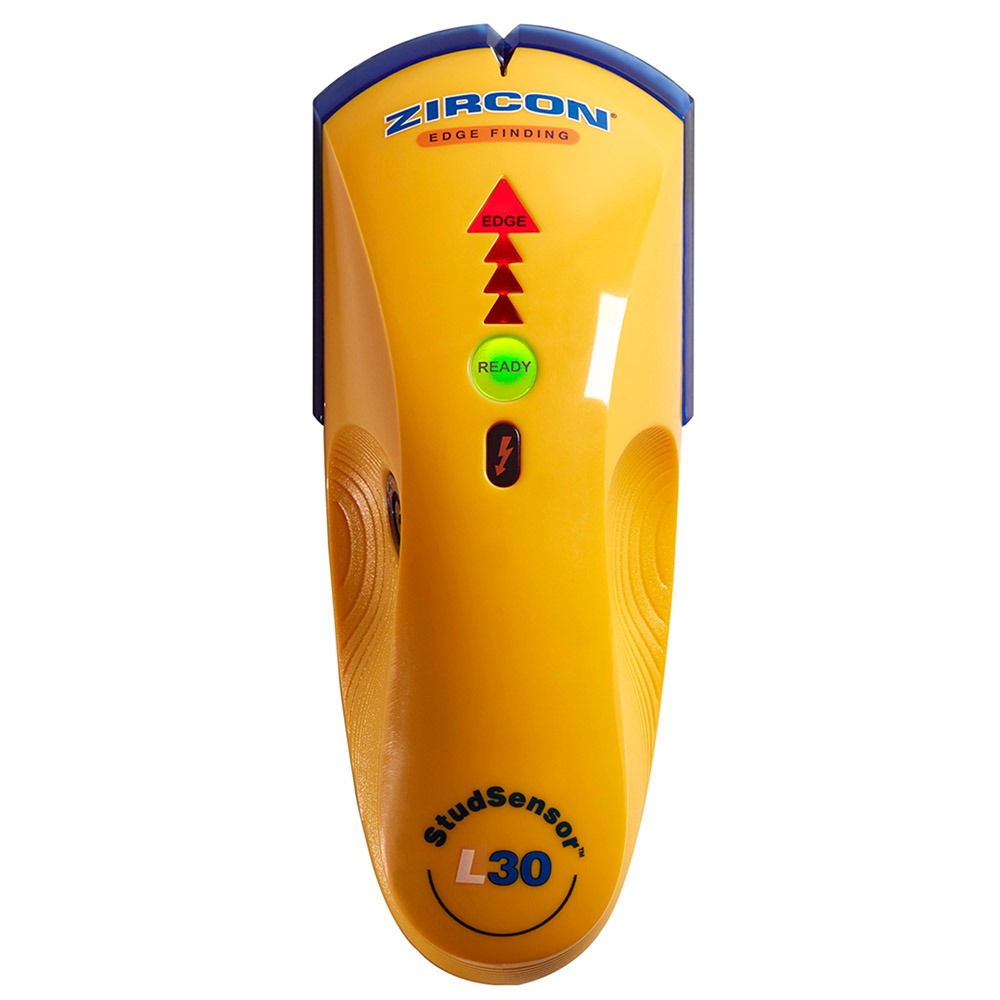
The exact official image shows the L30's EDGE, READY and WireWarning indicators. It is a product reference, not a safety test or a photograph of a tested specimen.
Key specifications
Key details at a glance
| Maximum stated stud depth | 0.75 in |
|---|---|
| Depth qualification | Exact manual ceiling is 3/4 inch (19 mm); L20/L30 do not have a separate deeper plan. |
| Documented scan modes | ['StudScan'] |
| Center and edge indication | No |
| Live-wire meter | Yes |
| Battery requirement | One 9V alkaline battery |
Use the exact model’s instructions for operating limits, supplied equipment and version differences.
Sources for this review
Sources for this assessment

Check this model against your wall
Use the finder to compare documented surface limits, center/edge indications and other requirements. A match is not a safety certification.