
Your needs, this model
Does it fit your priorities?
Where does the L20 mark a stud?
It signals an edge with the EDGE light, SpotLite and tone. Scan across the stud, reverse to mark the opposite edge, then calculate the midpoint; the tool does not show a direct center cue.
Explore this need in the finder →Will L20 scan a thicker wall or lath and plaster?
The exact L20 instructions state a 3/4-inch (19 mm) edge-finding maximum and do not recommend lath and plaster. It has no separate DeepScan mode; a thicker assembly is not addressed by this model’s one plan.
Explore this need in the finder →Does the L20 warn about live wiring?
The exact product page and L20 instructions reviewed describe no WireWarning meter. That missing feature is not a safety clearance: confirm wiring with other reliable information and use appropriate precautions before penetrating a wall.
Explore this need in the finder →The Zircon StudSensor L20 is a basic electronic edge finder with an arrow-shaped SpotLite pointer. Zircon's current U.S. product route identifies SKU 75114 and links instructions whose cover names the L20 and whose footer identifies P/N 66357, Rev B, August 2018. This review follows that exact page-to-manual link; it does not assume the tool is interchangeable with another StudSensor. No physical sample, ownership, or hands-on test was involved.
A clear edge cue, not a direct center reading
The L20 is intended to locate wood or metal stud edges behind a wall, with a manufacturer-stated maximum depth of 3/4 inch (19 mm). Its red EDGE light, READY light, steady tone, and SpotLite pointer mark the point where the sensor reaches an edge. The instructions tell the user to continue past the signal, reverse direction, and mark the other boundary. The center is then estimated as the midpoint between those two marks. That is a useful layout method, but it is not the same as a center icon or a display that shows the whole stud width.
The L20's value is its uncomplicated cue pattern: one edge at a time, a pointer on the wall, and a flat stud-edge groove for marking. That makes it easier to understand than a tool with several material or depth modes. It also means buyers should not expect the L20 to tell them whether a detected density change is wood, a pipe, or wiring. Zircon explicitly warns that nearby non-stud objects can be detected similarly and recommends checking repeatable stud patterns at multiple heights.
Its shallow ceiling defines the job
The 3/4-inch figure is the only documented stud-depth arrangement for this exact model. The L20 does not have a separate DeepScan mode, so a wall assembly thicker than that should not be treated as a task the finder can solve just by moving more slowly. If an edge is not repeatable, the instructions recommend moving away, starting again, and checking the suspected stud at another height. A maximum is a manufacturer limit under suitable conditions, not a promised result through every paint, texture, or layer.
In the L-line, the distinction is practical: the L30 adds a limited live-wire warning without raising the stud-depth ceiling, while the L40 and L50 add a separate 1-1/2-inch DeepScan arrangement. If a deeper edge indication is a must, the L20 is not the right L-series choice. If an on-tool center cue is necessary, compare the L70's ordinary StudScan, where both edges and center are shown, rather than estimating a midpoint from two L20 marks.
Electrical caution is not a built-in warning feature
The L20 manual includes general precautions about electrical wiring and pipes, but this exact model page and instruction sheet do not document WireWarning or a separate live-AC indicator. The tool's stud-density response cannot replace a wire detector, and absence of a stud signal cannot establish that a wall is clear. Use plans, visible service routes, other suitable instruments, and qualified help where needed; turn off power before working near electrical wiring. Do not drill on the basis of a stud finder alone.
Surface and setup limits matter
Zircon says the L20 is intended for interior use and does not recommend it for lath and plaster because plaster thickness varies. The manual also says it cannot scan through carpeting or padding and lists dense surfaces such as ceramic tile, slate, granite, marble, foil-covered insulation, and metallic-fiber wallpaper as unsuitable. Dry, nonmetallic wallpaper or fabric may be workable, but moisture, recently applied paint, and surface texture can change sensing behavior. A product's ordinary drywall plan does not imply support for tile, exterior walls, or metal mesh.
The instructions call for a new alkaline battery and a flat, motionless start; they also warn that moving during calibration can cause repeated beeping or erratic results. Follow the exact sheet for battery installation and wait for calibration before scanning. The sources reviewed do not establish whether a particular seller's package includes a battery or other accessories, so check the exact offer rather than inferring contents from the product image.
Who should compare it with another model?
The L20 is a documentation-based candidate for simple, dry interior drywall work when an edge light and wall pointer are enough and the stated 3/4-inch limit fits the job. Its drawbacks are equally concrete: it reports edges rather than a direct center, has no documented live-wire warning, and has no deeper stud mode. L30 adds WireWarning; L40 and L50 combine shallow StudScan and deeper edge-finding DeepScan; L70 provides both center and edge cues in its shallow plan but changes to a center-oriented DeepScan at depth. Compare those exact arrangements, not just model numbers or maximum-depth headlines.
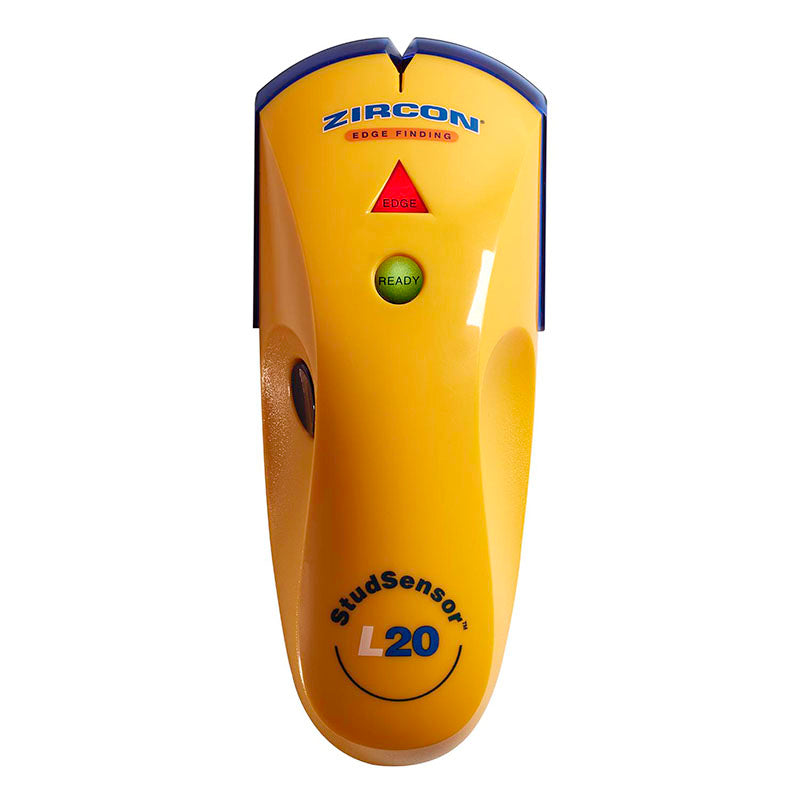
The manufacturer image shows the yellow L20 body and EDGE/READY indicators. It is an exact-model reference image, not a test photograph or evidence of included accessories.
Key specifications
Key details at a glance
| Maximum stated stud depth | 0.75 in |
|---|---|
| Depth qualification | Exact manual ceiling is 3/4 inch (19 mm); L20/L30 do not have a separate deeper plan. |
| Documented scan modes | ['StudScan'] |
| Center and edge indication | No |
| Battery requirement | One 9V alkaline battery |
Use the exact model’s instructions for operating limits, supplied equipment and version differences.
Sources for this review
Sources for this assessment

Check this model against your wall
Use the finder to compare documented surface limits, center/edge indications and other requirements. A match is not a safety certification.