
Your needs, this model
Does it fit your priorities?
When should I use the x85's DeepScan mode instead of Stud Scan?
The manual gives ordinary Stud Scan a 1-inch ceiling and describes DeepScan as the separate option for deeper targets. Although the model page cites 2 inches for DeepScan, the instructions say wood studs may only detect to 1 1/2 inches and warn a maximum-range target may produce edges without a center cue. Treat this as a qualified limit, not a depth promise.
Explore this need in the finder →Does the x85 give a live-wire warning while it finds a stud?
The x85's AC mode is a separate search for live, unshielded wiring; the reviewed sources do not document a WireWarning meter added to Stud Scan or DeepScan. If a live-wire meter must accompany the stud plan, this x85 arrangement does not satisfy that stated need. Even AC mode can miss concealed wiring and cannot certify a safe place to penetrate.
Explore this need in the finder →Can x85 Thermal mode substitute for a stud or general pipe scan?
No. Its thermal mode is specified for actively heated, water-filled plastic tubing of about 1/2-inch diameter, up to a maker-stated 2 inches. That is a separate target and arrangement from locating studs or metal; unheated or different pipe systems are not established by that claim.
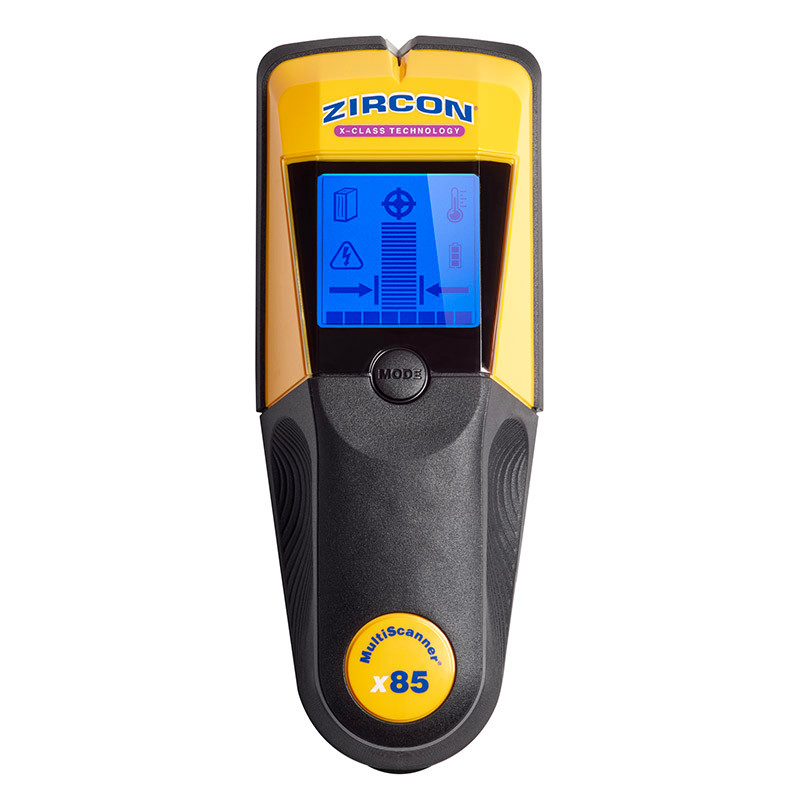
Explore this need in the finder →The MultiScanner x85 is a combination wall scanner rather than a simple center-finding sensor. Its Zircon product page identifies the U.S. shop listing as SKU 65180, while the linked English instructions and data sheet use the fuller x85 OneStep name. The page-2 stud-finder catalogue card links to this same product family, and the official product image shows an x85-labeled tool. The useful question is not whether it has a long list of modes, but which mode supports the target you actually need.
Stud Scan and DeepScan are not the same arrangement
Ordinary Stud Scan is specified for wood and metal studs to 1 inch, with center, edge and direction cues. DeepScan is the separate deeper mode. The shop page and data sheet advertise a 2-inch DeepScan ceiling for studs, but the instructions add an important wood-specific qualification: wood studs may only be detected to 1½ inches. The manual also warns that a target at the maximum range may show edges without a dependable center indication. That means the headline figure should not be read as a universal wood-stud depth or a guarantee that every cue survives at maximum range.
For a conservative comparison, this assessment uses 1½ inches as the wood-stud ceiling and treats the deep arrangement at that limit as edge-capable rather than promising a center. That is not a claim that the scanner never finds a center in DeepScan; the instructions say the center can appear for deeper targets, but do not state the exact point at which it may disappear. Unknown transition points should stay unknown instead of being turned into precise compatibility promises.
Two other modes search for different things
The x85 also has AC mode, which searches for live unshielded wiring, and Thermal mode, which looks for actively heated, water-filled plastic pipe of roughly ½-inch diameter. Those are separate operations, not added sensors that run alongside the stud modes. In particular, the reviewed x85 sources do not document WireWarning as an extra meter cue during Stud Scan or DeepScan. A shopper who requires a wire warning while locating a stud should not treat this x85 arrangement as meeting that requirement merely because an AC search is available on the same body.
The thermal specification is narrow too: it concerns active heat in water-filled tubing, not all pipes, dormant heating lines or a generic metal target. Metal Scan is not one of the x85's named modes. The separate routines create range, but they also require the user to select and interpret the right signal. Zircon's manual describes the x85 returning to the previously active mode at startup, with an exception after DeepScan; checking the icon before scanning is a useful habit.
Handle the scanner consistently
For a stud search, the instructions say to hold the device flat against the wall, calibrate without moving it, keep a steady grip and slide slowly. The center indicator, SpotLite pointer, signal bars and tone help identify a target, but the manual notes that deep targets can show only signal-strength bars rather than edges or center. Mark repeated results and compare them at other heights. The x85 requires three AAA batteries; the exact seller offer should be checked for package contents rather than assuming the current page or an older data sheet establishes every box insert.
Thermal work uses a different pace: Zircon's instructions describe a brisk, continuous scan because a handprint or heat from the operator can influence the temperature signal. Keep your body away from the test area and follow the model's floor-scanning instructions if using it for radiant heating. That thermal procedure is not a shortcut to identifying studs, hidden water lines in general, or safe places to penetrate a surface.
Wall materials and safety
The x85 is intended for interior use, and the instructions do not recommend lath and plaster. Uneven plaster can make studs difficult to find, while metal mesh blocks detection. It also cannot scan for wood studs or joists through carpet and padding. Fresh paint, moisture, textured surfaces, wallpaper with metallic material and plywood backing can affect results. These limits matter more than the presence of a DeepScan icon if the wall assembly is unknown.
AC mode is still only a detector. The manual warns that it can miss inactive wiring, conductors more than 2 inches behind the surface, conduit, metal coverings, plywood shear walls and moisture-related cases. A negative signal is not proof that the wall is clear. Turn off utilities before penetrating a wall and consult additional information or a qualified professional when the consequences are significant.
Who should consider it
The x85 may suit a buyer who has a real need for its combination of ordinary stud finding, a separate deeper stud mode, live-AC location and a narrowly specified thermal scan. Its distinctive range is less useful if the buyer expects all four functions to operate at once or wants a simple single-purpose stud finder. MultiScanner A250, for example, adds WireWarning during stud and metal scans, while x85's documented AC search is a separate mode; those capabilities should not be collapsed into one checkbox. The x85 is also a poor match for a plaster wall with metal mesh or a wood stud target that depends on an unqualified 2-inch reading.
This research-based assessment relies on the exact Zircon shop listing, its linked English instructions, and the manufacturer data sheet, checked October 31, 2026. The manual and data sheet were inspected through the official document viewer after direct byte retrieval failed; no local original PDF is claimed. No physical testing, ownership, measured accuracy, hands-on use, seller stock or offer-specific package was verified.
Key specifications
Key details at a glance
| Maximum stated stud depth | 1.5 in |
|---|---|
| Depth qualification | The current product page and historical data sheet state up to 2 inches for DeepScan. The linked instructions add that wood studs may only be detected to 1 1/2 inches and warn that a target at maximum range may show only edges rather than a center. This catalog records the conservative wood-stud ceiling as 1.5 inches; the advertised 2-inch figure is retained for context, not applied indiscriminately to wood. |
| Documented scan modes | ['Stud Scan', 'DeepScan', 'AC', 'Thermal'] |
| Center and edge indication | Yes |
| Live-wire meter | No |
| Battery requirement | Three AAA (LR03) batteries |
Use the exact model’s instructions for operating limits, supplied equipment and version differences.
Sources for this review
Sources for this assessment
- MultiScanner x85 — exact Zircon U.S. shop product page, SKU 65180
- MultiScanner x85 OneStep English operating instructions
- MultiScanner x85 OneStep manufacturer data sheet, C/N 2107 Rev D (08/13)
- Zircon U.S. Stud Finders collection, page 2 refresh
- Exact x85 front product photograph from the official Zircon shop page

Check this model against your wall
Use the finder to compare documented surface limits, center/edge indications and other requirements. A match is not a safety certification.