
Your needs, this model
Does it fit your priorities?
Is the Walabot DIY 2 M supported on my planned wall surface?
Walabot names drywall and plywood and warns against lath/plaster, concrete, tile, brick, metal-backed walls, and stucco. This does not guarantee performance for every thickness, finish, or assembly.
Explore this need in the finder →Will it show stud center and edges?
The M product page lists stud locations and centers, and Walabot’s M-specific guide names DIY 2 M Expert Mode for reading stud edges toward a center. The screen remains an interpretation aid, not a certified location.
Explore this need in the finder →Does the four-inch figure prove it can find studs at a four-inch depth?
No. The page describes a general object-depth ceiling. The reviewed M sources do not state a stud-specific numeric limit, so a numeric stud-depth answer remains unknown.
Explore this need in the finder →Which accessories come with this exact M package?
See the exact bundle contents on this review: package parts differ among base, Essential, Deluxe, and Premium, while the documented M scanner feature set is shared. Confirm the exact SKU and seller contents.
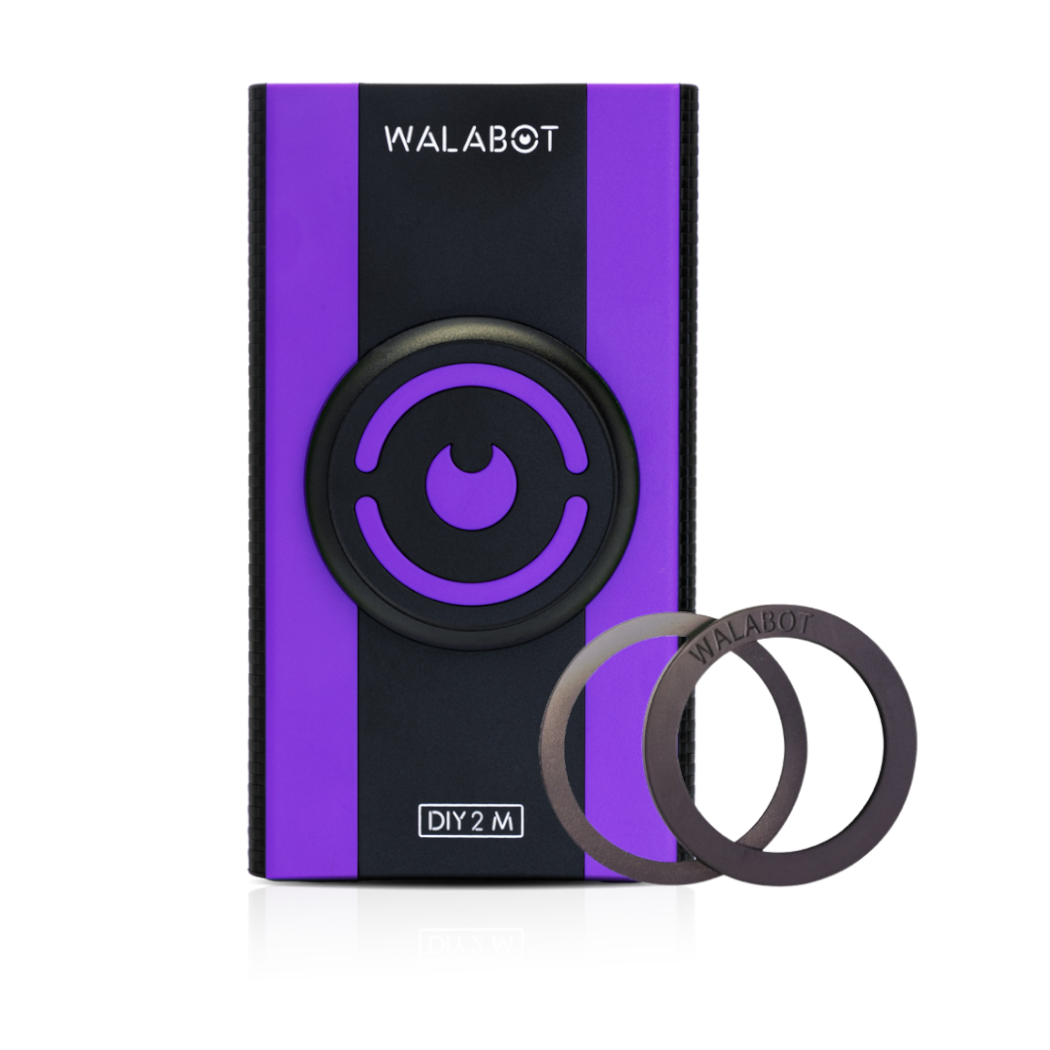
Explore this need in the finder →The Walabot DIY 2 M Essential Bundle is a distinct manufacturer package, SKU DIY2MBNDLE. Its U.S. product listing names three included items: the DIY 2 M scanner, Walattach MagSafe-compatible connector rings, and a USB Type-C charging cable. It does not list the protective case as part of the Essential bundle. The M scanner’s documented finding functions are the same feature set Walabot attributes to DIY 2 as of January 2026; the rings change the package, not a published sensing mode. This assessment is based on the maker’s material rather than personal testing.
The accessory decision is phone-specific
The point of Essential is the connector-ring option. If you already know that the MagSafe-compatible attachment fits your phone and case arrangement, this bundle puts that accessory in the same package as the scanner. “MagSafe-compatible” is not evidence that every iPhone case, Android phone, magnetic surface, or case thickness will work. Check the maker’s fit guidance and your actual handset before relying on the attachment. A compatible phone and app remain necessary to view the scanner’s output; no phone is listed as included.
Essential sits between the other packages
For the DIY 2 M family, the base configuration lists the device and cable; Essential adds the rings; Deluxe instead lists a protective case; Premium lists both rings and case with the device and cable. That comparison is more useful than assuming that “Essential” means a more capable scanner. The listed package contents identify which accessory you receive. The product-page artwork may show components attractively but should not replace the written contents list or the SKU on the seller’s offer. If protection during storage matters more than a phone attachment, Deluxe is the more relevant comparison; if both do, compare the exact Premium package.
The scanner’s use case remains narrow and visual
Walabot presents Images Mode as a graphic representation of wood and metal studs, pipes, and wires. Expert Mode shows raw radar data, which the maker says can help the user interpret more complex overlapping or intersecting responses. The brand’s beam-finder guide specifically includes DIY 2 M among the Expert Mode products and explains using visible stud edges to work toward a center. That is a more information-rich display than a single light, but it also puts the burden of interpretation on the user. A rendered response is not a literal picture or material identification.
Surface and depth claims need context
The M product page names drywall and plywood for scanning and warns against lath-and-plaster, concrete, tile, brick, metal-backed walls, and stucco. It states that objects may be detected up to four inches deep in drywall. The wording is about objects generally: it does not supply a distinct maximum for wood studs or a guarantee for an individual wall. Our numeric minimum-depth question concerns a maker-stated stud range, so this bundle does not match a numeric threshold simply because the page includes a four-inch figure. Thick paint, repairs, unusual backing, foil, or a surface outside the listed set should be treated as reasons to stop and consult the manufacturer’s instructions.
Setup and safety are part of the purchase
A phone-driven RF scanner is not a useful fit if you do not want to manage the app, a Wi-Fi connection, charging, and baseline setup. Walabot says the unit has a built-in rechargeable battery and supplies a Type-C cable. Its support material says DIY devices need calibration when beginning work on a new wall; the detailed app instructions should govern the exact positioning and motion. Use repeated, consistent scans rather than treating one display as conclusive. Although the device can depict wires, the reviewed M materials do not document a dedicated live-wire meter. Do not interpret a quiet or ambiguous screen as a safe drilling location.
Best match and clear limits
Essential makes sense when supported drywall or plywood is the project, phone-based Images and Expert views suit your workflow, and the included rings are an accessory you specifically want. It is not the right answer for someone who needs a storage case in the box, a proven fit for an unverified phone case, a live-wire meter, a numeric stud-depth promise, or scanning through the surfaces Walabot excludes. The important checks are exact model/SKU, current app support, handset and case fit, cable and power arrangement, and the listed contents of the offer. The rings themselves do not improve detection, surface coverage, or safety.
Key specifications
Key details at a glance
| Depth qualification | The M product page says objects can be detected up to 4 in / 10 cm deep inside drywall. No reviewed M source gives a separate wood-stud maximum; this general object-depth statement is not encoded as numeric stud depth. |
|---|---|
| Documented scan modes | ['Images Mode', 'Expert Mode'] |
| Center and edge indication | Yes |
| Live-wire meter | No |
| Battery requirement | Built-in rechargeable battery. The product page lists a USB Type-C charging cable; no independent runtime measurement or duration claim is made. |
Use the exact model’s instructions for operating limits, supplied equipment and version differences.
Sources for this review
Sources for this assessment
- Walabot U.S. all-products collection, captured 2026-10-31
- Walabot DIY 2 M exact U.S. product page
- Walabot DIY 2 M public product data
- Walabot support: DIY 2 M and DIY 2 feature comparison (browser-inspected research note; full direct capture returned 403)
- Walabot guide: DIY beam finder, including DIY 2 M Expert Mode
- Walabot support: calibration on each new wall
- Walabot DIY 2 M Essential Bundle exact U.S. product page
- Walabot DIY 2 M Essential Bundle exact public product-data record
- Exact Walabot DIY 2 M Essential Bundle manufacturer product image

Check this model against your wall
Use the finder to compare documented surface limits, center/edge indications and other requirements. A match is not a safety certification.