
Your needs, this model
Does it fit your priorities?
Do the StudBuddy Pro's vials locate stud edges or center?
No. The vials level a layout line; the magnet's fastener catch is the finding cue. The reviewed sources do not document electronic edge or center indications.
Explore this need in the finder →Is the Pro documented for a lath-and-plaster scan?
No lath-and-plaster operating plan is established by the exact Pro page and package reviewed. Do not infer plaster performance from a drywall claim.
Explore this need in the finder →Can you choose a minimum depth threshold for this Pro?
No numerical detection-depth limit is stated in the exact product evidence reviewed; the illustrated 24-inch wall segment is a scanning routine, not a sensing range.
Explore this need in the finder →The StudBuddy Pro is a two-job tool: it uses a magnet to find a likely drywall fastener, then adds features for laying out a mount. Its plumb and horizontal bubble levels, inch/centimeter rulers, soft-grip handle and felt glide pads distinguish it from the original 000107. The distinction is practical, but it is easy to overread: a vial that levels a line does not sense a stud edge, and a ruler is not a depth gauge.
Keep the sensing task separate from the layout task
The maker describes the Pro as retaining the original StudBuddy’s magnetic method. A magnet responds to a likely ferrous screw or nail used in attaching drywall, and the tool can stick at a detected point. That is a useful visual cue for a drywall mounting job, especially when a person wants to free a hand after finding a point. It is not an electronic scan of the full stud, and the manufacturer does not document left/right edge or center indications for this model.
The extra bubble vials and rulers are for setting a reference line and measuring a layout once a candidate point has been found. The Pro can therefore replace some separate layout steps for someone who already knows where the mounting holes should go. It cannot tell you whether the selected fastener position is structurally appropriate for a particular load, and it does not replace the mounting hardware instructions.
What the package directions do—and do not—establish
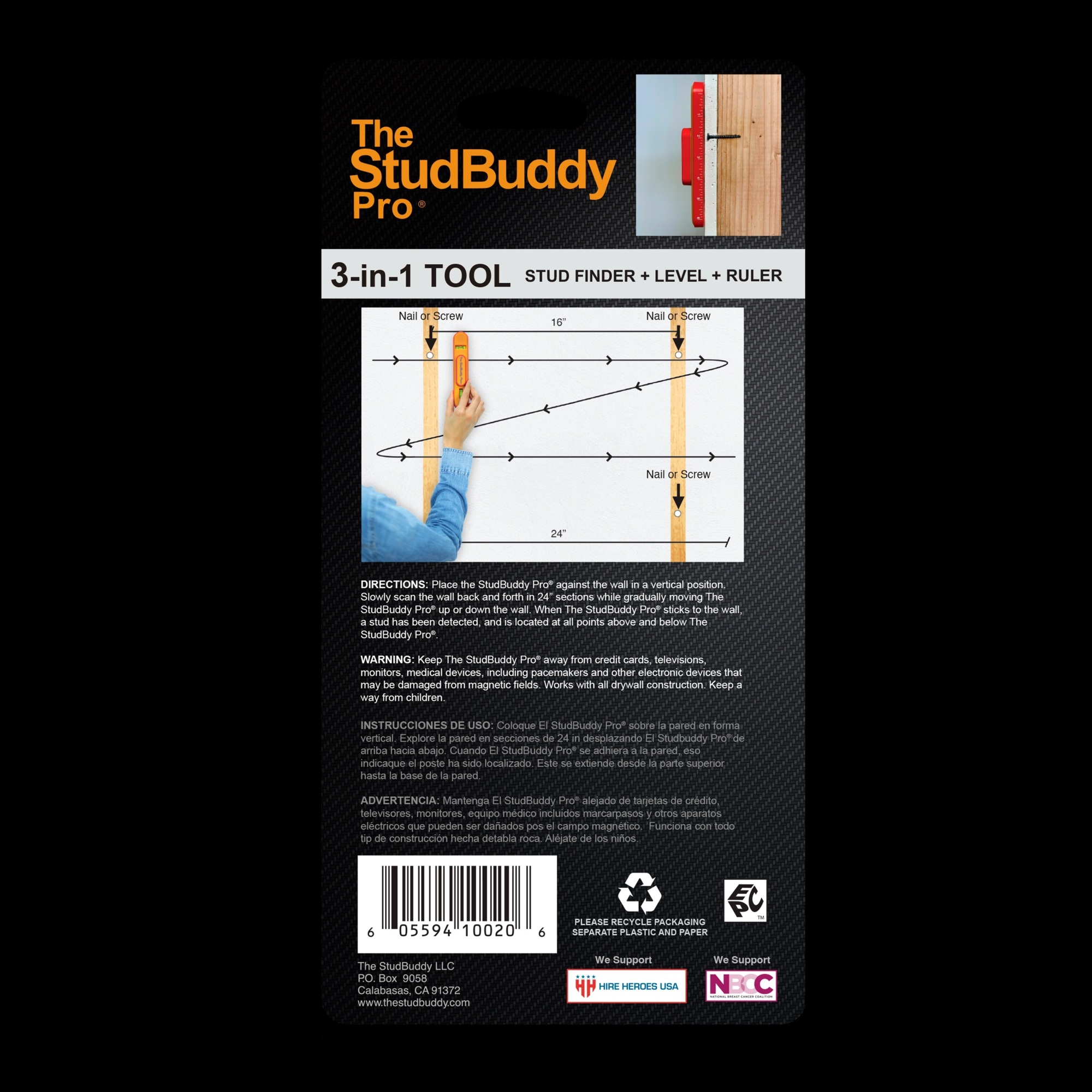
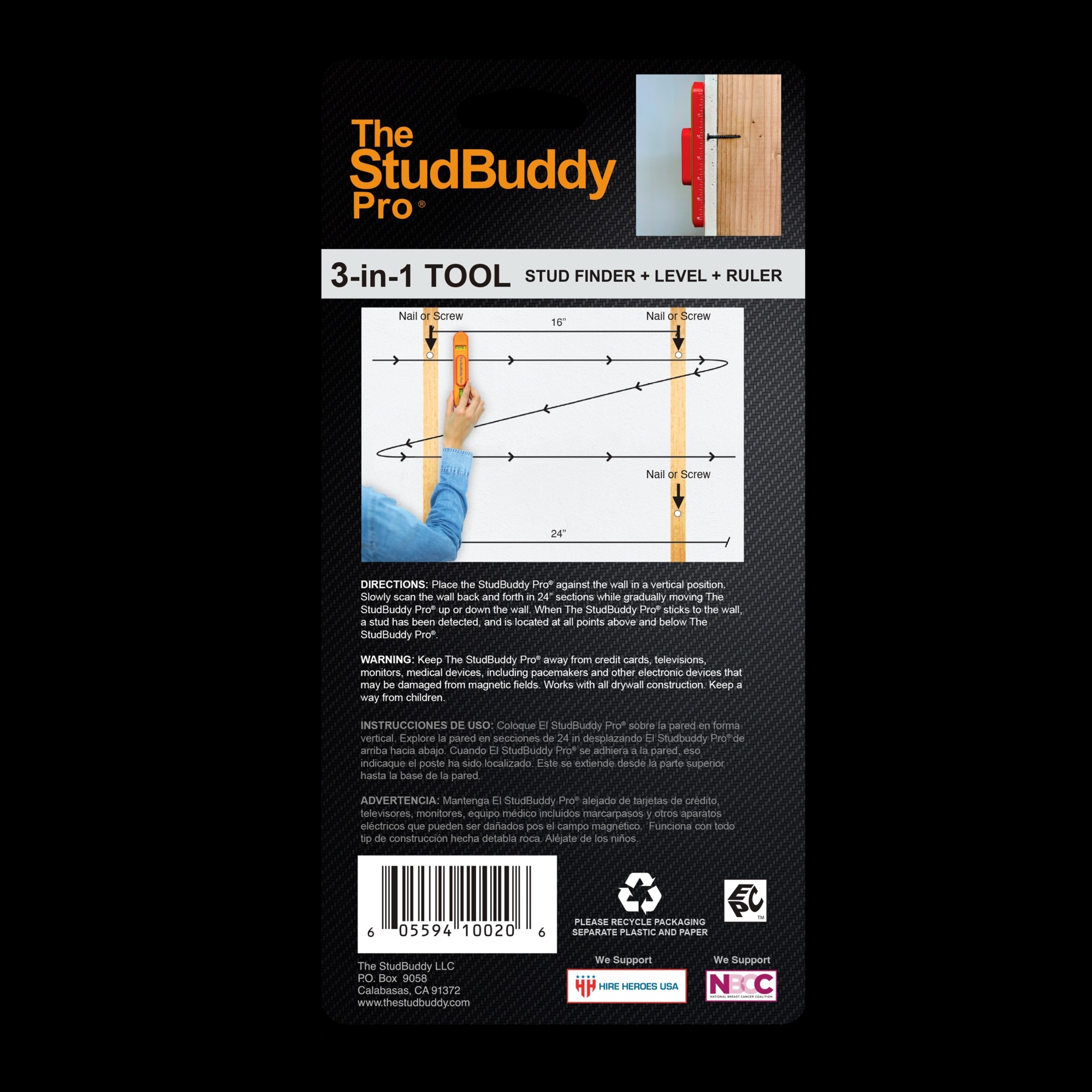
The reviewed Pro package depicts a vertical scan through a series of back-and-forth passes over roughly 24-inch wall sections, moving up or down as the search continues. That is an operating illustration, not a stated detection depth. The exact maker pages and package image reviewed here provide no numeric sensing-depth figure, so the Pro cannot satisfy a request for a documented minimum depth. Its scan-section illustration should not be re-labelled as a range specification.
The exact package also carries a magnetic-field caution covering credit cards, televisions, monitors, medical devices including pacemakers, and other electronics, and it says to keep the tool away from children. Check the package that arrives and follow its current warnings. A magnetic finder does not detect live wiring. No live-wire meter is documented in the exact evidence reviewed, and a warning meter—when another tool has one—would still not make a wall safe to drill.
Surface limits remain important
The maker describes the Pro for drywall, but the reviewed exact-model materials do not establish use through lath and plaster, tile, exterior materials or metal mesh. Do not transfer a capability from a broad product-family description, a different StudBuddy, or a seller’s category label. If a wall is not ordinary dry interior drywall, read the exact current package instructions and choose a model with an explicit supported procedure for that surface.
On drywall, the sensible role is to locate a likely fastening point, preserve it with a mark, and check the surrounding pattern against the hardware layout. One magnetic catch does not reveal the stud’s width or prove that every point above and below it is unobstructed. If a project needs two mounting points at a fixed spacing, use the Pro’s ruler as a layout aid only after you have independently established the likely stud locations.
How it differs from the original and Spot
Choose the original 000107 when the simplest magnetic cue is all you need and you already have separate layout tools. The Pro’s main documented advantage is combining that cue with levels, scales and a more controlled glide surface. Choose the Spot for a different signal mix: its maker describes an audible click at the detected location and a detachable Stud-Line for marking several points, but gives no numeric depth or measured magnet strength. These are distinct functional variants, not merely color or package changes.
A digital finder is the stronger category comparison if you specifically require stud-edge or center indications, a numeric depth capability, or a documented live-wire meter. The Pro may support an orderly layout, but it should not be described as an electronic alternative with those features. Nor do the built-in levels establish that the tool is more accurate at finding a stud; they address line orientation, not sensing.
Verify the 000109 name and exact pack
The official U.S. shop lists a standalone Pro and a separate Pro 6 Pack. Northern Tool cross-references the four-feature finder as model 000109, while its listing path/title uses “Plus” and the package image says Pro. That naming difference is a reason to verify the exact product label, UPC and package contents before ordering, not to assume every seller uses Pro and Plus interchangeably. The manufacturer’s six-pack page repeats the Pro feature set, so the larger package is a quantity variant rather than an additional sensing model.
In short, the Pro is a reasonable research-based match when a drywall fastener cue and built-in marking/leveling aids are useful together. It remains a magnetic point finder with important unknowns around depth and difficult surfaces. This assessment relies on manufacturer pages and an exact model package image; no hands-on use or performance testing is claimed.
Key specifications
Key details at a glance
| Depth qualification | The official Pro page, six-pack page and exact reviewed package image state no numerical detection depth. The 24-inch search segment pictured in package directions is not a depth figure. |
|---|---|
| Documented scan modes | ['Manual magnetic search for likely drywall fastener points'] |
| Center and edge indication | No |
| Built-in bubble level | Yes |
| Battery requirement | None; magnetic operation |
| Built-in ruler | Yes |
Use the exact model’s instructions for operating limits, supplied equipment and version differences.
Sources for this review
Sources for this assessment
Check this model against your wall
Use the finder to compare documented surface limits, center/edge indications and other requirements. A match is not a safety certification.