
Your needs, this model
Does it fit your priorities?
Is model 000107 documented for lath-and-plaster walls?
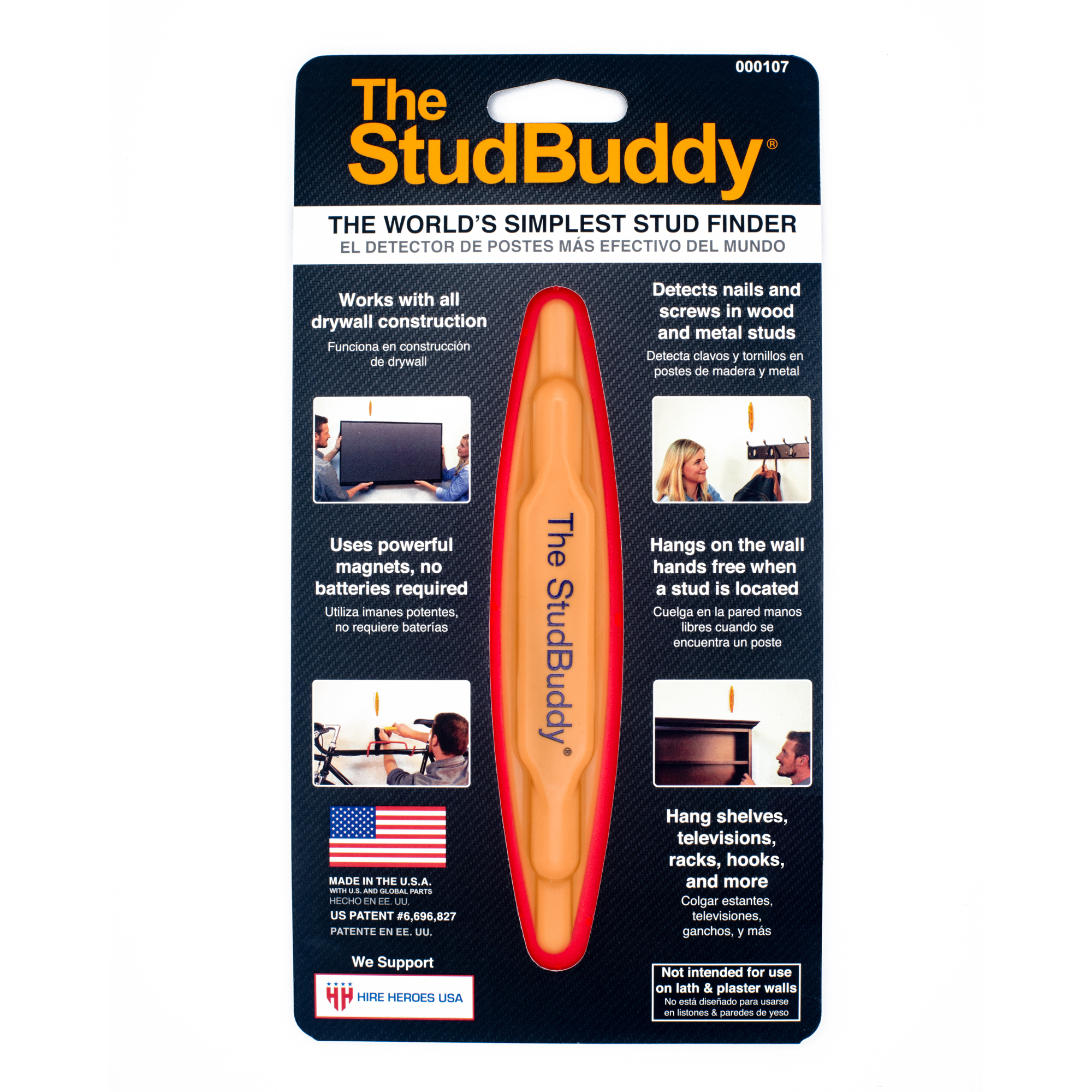
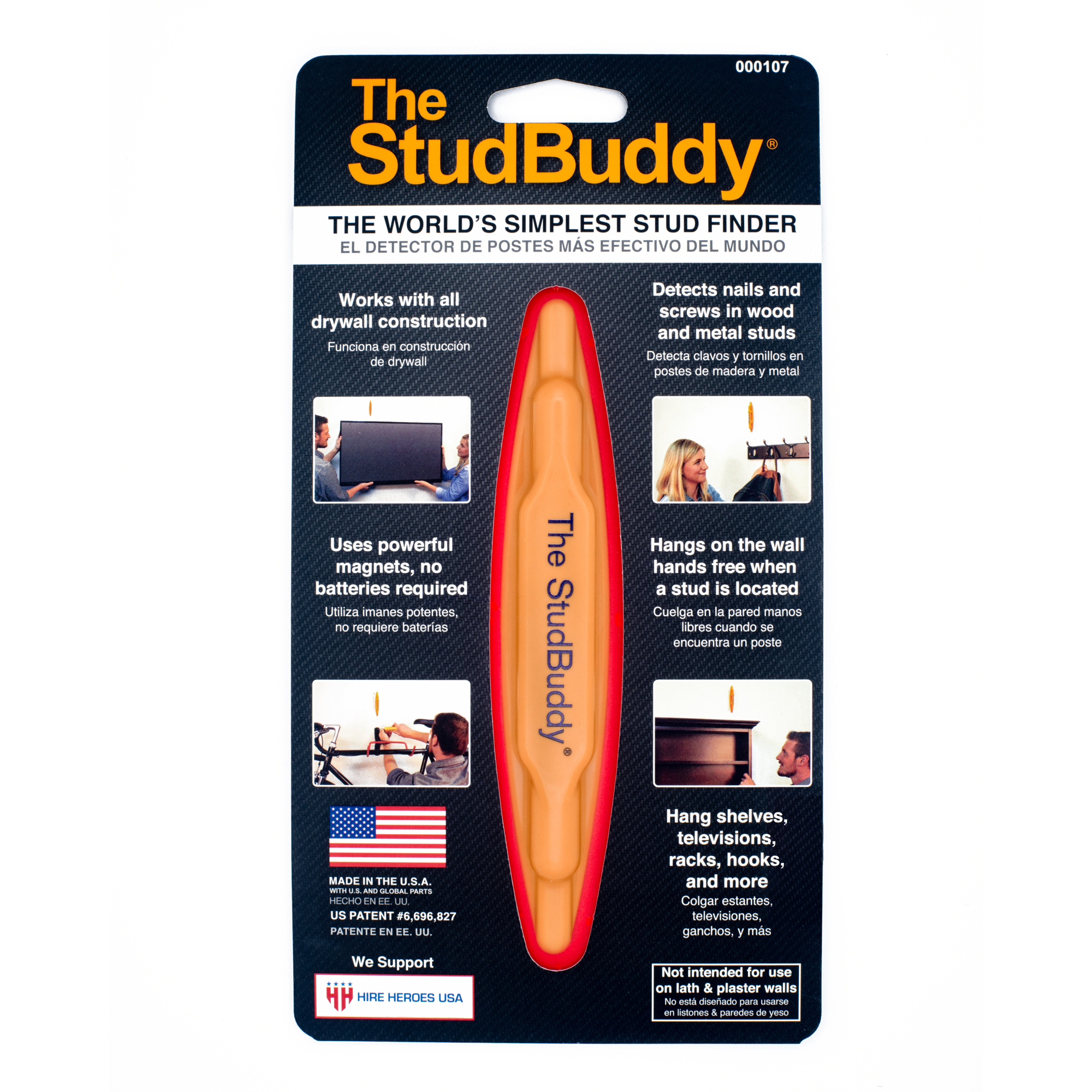
No. The exact model package says it is not intended for lath-and-plaster walls. Its drywall claim should not be stretched to older plaster construction.
Explore this need in the finder →Will the original StudBuddy show both stud edges and a center?
No electronic edge or center indications are documented. The maker describes a magnetic response to a screw or nail; use a finder with documented boundary indicators if that distinction is essential.
Explore this need in the finder →Does model 000107 have a stated minimum detection depth?
No numeric depth appears in the reviewed exact-model sources, so it cannot satisfy a numeric minimum-depth request here.
Explore this need in the finder →The StudBuddy 000107 makes sense only if its simple magnetic method matches the wall and task. It does not electronically map wood density or report a stud’s full boundaries. The maker describes a neodymium magnet that catches a screw or nail associated with drywall fastening; the tool then stays at that point as a visible reference. That can reduce the amount of interpretation a shopper has to do, but a fastener point is still not a complete stud survey.
What the original actually finds
The key shopping distinction is between detecting the stud itself and locating metal used to attach the drywall to framing. Model 000107 follows the latter route. When its magnet responds, the useful information is that a ferrous target is near the tool. The target may help locate framing if it is one of the relevant drywall fasteners, but the device does not tell you which material produced the attraction or draw the stud’s left and right edges.
That mechanism is the reason this model has no batteries or electronic calibration sequence to manage. It is also the reason a numeric depth claim should not be assumed: the exact first-party page and the 000107 package materials reviewed here publish no sensing-depth limit. Marketplace copy can describe an offer in many ways; for a depth-sensitive task, use only an exact-model specification that the maker supports.
A drywall tool with a clear surface boundary
The manufacturer describes the finder for drywall construction. More specifically, the package image cross-checked for model 000107 says it is not intended for lath-and-plaster walls. That restriction matters: a general claim about drywall does not automatically cover older plaster assemblies, metal lath, tile, exterior walls or a wall with reinforcement. None of those difficult surfaces has a documented operating plan for this model, so they should not be treated as supported uses.
The same limitation applies to electrical questions. A magnet that reacts to a likely fastener is not a wire detector. The reviewed exact-model information does not document a live-wire meter, and even a separate warning meter would not prove that a drilling location is safe. Use appropriate utility checks and safe work practices before putting a fastener into a wall.
How to use the fastener cue thoughtfully
The maker describes sliding the tool over drywall until it responds to the screw or nail that holds the panel. Treat that as the start of a confirmation process, not its conclusion. A single catch gives one candidate point; it does not prove the full width of the stud, identify the framing material, or validate the planned screw location. Follow the exact directions supplied with the package, check more than one plausible point where the wall allows it, and keep the mark tied to the actual mounting geometry.
For a project with multiple attachment points, the tool’s ability to stay at a catch can leave a hand free while you mark or compare locations. But the 000107 package does not add a bubble level, ruler, removable marker or center indicator. If you need a level line, a measured offset, or a dedicated way to preserve multiple marks, bring a separate layout aid or consider a different model whose added features are documented.
Where it sits beside other magnetic finders
The StudBuddy Pro is the closest sibling in the current maker catalogue, but it is not just a different package: the Pro adds plumb and horizontal bubble levels, inch/centimeter rulers, a soft grip and felt pads. Those additions help with laying out a mount after a likely fastener is found; they do not turn the Pro into an electronic edge scanner. The distinct Spot instead adds an audible click and detachable Stud-Line, while its maker calls the magnet larger. The Spot’s published details remain qualitative and do not establish a depth advantage.
Other magnetic products in this guide, such as the C.H. Hanson 3040 and Calculated Industries StudMark 7310, also use a fastener-point approach but have different documented layout features and package contents. Compare those exact distinctions rather than assuming all magnets have identical instructions, surface limits or included accessories. A digital detector is a more appropriate comparison when the job specifically calls for electronic edge or center indications, a numerical depth threshold, or a documented wire-warning feature.
Check the exact package, not just the family name
The maker lists the original as a standalone unit and in 2-, 6- and 12-piece packs. Those package counts are separate catalogue rows, even though the finder function is the same. Confirm that an offer is for model 000107 and the intended count; do not mistake a Pro, Spot or protective cover for the original finder. A current manufacturer card is not a promise that a particular seller has stock, includes the same packaging, or offers the same return terms.
Overall, the 000107 is a narrowly useful choice for someone who wants a no-battery magnetic clue on dry drywall and is comfortable confirming the likely fastener line independently. Its simplicity is not a substitute for depth data, edge/center mapping, difficult-surface instructions or electrical safety information. This is a source-based assessment, not a hands-on test.
Key specifications
Key details at a glance
| Depth qualification | The official product page and reviewed package materials do not state a numeric detection depth. Do not borrow a retailer category label or a different StudBuddy model's figure. |
|---|---|
| Documented scan modes | ['Manual magnetic search for likely drywall fastener points'] |
| Center and edge indication | No |
| Built-in bubble level | No |
| Battery requirement | None; magnetic operation |
| Built-in ruler | No |
Use the exact model’s instructions for operating limits, supplied equipment and version differences.
Sources for this review
Sources for this assessment
Check this model against your wall
Use the finder to compare documented surface limits, center/edge indications and other requirements. A match is not a safety certification.