
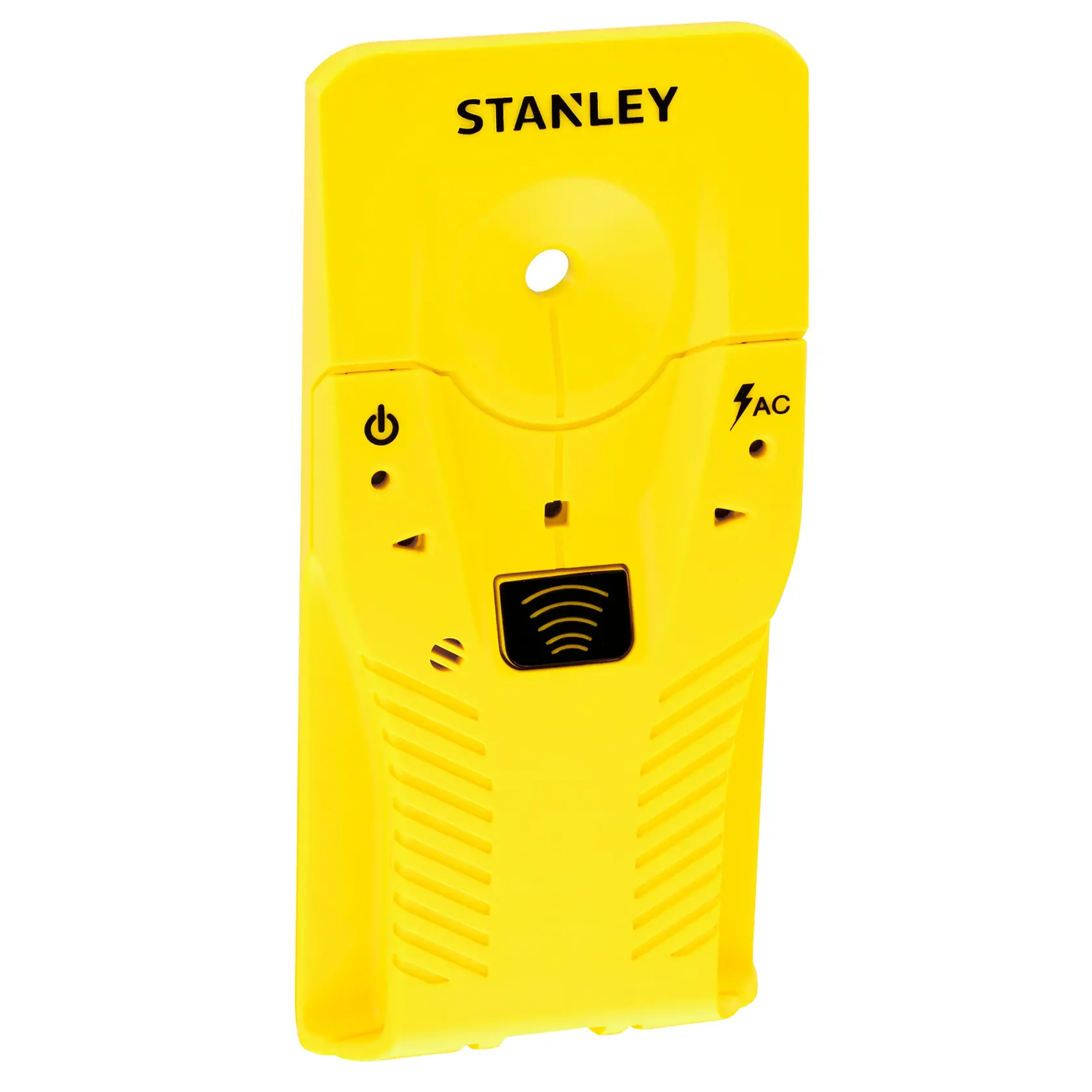
Your needs, this model
Does it fit your priorities?
What mark does STHT77587 provide on drywall?
The shared North American manual describes a single-pass center LED and tone for wood or metal studs. It does not document separate stud-edge indications, so the model should not be selected for an edge requirement.
Explore this need in the finder →How deep is the 77587 wood/metal plan rated?
The detailed table gives 3/4 inch for both wood and metal. That clears a 0.7-inch comparison value but fails at 0.8; the table’s stated tolerance and wall-condition warnings still apply.
Explore this need in the finder →Can its AC alert or material list justify a tile-wall drilling decision?
No. The manual excludes ceramic tile, plaster, concrete, metalized surfaces and other listed materials, and warns that AC detection can miss shielded or conduit wiring. The live-wire indicator is not a voltmeter or a safety clearance.
Explore this need in the finder →Research note: The STANLEY North American instruction manual identifies the STHT77587 and STHT77588 as separate models. Its indexed manual text was inspected, but the official PDF’s preserved local fetch is a 404 HTML response, not a PDF file; no local manual bytes or exact product image are claimed. The manual has internal wording anomalies noted below. This is a source-based review, not a hands-on test or claim of stock, ownership, measured results or retail package contents.
A one-pass center finder with a separate AC cue
The manual describes STHT77587 as an electronic tool that finds the center of wood or metal studs through drywall. A center LED and longer tone indicate the stud center in one pass, while a different AC LED and short beeps report nearby live voltage. It does not document stud-edge indications. This is a different choice from the older edge-only STANLEY 77-100, 77-110 or 77-075, where the user marks two edges and estimates the center from the midpoint.
The exact STHT77587 specification table gives a 3/4-inch drywall maximum for both wood and metal studs. That shared ceiling is distinct from the STHT77588, whose manual table gives different numbers by stud material. Do not infer that the two model numbers are interchangeable just because one manual covers both. A 0.7-inch comparison threshold is within the 77587’s stated limit; a 0.8-inch threshold is not. Wall thickness, density, finish and the manufacturer’s required scanning routine remain important.
Calibration, holding position and the surface list
The manual specifies two AAA batteries and automatic calibration. Hold the sensor only by its handle area, set it flat against the wall and press the control while stationary until the startup LEDs settle. Continue holding while moving slowly left or right. The instructions call for a smooth surface and a vertical position parallel to a door or window on the same wall. They list drywall and other common building materials as the operating context, but explicitly exclude concrete, mortar, block, brick, plaster, carpeting, foil-faced material, metallic surfaces and ceramic tile. Plastic or non-ferrous pipes are also outside the intended target scope.
That makes the 77587 a narrow drywall tool, not a universal detector for every wall assembly. The manual does not establish an approved lath-and-plaster plan. If the surface is tiled, heavily textured, metalized or unusually dense, a center indication should not be treated as an exception to the listed exclusions. The same goes for an unexpected reading near a window or door, where framing may be doubled or wider than a typical stud.
AC detection is a warning, not electrical verification
The North American manual specifies 110V at 60Hz and says the AC indicator may illuminate through drywall up to 2 inches from the wire. It describes directional cues as the sensor approaches and different audio patterns when AC and stud center coincide. The manual also warns that shielded wires, metal conduit or casing, metalized walls and thick or dense materials may not be detected. It expressly says the tool is not a measuring device or a substitute for a voltmeter and that a separate method should confirm a de-energized condition.
Those cautions make the live-wire feature a secondary alert only. Static charge can widen the apparent detection area by several inches around a wire. The sensor may also signal a stud near a live wire, but that does not make a drilling spot safe. Turn off power when working near wiring and verify independently.
Limits in the evidence and what to check
The manual’s battery-installation section contains a model-number inconsistency: one line names STHT77577, while its title, other use instructions and specification table identify STHT77587/STHT77588. The current assessment follows the repeated exact 77587/77588 identifiers, but this typo is a reason to inspect the label on any offered unit before purchase. It is not evidence for a third model or a battery-included package.
The broad current STANLEY measuring-tools category snapshot did not include the exact code, but it does not close the manufacturer’s historical model universe or prove that a seller has no stock. A buyer should verify STHT77587 on the tool and packaging, confirm two AAA batteries are available, inspect the case and battery compartment, and retrieve the matching manual. The source record does not establish package accessories or availability.
Who should consider this earlier reference
STHT77587 is a candidate when a one-pass center mark and an added live-AC warning are both useful on drywall, and when a 3/4-inch wood-or-metal limit is enough. It is not a fit for an edge requirement, a deeper-wall job or any use that relies on its AC indicator as proof of safety. Compared with the STHT77588, it has the same stated 3/4-inch depth for both stud materials, while the larger-number model has material-specific depth differences. The exact code and the detailed table matter.
Sources: STANLEY STHT77587/STHT77588 North American instruction manual (official indexed manual text inspected; direct local retrieval returned 404); STANLEY U.S. Measuring & Marking category (checked 2026-11-02; broad category only).
Key specifications
Key details at a glance
| Maximum stated stud depth | 0.75 in |
|---|---|
| Depth qualification | The 3/4-inch figure is for both wood and metal, not a deeper mode. It has a live-wire alert but no stud-edge cue; wire detection can miss shielded/conduit wiring and the source manual has a battery-step typo (77577) to verify against the package. |
| Documented scan modes | ['Wood-stud center scan through up to 3/4 in drywall', 'Metal-stud center scan through up to 3/4 in drywall', 'Live-AC proximity alert through drywall'] |
| Center and edge indication | No |
| Live-wire meter | Yes |
| Battery requirement | Two AAA 1.5V batteries (3V DC); package inclusion not established |
Use the exact model’s instructions for operating limits, supplied equipment and version differences.
Sources for this review
Sources for this assessment
Check this model against your wall
Use the finder to compare documented surface limits, center/edge indications and other requirements. A match is not a safety certification.