
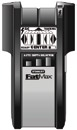
Your needs, this model
Does it fit your priorities?
Does the 77-730 combine stud cues and an AC warning during a drywall scan?
In its stud-scan arrangement, the manual says one pass can show both stud edges and center while an AC proximity warning is active. It also names a separate AC TRACKING mode; that wire-only workflow is not the same as the stud-scan plan.
Explore this need in the finder →What reaches the manual’s 1-1/2-inch depth limit?
The specification gives wood or metal stud detection up to 1-1/2 inches through drywall. The manual pairs that greater depth with a wider center-accuracy figure than its shallow 1/2-inch condition. Treat both as stated limits, not readings guaranteed for your wall.
Explore this need in the finder →Does AC TRACKING prove that a wall is safe to penetrate?
No. The US manual specifies 110V AC and up to 2 inches through drywall, warns about shielded/conduit wiring and dense or metallized walls, and explains that static can widen the apparent detection area. De-energize circuits and verify with an independent method.
Explore this need in the finder →Research note: This assessment uses STANLEY’s official two-page manual for the FatMax Stud Sensor 400, model 77-730. It is a research-based fit analysis, not a hands-on test; no ownership, measured performance, retail package, current stock or customer experience is claimed. The broad current U.S. measuring-tools snapshot does not list this exact code, but it is not a dedicated or exhaustive finder catalogue.
Center and edges in the stud-scan mode
The manual describes a one-pass scan that displays the relative position of a stud and identifies both its edges and center. A tone is heard directly over center, and the housing has a marking notch. STANLEY also says the unit begins at high sensitivity and adjusts after the first detected stud; the instructions recommend sliding past that first response so the sensitivity can self-correct to the wall and stud materials. This is a different arrangement from the edge-only IntelliSensor models, which ask the user to mark twice and calculate a midpoint.
The specified stud depth is up to 1-1/2 inches through drywall for wood or metal studs. The manual provides a different center-accuracy figure at shallow and deeper conditions, so the headline depth should not be read as equal accuracy at every wall thickness. Surface moisture, density and construction still affect sensing. The device’s screen shows a relative signal, not a confirmed stud identity or a map of every object behind the surface.
One model, two different AC workflows
During the stud scan, the manual says a live-wire warning is always active. For the U.S. model, it specifies detection of 110-volt AC wiring up to 2 inches through drywall and describes the warning as a proximity cue, typically over a range several inches from the wire. The red LED and AC icon supplement the stud display. The source also describes a separate AC TRACKING mode, activated with a double click and held button, which scans for a live AC wire without providing the stud-center and edge display.
Those modes should not be blended in a fit claim. The 1-1/2-inch stud limit belongs to the stud-scan procedure; the 2-inch limit belongs to the AC warning. The AC TRACKING screen is not an alternate deep stud scan. The manual warns that shielded wires, metal conduit or casings, metallized surfaces and thick or dense walls may prevent detection. Static charge on drywall can spread the apparent voltage-detection area. Turn power off near wiring and verify independently before making a penetration; this sensor is not a voltmeter or a safe-to-drill certification.
Calibration, the first pass and surface conditions
Use a 9-volt battery; the manual does not establish package inclusion for a specific listing. Hold the tool flat with firm contact and keep the activation button pressed. Wait for the word “Ready” and the tone to stop before scanning. Do not calibrate over a stud, dense metal, wet or freshly painted area. If the display flashes all segments, the instructions say to move and try again. Scan slowly in a straight line and keep holding the activation control; releasing it switches the tool off.
For stud sensitivity, the source instructs the user to pass the first detected stud so the device can adjust. That is a setup step, not a test result. The manual discusses wallpaper and fabric when they contain no metallic foil or fibers, and recommends a cardboard spacer for rough ceilings with calibration through the same spacer. It does not establish a specific lath-and-plaster or exterior wall plan. Avoid assuming that “other common building materials” means tile, mesh or any thick wall is supported.
Practical tradeoffs versus related STANLEY models
Among the reviewed older STANLEY electronic finders, 77-730 has the broadest documented combination of direct center and edge cues, a 1-1/2-inch wood/metal stud maximum and a live-AC warning. The IntelliSensor Plus 77-115 reaches the same stated stud depth through selectable modes but uses edge marking to estimate center and has no documented wire meter. The 77-100, 77-110 and 77-075 are shallower edge models with 3/4-inch limits. This comparison is based on their model-specific manuals, not on laboratory performance or a claim that one unit is more accurate in a given wall.
Recall status changes the buying decision
The U.S. Consumer Product Safety Commission’s 2009 recall notice names the FatMax Stud Sensor 400, model 77-730. It says affected units have a date code inside the battery cover that does not begin with the letter R; the reported hazard is failure to calibrate properly and detect AC wiring. The notice directs owners to contact STANLEY to determine whether a specific unit is included and obtain the remedy. The model-only record here cannot establish a particular unit’s date code, so the finder excludes the generic 77-730 identity from purchase matches. This is not a claim that every unit is recalled, or that an R-coded unit has been checked or cleared.
Anyone who already owns one should inspect the date code and contact STANLEY about the exact unit before relying on it; never treat the 77-730’s wire warning as permission to drill. See the CPSC recall 09-185 for the model and date-code details.
Where the manual-defined design remains useful
This earlier review remains a technical reference for the documented drywall workflow: one-pass center-and-edge indication plus a separate limited live-AC cue. The user must hold the control through calibration and scanning, confirm the exact model, and treat the wire alert as an additional signal rather than a safety check. If the job depends on detecting wiring behind metal conduit or a thick/metalized wall, the manual expressly warns against relying on this signal alone. Because this model record does not encode the exact unit’s date code, this site does not recommend purchasing it; the full assessment is retained to explain its operating modes and the recall limitation.
Sources: STANLEY FatMax Stud Sensor 400 / 77-730 official instructions; STANLEY U.S. Measuring & Marking category (checked 2026-11-02; not a complete finder inventory); U.S. CPSC recall 09-185 (the exact unit’s date code determines applicability).
Key specifications
Key details at a glance
| Maximum stated stud depth | 1.5 in |
|---|---|
| Depth qualification | At depths above 1/2 inch the manual lists wider center accuracy, and results remain dependent on wall material. The AC warning can miss hazardous wiring and does not replace a meter, power shutoff or independent verification. |
| Documented scan modes | ['One-pass wood/metal stud center-and-edge scan with live-wire warning', 'AC TRACKING mode for a live-AC wire only; no stud indication in this separate mode'] |
| Center and edge indication | Yes |
| Live-wire meter | Yes |
| Battery requirement | One 9V battery; retail package inclusion not established |
Use the exact model’s instructions for operating limits, supplied equipment and version differences.
Sources for this review
Sources for this assessment
Check this model against your wall
Use the finder to compare documented surface limits, center/edge indications and other requirements. A match is not a safety certification.