
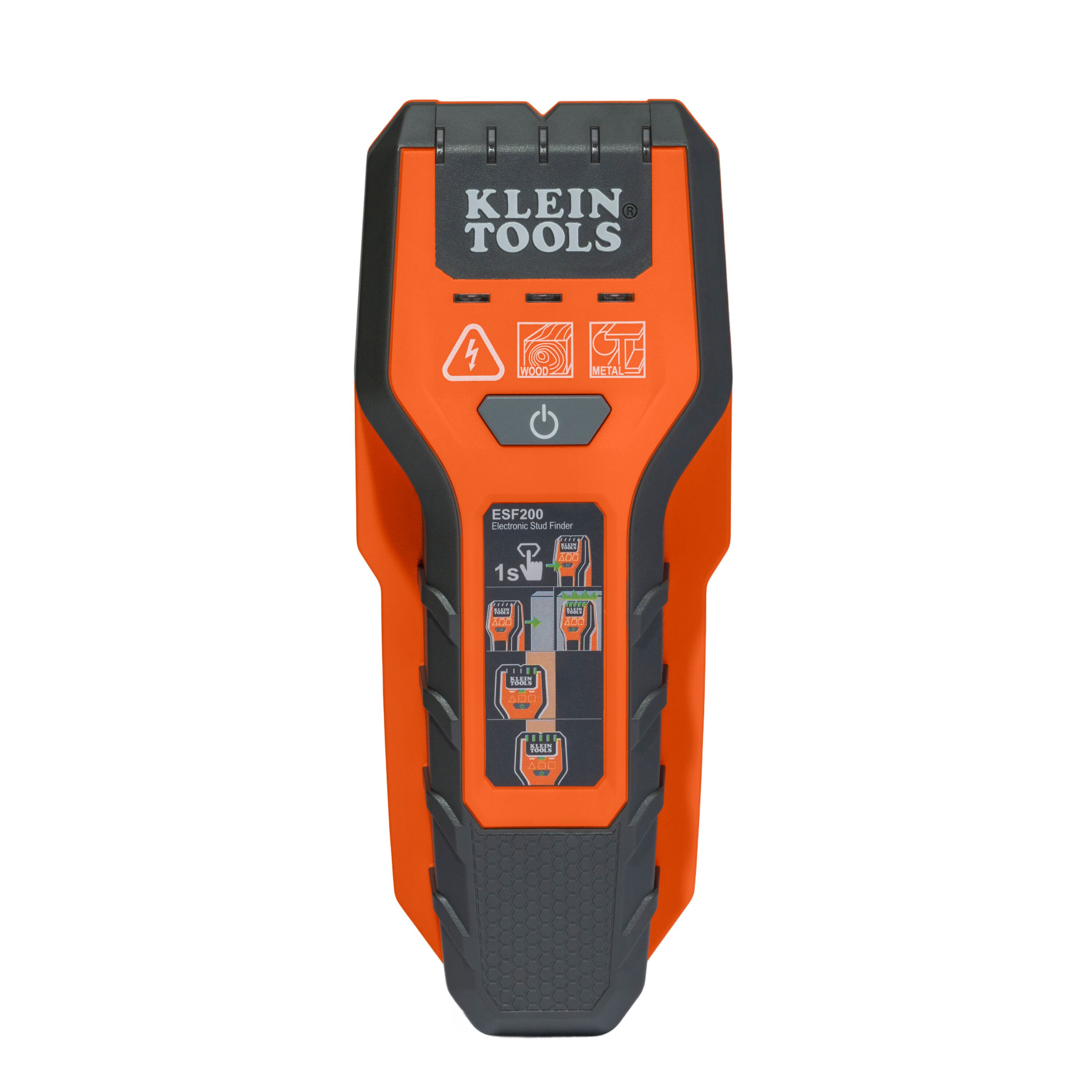
Your needs, this model
Does it fit your priorities?
Does the ESF200 show both stud edges and the center?
Yes. The five location LEDs begin lighting at a stud edge, and all five illuminate at the center. The center notch can help mark the response, but follow the manual's repeat-scan procedure and do not infer that every response is a stud.
Explore this need in the finder →How should I interpret its live-AC warning?
It is a separate warning cue for live, unshielded AC, not a locator or proof of safety. The manual says it may appear up to 16 inches from the wire and may fail in several conditions, including unenergized wiring, conduit, metal covering or moisture. Turn off power before penetrating the wall.
Explore this need in the finder →Does its 2-inch AC range mean it finds wood studs that deep?
No. The ESF200 page distinguishes 3/4 inch for wood, 1.5 inches for ferrous metal, and 2 inches for AC voltage. The stud finder matcher uses the wood-stud ceiling, so 0.7 inches matches but 0.8 inches does not.
Explore this need in the finder →Klein Tools' ESF200 combines stud location with separate material and live-AC indicators. Its key shopping distinction is easy to blur: the manufacturer lists wood studs to 3/4 inch, ferrous metal to 1.5 inches, and AC voltage to 2 inches. For a stud-depth comparison, only the wood figure belongs in the finder. This document-based review covers the U.S. ESF200 and its current instructions; it does not describe personal use or test performance.
One scan, several different cues
The ESF200 does not require a mode change between its advertised wood, metal and live-wire functions. The five stud-location LEDs indicate the detected object's edges and center; the unit has separate indicators for wood, metal and live, unshielded AC. Klein's manual says the wire indicator can illuminate at the same time as the wood or metal indicator—for example, when an energized wire follows a stud. This is more informative than treating every LED pattern as the same signal, but it still does not identify every hidden object or give a precise safe drilling point.
The basic routine is to place the sensor plate flat against the wall, let the device auto-calibrate, then scan steadily. If it starts directly over a stud, the manual says the location LEDs may not illuminate; move along the wall until a response appears and scan back to confirm. For the AC warning, the instructions advise marking where the indicator begins and ends. They also caution that the warning may appear up to 16 inches from the wire's actual position, so the alert is not a conductor locator. Known electrical switches can be turned on during a scan to energize circuits, but the manual directs users to turn them off before drilling.
Separate the wood-stud number from the other limits
The ESF200's wood-stud ceiling is 3/4 inch (19 mm). Its larger ferrous-metal and AC numbers answer different detection questions. They do not make it a 1.5- or 2-inch wood-stud finder. Under this site's numeric threshold, it matches 0.7 inch and falls short of 0.8 inch for stud depth. A buyer who needs a deeper stated stud range should compare the ESF100 or ESF150LL, which Klein lists to 1.5 inches for wood and metal studs. If 3/4 inch is adequate but a dedicated live-AC cue is wanted, the ESF200's additional indicator is the differentiating feature.
For maximum accuracy, Klein recommends clean, dry, single- or double-layer drywall, without gaps between framing and board. The manual lists moisture, foil-backed insulation, metal materials, conductive wallpaper and strong electromagnetic fields among factors that can affect accuracy. It also says the live-wire function can fail when wires are unenergized, more than 2 inches behind the scanned wall, in conduit, behind plywood shear walls or metallic coverings, or when moisture is present. A positive cue is only a warning; a missing cue is not proof that no wire is present.
Included power and the case for a cautious workflow
Klein lists two AAA batteries in the package and specifies a roughly 30-hour runtime, approximately 10-minute inactivity shutoff and 6.5-foot drop protection. The housing is about 6.75 inches long, and the device weighs about 4.9 ounces including batteries. A mute switch is available beneath the battery cover; muting the buzzer does not remove the visual alerts.
On a wall with nearby services, the all-in-one capability can invite overconfidence. The ESF200 is not insulated, and its instructions warn that electronic finders may miss objects or respond to unintended ones. Use drawings, opposite-side inspection and other independent information where available; shut off utilities before piercing the wall. Do not use the AC indicator as a clearance test.
Who should compare it
Compare the ESF200 if simultaneous center/edge feedback and a separate live-AC warning are desirable for a dry drywall scan, and if the modest 3/4-inch wood-stud limit fits the job. The simpler ESF050 also provides edge-and-center cues with an auto-calibrating interface but does not offer the documented live-AC indicator. The ESF100 and ESF150LL list a deeper 1.5-inch stud ceiling; the ESF150LL adds cross-line lasers rather than an electrical warning. These are feature comparisons based on manufacturer documentation, not side-by-side tests.
If a task requires deeper wood detection, plaster support or reliable wire clearance, the ESF200's multi-indicator layout does not resolve those constraints. Read the exact manual, identify the actual wall construction and keep the safety plan separate from the stud-finding plan.
Sources and verification
This assessment uses Klein Tools' ESF200 U.S. product page and its ESF200 instructions, document 1391077 Rev 08/26 C. The exact-model image is the manufacturer's ESF200 product image.
Key specifications
Key details at a glance
| Indicator lights | 5 |
|---|---|
| Maximum stated stud depth | 0.75 in |
| Depth qualification | Klein lists 3/4 inch (19 mm) for wood studs, 1.5 inches for ferrous metal and 2 inches for live AC. The latter figures concern other targets and do not increase the wood-stud depth. |
| Documented scan modes | ['Automatic wood/metal/live-AC scan'] |
| Center and edge indication | Yes |
| Live-wire meter | Yes |
| Built-in bubble level | No |
| Battery requirement | Two AAA alkaline batteries; included. |
| Built-in ruler | No |
Use the exact model’s instructions for operating limits, supplied equipment and version differences.
Sources for this review
Sources for this assessment

Check this model against your wall
Use the finder to compare documented surface limits, center/edge indications and other requirements. A match is not a safety certification.