
Your needs, this model
Does it fit your priorities?
What does the ESF150LL add over the ESF100?
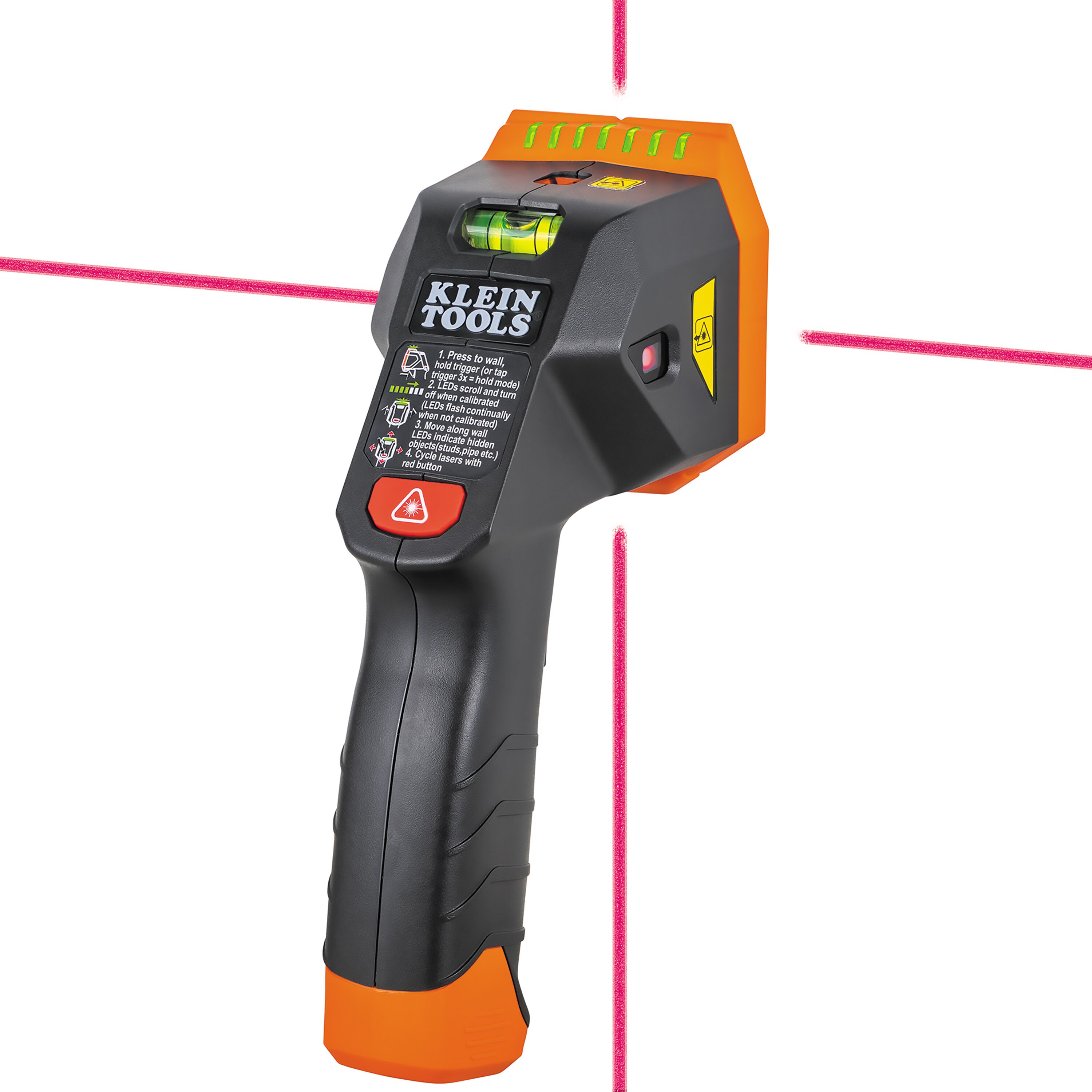
Both list a 1.5-inch stud ceiling, seven green LEDs, center/edge markers and a bubble vial. The ESF150LL adds switchable vertical and horizontal Class 3R lasers; it is a layout aid, not a deeper scan or live-wire detector.
Explore this need in the finder →Can I run both cross-line lasers while scanning?
The manual says the red vertical and horizontal lines can be selected independently or together. Their function is to transfer alignment marks; they are not part of the stud-detection signal. Follow the laser safety instructions and power them off after use.
Explore this need in the finder →Does it have a live-wire warning or deeper stud range?
No dedicated live-wire meter is listed, and its wood/metal stud ceiling remains 1.5 inches. The laser option adds marking capability rather than depth or electrical classification.
Explore this need in the finder →The Klein Tools ESF150LL pairs an electronic stud scan with a built-in horizontal and vertical cross-line laser. Klein lists wood and metal stud detection up to 1.5 inches (38 mm), a seven-green-LED display, edge and center markers, a bubble vial, and the two laser lines. Its added layout capability is the meaningful distinction from the ESF100; it does not increase the stated stud depth or add a live-wire meter. This is a manual-and-product-page assessment, not a hands-on test.
Stud detection and line projection are separate jobs
The ESF150LL uses its sensor plate and LEDs to indicate a density response, with notches for marking center and edges. The lasers project a separate red horizontal line, vertical line, or both, selected by cycling the laser control. Klein's product page describes projection up to 15 feet in all directions. These lines can help transfer a layout mark, but they do not participate in the stud scan and do not validate what the sensor detected.
The instructions describe Normal and Hold calibration routines. Keep the sensor plate flat against the wall while calibrating; Hold mode is a trigger-lock option for continuous scanning and must be activated each time the finder is powered on. During scanning, avoid touching around the sensor plate because the manual says that can affect the indicator LEDs. Once the desired location is confirmed, the laser switch cycles from vertical to horizontal to both, and a long press switches the lasers off. The lines automatically time out after five minutes of inactivity.
A real laser safety tradeoff
The manual identifies the red source as Class 3R, at or below 5 mW, with a 650 ± 10 nm wavelength. It warns against staring into the beam, using optics to view it, removing warning labels, or placing the instrument where someone could inadvertently look into a beam. Klein says untrained people or those who have not read and understood the instructions should not use it. Set the instrument securely in a tidy area, keep the lines out of eyes, and turn them off after use. These are not boilerplate details to ignore: a cross-line feature adds a safety procedure the ESF100 does not have.
The manufacturer also states up to 30 hours of stud-finding-only runtime but up to eight hours with all lasers on. The stated dimensions are about 7.63 by 4.5 by 2.75 inches, and the page lists a weight of about 16 ounces. For a buyer who needs only a center/edge cue and bubble vial, the ESF100 is a narrower, laser-free comparison at the same 1.5-inch published stud ceiling.
Depth and wall conditions
Klein specifies up to 1.5 inches (38 mm) for wood and metal studs. That is a comparison ceiling rather than an expected reading through every finish. The manual says to use the unit indoors and cautions that moisture, nearby strong magnetic or electromagnetic fields, metal building materials, foil-backed insulation and conductive wallpaper can affect accuracy. It also warns that a finder may detect wiring or pipes in the same way as a stud, and the product page lists no voltage or live-wire function.
For a dry-wall scan, calibrate with the sensor plate flat, move steadily, mark both edges when possible, and repeat in a second location. Interpret the projected cross-line only as a layout aid after the sensing response is checked. If an electrical cue is required, the ESF200 is a different candidate because it documents a live-AC warning; its wood-stud ceiling is only 3/4 inch, and its wire warning is not a safety clearance. If depth above 1.5 inches is essential, none of the ESF150LL's lasers changes that limit.
Who should compare the ESF150LL
The ESF150LL is most relevant when a buyer wants the ESF100-style center/edge interface, bubble vial and 1.5-inch stated stud ceiling plus a way to project a reference line from the tool. Someone who only needs edge/center indications may prefer to compare the ESF100 without the Class 3R laser precautions. Someone whose priority is live-wire warning should compare the ESF200, while keeping its distinct and shallower wood figure in view. These are documented capability comparisons, not performance rankings.
No LED arrangement or laser line proves that a location is suitable for an anchor. The manual warns that hidden objects can be missed or misread. Consult other information and shut off utilities before penetrating the wall; use a qualified installer if the consequences of a mistake are significant.
Sources and verification
This assessment uses Klein Tools' ESF150LL U.S. product page and its ESF150LL instructions, document 1390776 Rev 06/24 A. The exact-model image is the manufacturer's ESF150LL product image.
Key specifications
Key details at a glance
| Indicator lights | 7 |
|---|---|
| Maximum stated stud depth | 1.5 in |
| Depth qualification | The ESF150LL instructions state up to 1.5 inches (38 mm) for wood and metal studs. Laser lines assist layout, not stud depth or object identification. |
| Documented scan modes | ['Normal scan', 'Hold scan', 'Vertical laser', 'Horizontal laser', 'Cross-line lasers'] |
| Center and edge indication | Yes |
| Live-wire meter | No |
| Built-in bubble level | Yes |
| Battery requirement | Two AA alkaline batteries; included. |
| Built-in ruler | No |
Use the exact model’s instructions for operating limits, supplied equipment and version differences.
Sources for this review
Sources for this assessment

Check this model against your wall
Use the finder to compare documented surface limits, center/edge indications and other requirements. A match is not a safety certification.