
Your needs, this model
Does it fit your priorities?
What marking aids are built into the ESF100?
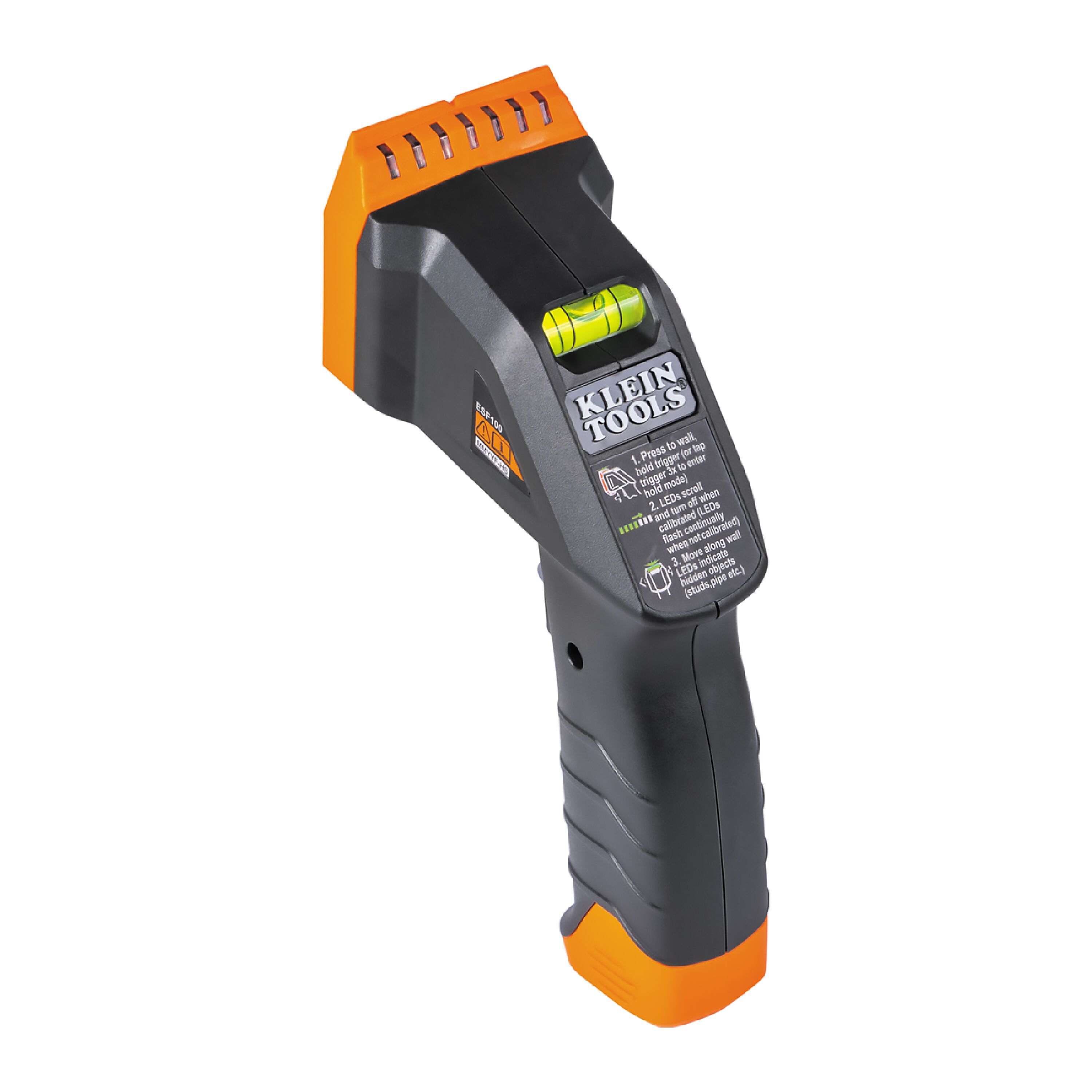
It has seven green LEDs for full-width and center indication, top and bottom center/edge V-notch markers, and an integrated bubble vial. The bubble helps with level marks but does not verify the stud response.
Explore this need in the finder →Can I use Hold mode without calibrating?
No. The manual says calibrate before each use; Hold mode is a trigger-lock mode for continuous scanning after calibration. It is not a sensitivity or depth setting.
Explore this need in the finder →Does it warn about live wires?
No dedicated live-wire indicator is documented for the ESF100. Wiring may create a response like a stud, so the reading does not identify it or guarantee clearance. Use separate safety checks and shut off utilities before penetrating the wall.
Explore this need in the finder →The Klein Tools ESF100 is a trigger-operated electronic stud finder with a stated depth up to 1.5 inches (38 mm) for wood and metal studs. Its most distinctive practical combination is a seven-LED full-width display, a bubble vial, and separate center and edge marking notches. Klein also sells the ESF150LL, which shares the 1.5-inch stated ceiling but adds cross-line lasers. This is a source-based assessment of the ESF100, not a product test.
Read the indicator and the marker separately
The product page describes green LEDs that span the stud width and mark the center; the manual identifies seven green LEDs, center and edge V-notch markers, and an integrated bubble vial. The lights help bracket the detected response, while the notches provide places to transfer a mark. The vial helps level that mark; none of these features confirms that the hidden response is a stud rather than a pipe or another density change.
Klein's instructions require calibration before each use. In Normal mode, hold the sensor plate flat to the surface and use the trigger sequence until calibration succeeds. Hold mode functions as a trigger lock for continuous scanning without keeping the trigger depressed; the instructions specify a separate trigger sequence to enter it, and it must be activated each time the tool is powered on. That is a workflow distinction, not an extra depth mode. Keep the sensor plate and surrounding area clear while scanning, move at a steady pace, and verify a second framing location before relying on the first.
What the 1.5-inch figure does and does not mean
The ESF100's maker-stated limit is up to 1.5 inches (38 mm) for wood and metal studs. That figure is useful for comparing this model with the ESF050 and ESF200, each of which has a 3/4-inch wood-stud limit. It remains a maximum: the instructions say moisture, metallic building materials, foil-backed insulation, conductive wallpaper and strong magnetic fields can affect detection. Klein recommends indoor use and a clean, dry surface. A scan through thicker or more complex wall construction may not reproduce the published ceiling.
The ESF100 does not list a dedicated live-wire meter. Its manual warns that electrical wiring and pipes may be detected in the same way as studs. That means the tool should not be treated as a voltage tester or a safety clearance device. If electrical work is involved, verify the circuit and shut off services before penetrating a wall.
Power and package details
Klein's U.S. listing identifies the ESF100 and specifies two included AA alkaline batteries. It lists a 6.6-foot drop rating, a roughly 30-hour runtime, an approximately three-second shutoff after the trigger is released, and a body about 7 by 4.5 by 2.25 inches. These details may help someone plan ordinary storage and battery replacement, but package codes and seller offers can differ, so confirm the exact ESF100 model and contents before ordering.
The bubble vial is a modest convenience for a picture or shelf mark; it does not act as a laser or produce a long projected level line. The ESF150LL is the model to compare if a built-in horizontal or vertical reference line would help transfer a mark across the wall. Its added Class 3R laser requires the safety precautions in its own manual. If automatic calibration is more important than the deeper published range, compare the ESF050; if a live-AC alert matters, the ESF200 adds one but retains a shallower 3/4-inch wood-stud ceiling.
Use its setup limits as part of the decision
The ESF100's two scan patterns can be convenient after the calibration sequence is understood, but buyers should not mistake a center cue, green LEDs or a bubble level for object identification. The device is designed to suggest hidden inconsistencies, and the manual cautions that objects may be missed or unintended objects detected. Start away from known studs where possible, scan across the suspected edge, repeat in the opposite direction, and compare the pattern with construction information. For a heavy load or a location near utilities, use further checks or a qualified installer rather than increasing confidence from one consumer tool.
Sources and verification
This assessment uses Klein Tools' ESF100 U.S. product page and its ESF100 instructions, document 1390775 Rev 06/24 A. The exact-model image is the manufacturer's ESF100 product image.
Key specifications
Key details at a glance
| Indicator lights | 7 |
|---|---|
| Maximum stated stud depth | 1.5 in |
| Depth qualification | Klein and the manual state up to 1.5 inches (38 mm) for wood and metal studs. The maximum is an upper bound, not a guaranteed scan result. |
| Documented scan modes | ['Normal scan', 'Hold scan'] |
| Center and edge indication | Yes |
| Live-wire meter | No |
| Built-in bubble level | Yes |
| Battery requirement | Two AA alkaline batteries; included. |
| Built-in ruler | No |
Use the exact model’s instructions for operating limits, supplied equipment and version differences.
Sources for this review
Sources for this assessment

Check this model against your wall
Use the finder to compare documented surface limits, center/edge indications and other requirements. A match is not a safety certification.