
Your needs, this model
Does it fit your priorities?
Can I see both the stud edges and center?
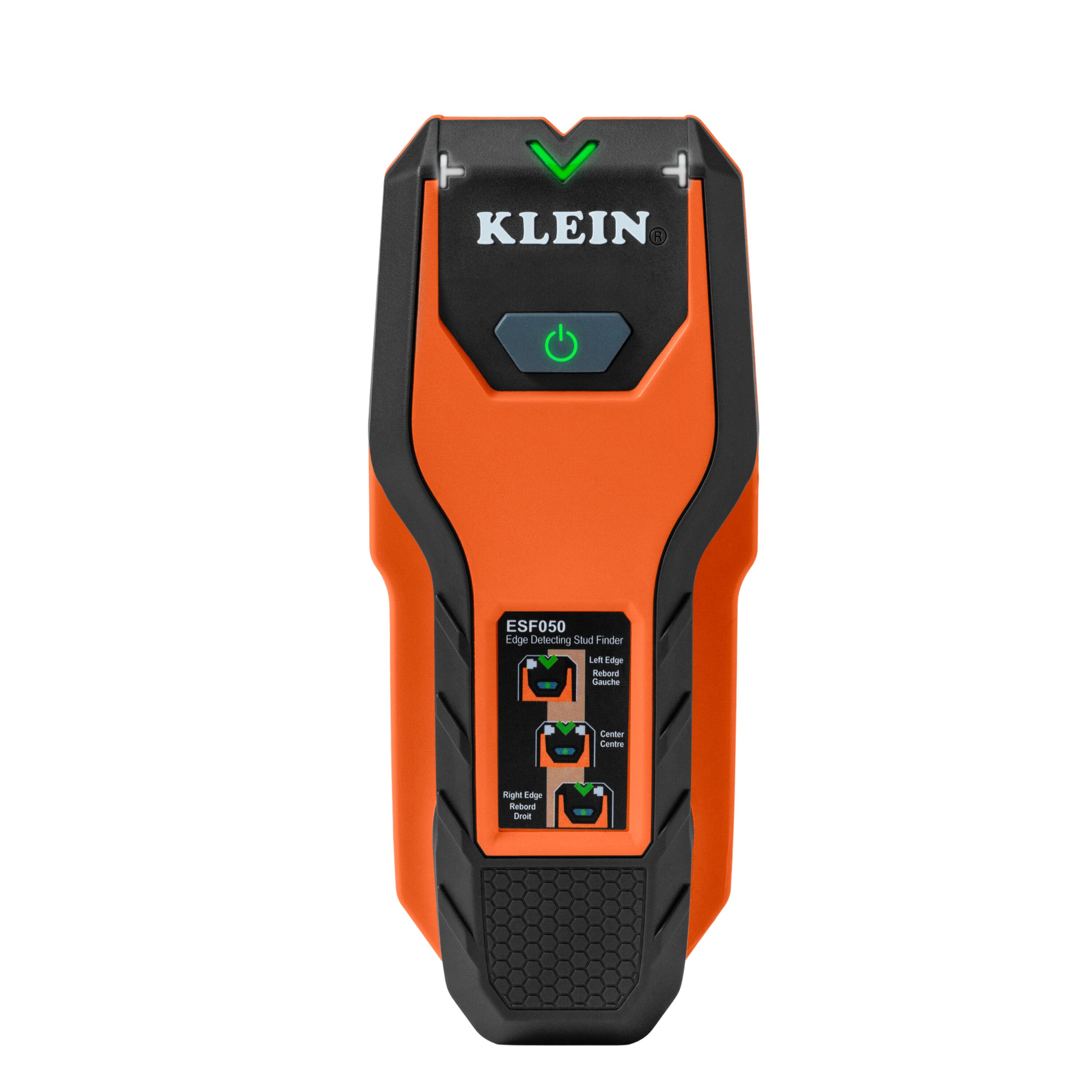
Yes. The ESF050 instructions describe separate left-edge, right-edge and center LED states. Scan across the stud, mark each edge, then verify by locating another stud and returning to the first. These cues indicate a response, not the identity of a hidden object.
Explore this need in the finder →Is the ESF050 a live-wire detector?
No dedicated live-wire meter is documented. Its manual says electrical wiring or pipes may trigger responses like studs, but the ESF050 does not classify them or establish that a wall is clear. Shut off services before penetrating a wall and use independent information.
Explore this need in the finder →What is its stated stud-depth limit?
Klein states up to 3/4 inch (19 mm) for wood and metal studs. That clears the finder's 0.7-inch comparison setting but not 0.8 inch, and actual results depend on the wall and careful contact.
Explore this need in the finder →The Klein Tools ESF050 is best understood as a compact, self-calibrating edge-and-center finder for a limited, clearly stated depth range. Klein specifies detection of wood and metal studs up to 3/4 inch (19 mm) deep. That is a useful model boundary, not a promise that the tool will read every stud through every finish. This is a document-based assessment of the exact ESF050, not a hands-on test.
What the three indicator states are for
The ESF050 uses separate left-edge, center-notch and right-edge LEDs. The manual says the relevant pair of indicators lights as the V-notch crosses an edge; all three illuminate when the notch is centered. That makes the interface more specific than a single beep or a signal-strength bar, but the displayed pattern still reports a change behind the surface rather than identifying an object with certainty. Pipes, wiring or other hidden features may produce a response that resembles a stud.
For a layout task, the instructions recommend marking the first detected edge, moving to the opposite side to identify the other edge, and checking a second stud before returning to the first. They also warn that the indicators may not illuminate if the finder is placed directly above a stud at the start. Instead, put the sensor plate flat against the surface away from a known location when possible, scan steadily, and move back across the first response. This is an operating sequence from the manual, not a claim that a reading was personally tested.
The depth ceiling is the deciding tradeoff
Klein lists the ESF050 for wood and metal studs to 3/4 inch (19 mm). It is therefore a candidate for a 0.7-inch screening threshold, but it does not meet the next 0.8-inch step in this site's numeric finder. If the wall assembly or finish is thicker than the model's stated range, the three-light display does not compensate for the shortfall. For a higher documented ceiling, compare the ESF100 or ESF150LL, both of which list wood/metal stud detection to 1.5 inches (38 mm). The ESF200 keeps the 3/4-inch wood figure while adding a separate live-AC warning; its 1.5-inch metal and 2-inch AC figures are not wood-stud ratings.
The ESF050's narrowness may be an advantage if the buyer wants a simple interface and does not need a level or cross-line layout feature. It does not include a bubble vial, and the manufacturer documents no live-wire meter. The manual says wiring and pipes can be detected in the same manner as studs; that warning is not equivalent to voltage classification.
Wall conditions still matter
Klein's instructions recommend clean, dry, single-layer drywall for maximum accuracy, with no gap between the studs and drywall. Moisture, metallic building materials, foil-backed insulation, conductive wallpaper and strong magnetic or electromagnetic fields can affect accuracy. The manual does not establish the ESF050 for lath and plaster, tile, exterior cladding or metal-mesh construction, so those should not be inferred from its broad “metal and wood” label. If the specific wall is outside the stated conditions, keep that as an unanswered compatibility question.
At first use, install the two included AAA batteries with the marked polarity. The unit powers on with a one-second press and automatically calibrates when placed against the wall; Klein lists about 30 hours of runtime, a default shutoff after about ten idle minutes, and 6.5-foot drop protection. The small body measures about 5.7 by 2.41 by 1.1 inches. Its protective felt pads are functional: the manual says not to remove them because the detector will not operate properly without them.
Who should compare it
Consider the ESF050 when both center and edge cues matter, the wall is a clean, dry single layer of drywall, and 3/4 inch is adequate as a published comparison point. If a deeper stated wood-stud limit matters more than the compact edge-to-edge display, the ESF100 has a 1.5-inch ceiling and a bubble vial but requires its own calibration routine. If a documented live-AC warning is the priority, the ESF200 is the relevant Klein comparison, with important limits on what that warning can detect and a separate 3/4-inch wood depth.
No consumer stud finder alone can establish that a drilling point is safe. The ESF050 instructions explicitly caution that hidden objects may be missed or misread and direct users to use other information before penetrating a wall. Turn off utilities before drilling and verify important locations with independent evidence.
Sources and verification
This assessment uses Klein Tools' ESF050 U.S. product page and its ESF050 operating instructions, document 1391112 Rev 03/26 B. The exact-model image is the manufacturer's ESF050 product image.
Key specifications
Key details at a glance
| Indicator lights | 3 |
|---|---|
| Maximum stated stud depth | 0.75 in |
| Depth qualification | Klein lists wood and metal stud detection to 3/4 inch (19 mm). This is a maker-stated ceiling for the stud finder, not a guaranteed result in every wall. |
| Documented scan modes | ['Automatic electronic stud scan'] |
| Center and edge indication | Yes |
| Live-wire meter | No |
| Built-in bubble level | No |
| Battery requirement | Two AAA alkaline batteries; included. |
| Built-in ruler | No |
Use the exact model’s instructions for operating limits, supplied equipment and version differences.
Sources for this review
Sources for this assessment

Check this model against your wall
Use the finder to compare documented surface limits, center/edge indications and other requirements. A match is not a safety certification.