
Your needs, this model
Does it fit your priorities?
Does the T6 show both stud center and edges?
Yes. The shared T6/T62/T9 manual says its LEDs track center and edges simultaneously. It also warns that the LEDs react to density variation, so repeat an irregular signal and do not treat it as proof of wood.
Explore this need in the finder →Can the T6 scan lath and plaster?
The shared instructions name the T6 for conditional scans up to 1.5 inches, but irregular plaster thickness, construction variation and metal mesh can defeat detection. That is not a guarantee for every wall.
Explore this need in the finder →Does the T6 need calibration before a scan?
No startup calibration is required according to its T6/T62/T9 instructions. The user should keep a finger on the on button and hold the instrument by its handle throughout the scan.
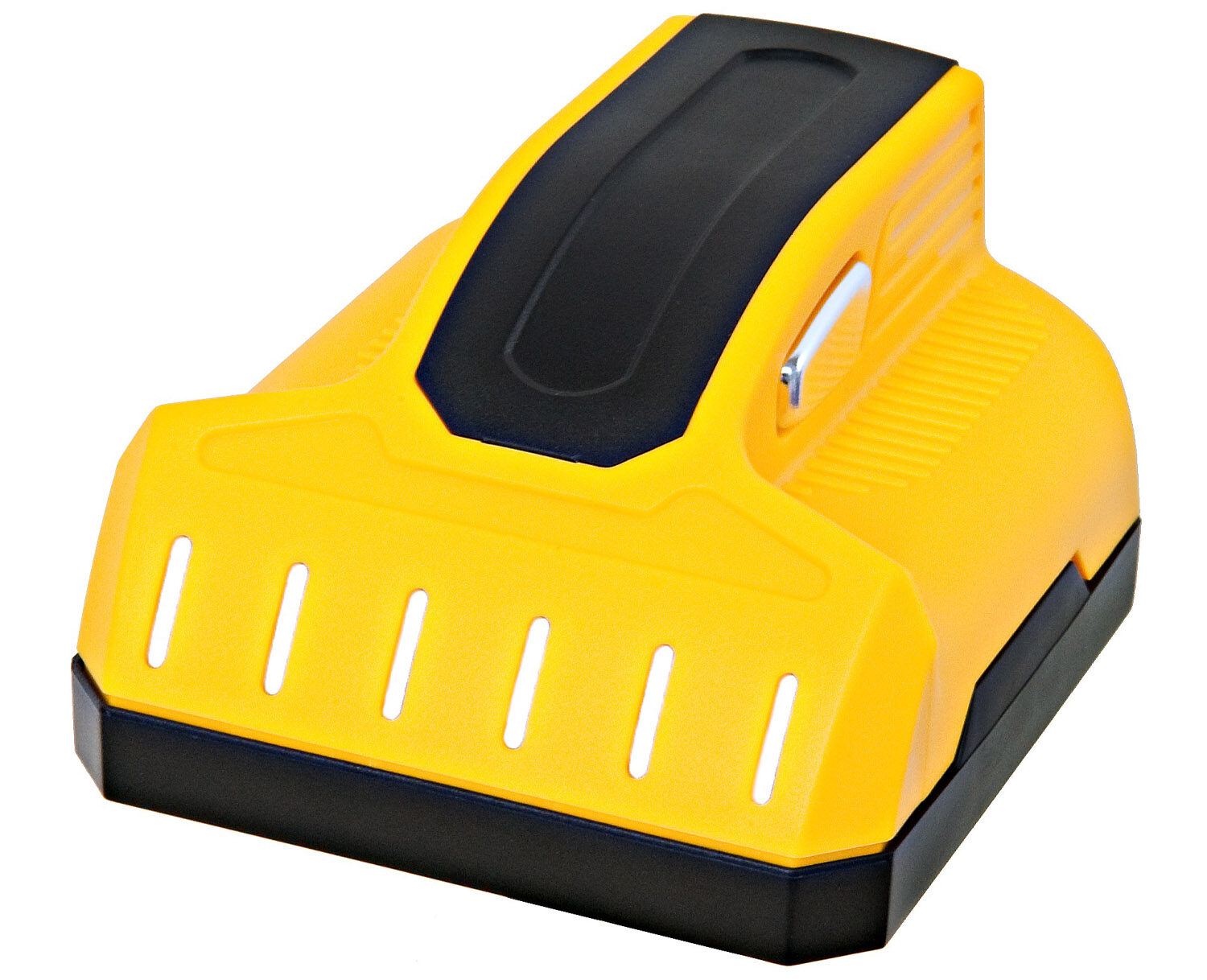
Explore this need in the finder →The Franklin Sensors ProSensor T6 is a six-sensor, six-light electronic stud finder. Its product page calls out a 1.5-inch detection depth and a display intended to show single-stud width. The shared T6/T62/T9 instructions provide a distinct operating picture: the LEDs track center and edges simultaneously, the on button is held throughout the scan, and no calibration is required. The T6 is a real wall-finding candidate, but its documentation does not make the signal an object identifier or a safety check. This is a source-based assessment rather than a hands-on test.
Six lights for a single-width pattern
The official T6 page's single-stud-width description is more specific than simply saying that the finder has a row of lights. The manual says the lights track the center and edges of a stud at the same time. That combination can help with locating a span and marking a candidate, but the signal is still based on changes in wall density. An uneven patch, pipe or wire near the surface may also illuminate the lights. The instructions recommend continuing to scan vertically while holding the button so a persistent response can be distinguished from a small irregularity.The family manual says that a center LED turns green in certain models, but its sentence does not identify the T6 as one of them. The reviewed T6 page likewise does not make that model-specific color claim. This assessment therefore treats the T6's center-and-edge arrangement as supported and its green-center status as unknown. That is a more useful comparison than borrowing a color feature from the T9, T62 or another nearby model.
Startup is simple, but the button stays held
The T6 instructions say that the unit can be pressed on or off the wall and that no calibration is needed. The operator should hold the finder by its handle, avoid touching the sensor area and keep a finger on the button for the entire scan. It uses two AAA 1.5-volt alkaline batteries; the manual says not to use rechargeables or mix old and new cells or chemistries. The maker's page and instructions do not establish whether batteries are included in a particular seller's package.For an uncertain signal, make another pass rather than treating an isolated flash as a stud boundary. The manual's warning is important: the device can detect variation without identifying whether it is framing, a pipe, a wire or a change in wall material. No result from the T6 alone certifies a location as safe to drill.
Drywall is the ordinary case; plaster is conditional
The manufacturer's instructions frame clean, dry interior wall use as the ordinary routine. They also say that the T6 can see up to 1.5 inches through most lath-and-plaster walls. “Most” matters: the manual warns that thickness irregularities and construction variations beyond that depth are not guaranteed to be detected, and metal mesh may prevent detection. The 1.5-inch product-page maximum should be treated as a comparison ceiling, not a promise that a tool will see through every wall with that thickness.The same instructions warn that wet paint or wallpaper should be allowed to dry, foil-backed insulation can cause inconsistent results, and metallic-content wallpaper can block the detector. Tile, flooring, roofing and exterior applications are not recommended. A plaster user should read the complete limit for the exact assembly rather than converting a conditional note into blanket compatibility.
Where the T9 differs
The T9 is a separate model, not a T6 bundle: its official page lists eight sensors, nine lights, a center-and-edge finder and a pencil caddy. The T6 page instead describes six sensing points, six LEDs and a single-stud-width display. Both share the no-calibration, held-button instructions. Their depth wording also needs care: the T6 page and manual both give 1.5 inches, while the T9 page gives 1.5 inches generally and its manual separately states up to 1.6 inches through most lath-and-plaster walls. The higher T9 number is conditional and does not imply a universal accuracy improvement.When to consider it
The T6 is a reasonable source-supported option for a dry interior wall when simultaneous center and edge information, a single-width presentation and a 1.5-inch stated maximum suit the job. It is less suitable if you need an explicit green center marker, a live-wire meter, a deeper stated ceiling or a maker-backed tile/exterior mode. The exact sources reviewed here do not document a meter. Before drilling, turn off utilities and corroborate the likely framing with another source of information. Also confirm the T6 suffix, seller's package, battery inclusion and return terms: none of those retail details follows from a product photograph or the family manual.Key specifications
Key details at a glance
| Sensing points | 6 |
|---|---|
| Indicator lights | 6 |
| Maximum stated stud depth | 1.5 in |
| Depth qualification | The official T6 page states a 1.5-inch maximum; the shared T6/T62/T9 manual repeats that limit for T6 and gives a conditional lath-and-plaster qualification. |
| Center and edge indication | Yes |
| Live-wire meter | No |
| Battery requirement | 2 AAA 1.5 V alkaline cells; do not use rechargeable cells or mix chemistries |
Use the exact model’s instructions for operating limits, supplied equipment and version differences.
Sources for this review
Sources for this assessment
Check this model against your wall
Use the finder to compare documented surface limits, center/edge indications and other requirements. A match is not a safety certification.