
Your needs, this model
Does it fit your priorities?
Does the M50 have a live-wire meter?
No dedicated meter is documented. The exact page and manual call out a live-electrical warning symbol; the manual says it may illuminate for live wiring near studs after repeated passes. A warning can miss wiring and never clears a drilling location.
Explore this need in the finder →What do the M50's five lights tell me?
Franklin lists five sensors and five LEDs, but the exact M50 page and linked instructions do not describe a center/edge light pattern. Do not treat the count alone as a confirmed center or edge signal; compare the model-specific documentation and use repeat scans to investigate a density change.
Explore this need in the finder →Is the M50 a dependable lath-and-plaster choice?
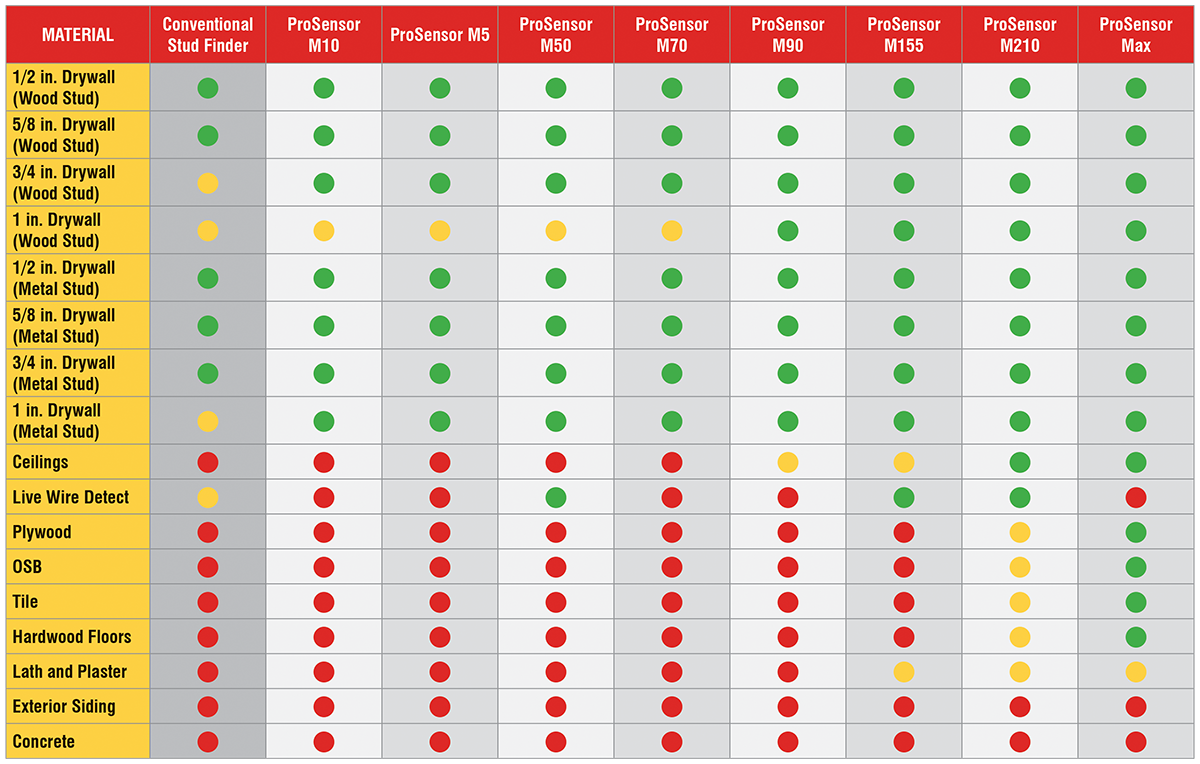
Its 05/25 manual says it may see through most lath-and-plaster walls up to 1.5 inches, with thickness and mesh cautions. A current Franklin M-Series chart colors the M50 plaster cell red but has no visible legend. Because the official sources conflict, plaster is not treated as a supported match in this assessment.
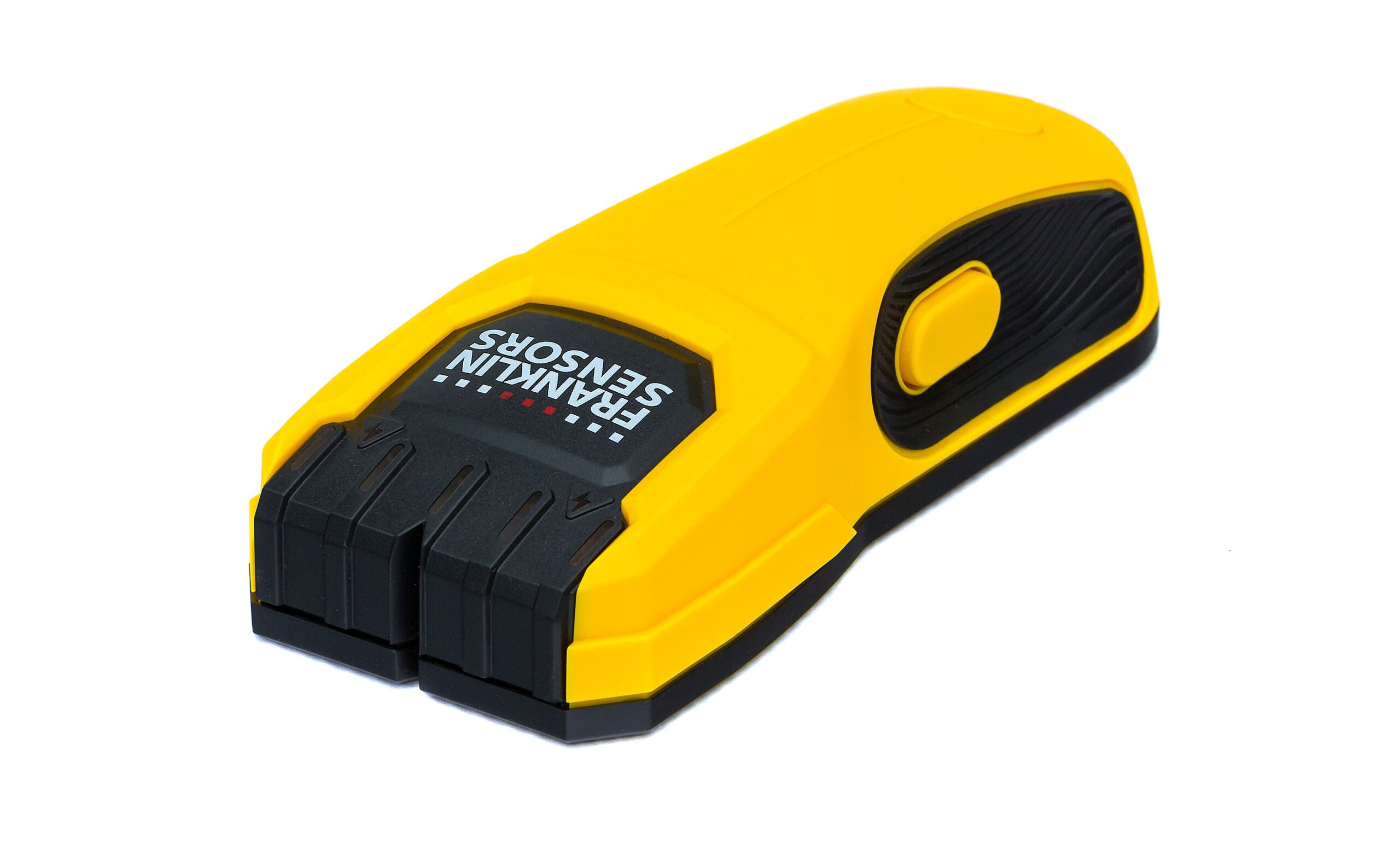
Explore this need in the finder →The Franklin Sensors ProSensor M50 is a five-sensor, five-LED electronic stud finder with a stated maximum depth of 1.5 inches. Its model page also lists a Live Electrical Warning. Those details make it different from the shorter-depth M5 and M10, but none of the published numbers proves that the tool will find a particular object in an unknown wall. This review is a documentary assessment of the exact U.S. M50 model page and its linked 05/25 operating and safety instructions, not a hands-on test.
What the five lights establish—and what they do not
Franklin lists five sensing positions, five LEDs and a 1.5-inch detection-depth maximum. It describes the device as reporting density changes behind a surface. A signal can therefore come from a stud, pipe, wire, other object or variation in the surface; the finder does not identify the material it senses. The M50 instructions call for holding the handle and keeping the button depressed while scanning. They say a start-up calibration is not required and describe the lights as showing a hidden-object location. Unlike the M5 manual, however, the reviewed M50 material does not explain its five-light display as a center-and-edge pattern. Counting LEDs is not enough to claim that a particular pattern marks either stud edge, so the matcher leaves those indications unassigned for this model.Setup is simple, but the scan still needs interpretation
The manual's sequence is to hold the handle, press and keep holding the button, then make a slow pass. It allows the button to be pressed on or off the wall. Clean and dry contact matters; following a major temperature change, the sensing board should be allowed to adjust to room conditions. If a reading is uncertain, repeating the same area and scanning vertically can help distinguish a sustained feature from a short irregular signal. The maker also says that the M50 uses Active Learning and that continuing to hold the button while scanning may improve its readings. That is manufacturer guidance, not independent evidence of a measured accuracy advantage. One practical limitation is that no consumer stud-finder signal should be read as an object label. A line of illuminated LEDs may be consistent with a stud, but a pipe or wire can produce a density change too. Use plans, visible pipe entries, outlet locations, stud-spacing patterns and other appropriate evidence. When a wall reading matters, compare multiple clues rather than treating a broader light pattern as certainty.The warning is not a meter or a clearance
The M50 has a separate yellow lightning-bolt electrical warning, but that is not the dedicated live-wire meter required by the finder. The instructions say the warning may illuminate while the button is held, advise slow passes in both directions over the same area and note that the feature is optimized for live wires near studs. It can still miss wiring. The manual specifically warns that a stud finder alone should not be relied on to locate hidden objects. Turn off gas, water and electrical power before penetrating a wall, and check the proposed location independently; a warning or the absence of one does not establish safety.Do not let the depth number settle the plaster question
The 1.5-inch figure is useful as a comparison boundary, not a promised reading. The M50 instructions say the finder may see through most lath-and-plaster walls up to that depth, but qualify the claim when plaster thickness or construction varies and warn that metal mesh may block detection. There is an additional unresolved signal in the manufacturer material: the current M-Series comparison graphic shows the M50 cell red in its plaster row, but the graphic we reviewed has no visible legend. Because the exact manual and current chart do not agree clearly, this assessment does not present plaster as a supported M50 match. A buyer with lath and plaster should seek model-specific clarification and treat the actual wall as an open question, not assume the larger maximum resolves it. For ordinary scanning, foil-backed insulation may cause inconsistent readings and metallic wallpaper can block the signal. The manual does not recommend the M50 for tile, flooring, roofing or exterior materials because their density varies. That warning should not be stretched into a claim that the finder handles every textured interior wall; the instructions instead advise finding a consistently flatter area for contact.Where it sits beside the M5 and M10
The M50's clearest distinction in this reviewed Franklin group is its stated 1.5-inch ceiling and separate electrical warning. The ProSensor M5 has five sensors too, but its exact manual maps the LEDs to both stud center and edges, gives a 1.0-inch maximum and says no start-up calibration is needed. The M10 also has a 1.0-inch maximum; its three-light manual describes a center cue and a wall-placement calibration step, not simultaneous edge indication. Thus the M50 is not automatically the better choice: the M5 has a more explicit indicator description, while the M10 gives a precise center marker; the M50 adds a warning symbol that is not a meter. None identifies the sensed object or makes drilling safe. The M50 is a reasonable research candidate when dry interior-wall scanning, its documented warning function and a 1.5-inch published maximum fit the comparison. Check the exact model, required AA cells, surface and seller package before choosing; the reviewed manufacturer sources do not establish what a particular retail offer includes. If precise edge/center cues, a dedicated meter, a deeper-than-1.5-inch threshold or a difficult surface is essential, compare the model that documents that exact capability rather than inferring it from the M50's five-light count.Key specifications
Key details at a glance
| Sensing points | 5 |
|---|---|
| Indicator lights | 5 |
| Maximum stated stud depth | 1.5 in |
| Depth qualification | The exact M50 page states a 1.5-inch maximum. It is a comparison ceiling, not a guarantee for any wall or hidden object. |
| Live-wire meter | No |
| Battery requirement | 2 AA; do not mix old/new cells or battery chemistries |
Use the exact model’s instructions for operating limits, supplied equipment and version differences.
Sources for this review
Sources for this assessment
Check this model against your wall
Use the finder to compare documented surface limits, center/edge indications and other requirements. A match is not a safety certification.