
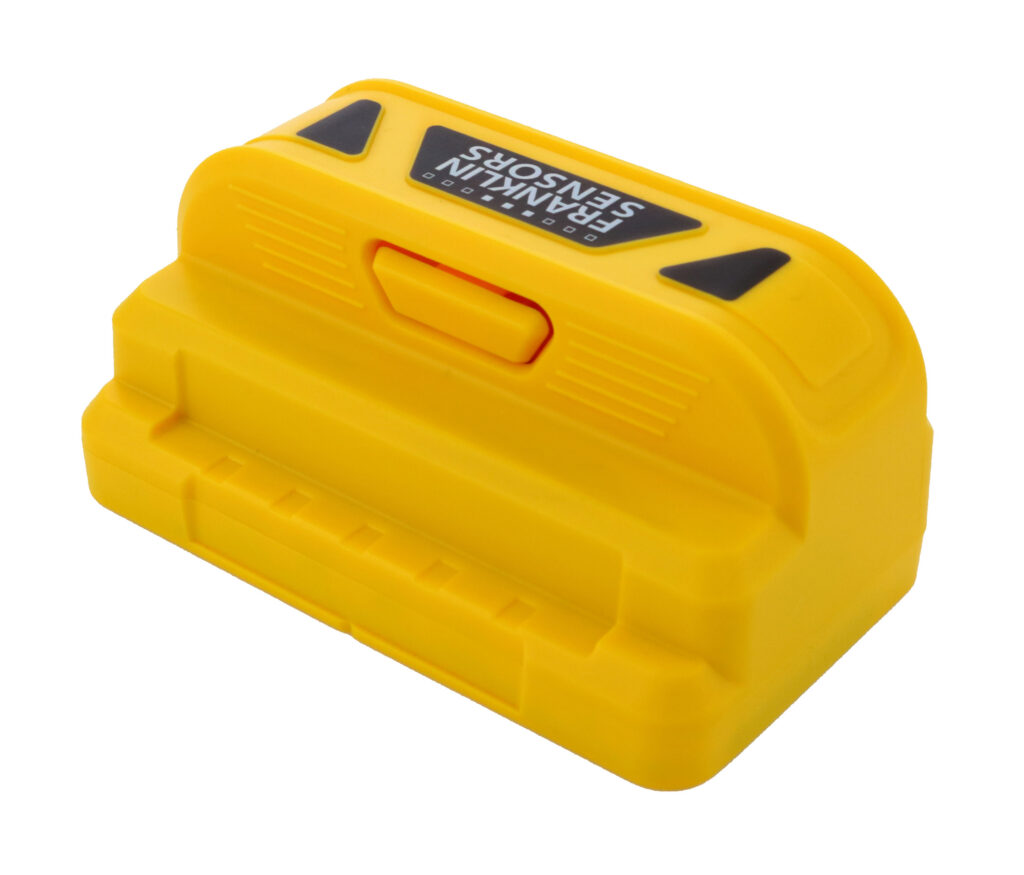
Your needs, this model
Does it fit your priorities?
Can the M5 show both stud edges and center?
Yes. The exact M5 instructions say its LEDs track stud center and edges simultaneously. They still respond to density changes rather than identifying wood, metal, pipes or wires.
Explore this need in the finder →What is the M5's stated maximum depth?
Franklin's exact M5 page lists 1.0 inch. The light pattern and three-inch display do not raise that ceiling, and a published maximum does not guarantee a reading through a particular finish or wall build-up.
Explore this need in the finder →Does the M5 need calibration before scanning?
No startup calibration is required by the M5 manual: press and hold the button, then begin scanning with the button either on or off the wall. Keep your hand on the handle and use repeated passes to investigate inconsistent signals.
Explore this need in the finder →The Franklin Sensors ProSensor M5 is a compact five-sensor finder with five LEDs, a three-inch display width and a stated 1.0-inch maximum detection depth. Its most useful distinction is not the sensor count by itself: the exact M5 instructions say the lights track stud center and edges at the same time. This is an evidence-based assessment of the current U.S. M5 model page and its linked 03/25 operating and safety instructions, not a report of personal testing.
A wide pattern with a modest depth ceiling
Franklin specifies five sensors and five LEDs, and lists the display width as three inches. The manual says the indicators track both the center and edges of a stud, which can help someone compare a broad signal span with the wall's likely framing pattern. But the LEDs still respond to density differences; they cannot tell whether a signal is wood, metal, a pipe, wire or another irregularity. Repeated alignment with likely framing spacing is a useful cross-check, not proof of object identity. The M5's stated maximum is 1.0 inch. Treat that as a boundary for comparing documented claims, not a guarantee at one inch or through a particular finish. A thick, wet, patched or textured surface can change the result. In the Franklin family it is easy to confuse the M5 with the M50 because both pages list five sensors and five lights. The exact M50 page gives a higher 1.5-inch ceiling and a separate live-wire warning; the M5 page's maximum is 1.0 inch and the reviewed M5 instructions do not describe that warning. The added depth/warning should not be borrowed from one model to the other.The M5 does not need a start-up calibration
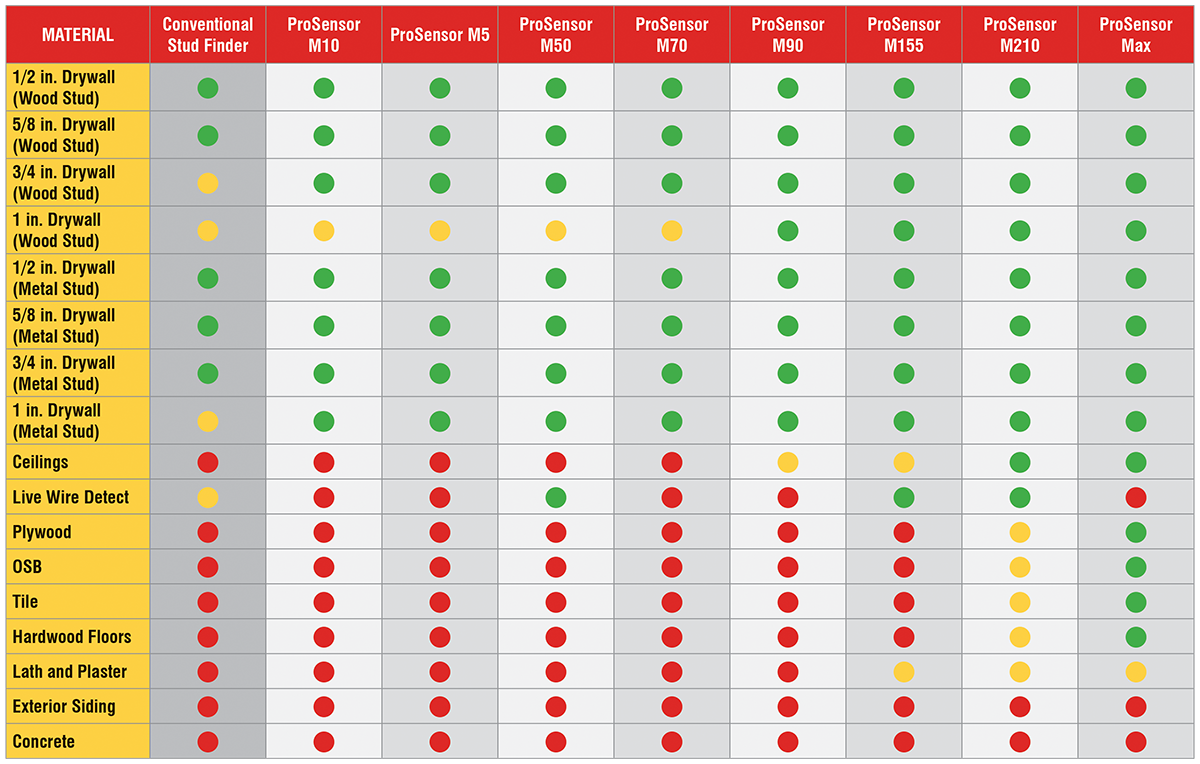
The model-specific manual says the user can press and hold the button on or off the wall and begin scanning without calibration. Keep the hand on the handle rather than the sensing edges, and maintain the button press while making a pass. The maker's troubleshooting advice is to move vertically over a suspected signal: a stud is more likely to produce a consistent indication, whereas a short-lived change may be a surface irregularity. Wires and pipes close to the wall can also activate the LEDs. This is a recommended operating routine, not a test result from this review. Start with a clean, dry finder and wall. The M5 instructions say wet paint or wallpaper can interfere, metallic wallpaper can block the signal and foil-backed insulation may produce inconsistent readings. The exact manual does not establish a lath-and-plaster operating plan, and the current Franklin M-Series comparison image also colors the M5 plaster cell red without an accompanying visible legend. This review therefore keeps lath and plaster out of the supported match plan rather than extending M50 or M10 language to the M5. The same restraint applies to tile, roofing and exterior materials: no positive M5 support is established by the reviewed exact instructions.Its indicator description differs from the M10
The M10 shares a one-inch headline but has a different operating story. The current shared M10/M12 manual names the M10's three sensors and says its signal grows near the stud center, ending in a green center light. It also says to place the finder against the wall before pressing the button to calibrate. The M5 instructions instead describe five lights tracking both center and edges and say no calibration is required. For someone who wants to see a broad edge-to-center pattern, the M5 is the better-documented match; for someone who prefers a green center cue and can follow the specified calibration sequence, the M10 offers that distinct signal. Neither one-inch maximum should be treated as a deeper capability.Safety and package questions remain separate
No dedicated live-wire meter is documented for the M5. Its manual warns that a detected inconsistency may be a stud, wire, pipe or other feature and instructs users to turn off gas, water and power before penetrating a wall. A M5 light pattern is not a safety clearance. Check the proposed hole using additional information and appropriate precautions. The manual requires two AAA batteries and cautions against mixing ages or chemistries; the product page does not establish whether batteries are included in a specific retail package. The same is true of other seller-specific contents. Confirm that the listing is the standalone ProSensor M5 rather than a similarly named Franklin model, then check the included cells and current instructions for the exact unit. Its fit is clearest for ordinary dry interior walls, a one-inch comparison threshold and a preference for documented simultaneous center-and-edge indication. If a deeper reach, live-wire meter, plaster plan or difficult-material guarantee is essential, the M5's reviewed documentation does not establish it.Key specifications
Key details at a glance
| Sensing points | 5 |
|---|---|
| Indicator lights | 5 |
| Maximum stated stud depth | 1 in |
| Depth qualification | The exact M5 page states a 1.0-inch detection depth. This is a comparison maximum, not a promise through every wall or at that depth in a particular installation. |
| Center and edge indication | Yes |
| Live-wire meter | No |
| Battery requirement | 2 AAA; do not mix old/new cells or alkaline, standard and rechargeable chemistries |
Use the exact model’s instructions for operating limits, supplied equipment and version differences.
Sources for this review
Sources for this assessment
Check this model against your wall
Use the finder to compare documented surface limits, center/edge indications and other requirements. A match is not a safety certification.