
Your needs, this model
Does it fit your priorities?
What does the M10S show when it reaches a stud center?
The M10S manual says red LEDs illuminate in sequence as the signal increases and a green LED comes on at the center. It describes a center cue, not simultaneous left and right edge indications or identification of the hidden object.
Explore this need in the finder →Does the M10S need to be calibrated against the wall?
Yes. Its instructions say to place it firmly on the wall, then press and hold the button to calibrate and begin scanning. That sequence is model-specific and differs from the T6/T9 instructions, which say calibration is not required.
Explore this need in the finder →How far does the M10S scan through lath and plaster?
The M10S manual gives a conditional 0.75–1.0-inch range and warns that changing plaster thickness or metal-mesh reinforcement can defeat detection. The one-inch headline is not a guarantee on a particular wall.
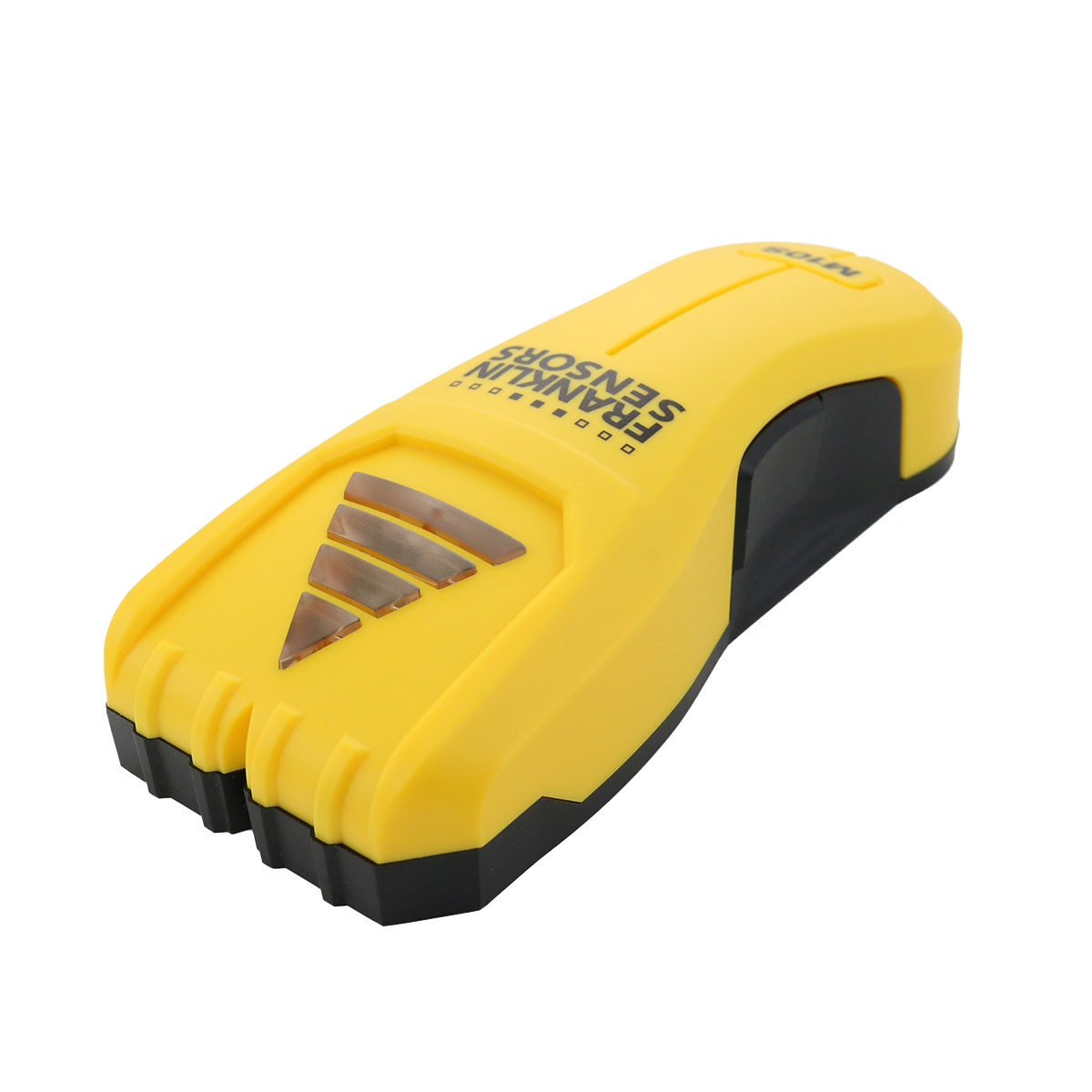
Explore this need in the finder →The Franklin Sensors ProSensor M10S is a small electronic stud finder built around three sensing points and three indicator lights. Its product page gives a one-inch detection-depth maximum, and its model-specific instructions describe a green center cue and a required wall-contact calibration step. Those details make the M10S a different assessment from the similarly named M10: the three-light count is alike, but the M10S has its own manual and a distinct set of surface notes. This is a documentary review of manufacturer material, not a hands-on test.
A narrow, center-first display
The M10S instructions say that red lights come on in sequence as the signal grows toward the stud center, where a green light illuminates. That gives the user a visible center indication, but the instructions do not describe simultaneous left and right edge boundaries for this model. The three lights should therefore be read as a center-oriented signal, not as proof of the width, material or identity of an object behind the surface. If a project depends on placing a screw near a member's center, the M10S does not replace finding and checking both boundaries with a suitable method.The manual also names Active Learning Technology and says readings become more precise as the wall is scanned. That is a manufacturer description rather than a measured result. The same manual warns that a light pattern can respond to surface inconsistency, a wire or a pipe as well as a stud. Repeated passes and a check at another height are sensible ways to test whether a reading is coherent, but they cannot establish that the response is wood.
Calibration is part of the operating plan
Unlike the T6 and T9 instructions, the M10S manual does not say that calibration is unnecessary. It directs the user to place the tool firmly against the surface before pressing and holding its button to calibrate and begin scanning. The hand should stay on the handle; holding the sides can make the unit work inaccurately. Anyone comparing several Franklin models should keep this step visible rather than assuming that all three-light finders start the same way.Two AAA cells are required, and the manual recommends alkaline batteries for best performance. It warns not to mix old and new batteries or battery chemistries. The official model page currently points to a Canadian retailer rather than identifying U.S. stock. That does not change the product's identity, but it makes seller, regional version, return terms and package details worth verifying before purchase; no retail SKU or included-battery claim is established here.
Surface and depth limits need to travel together
The product page states one inch as the M10S maximum. The manual gives a more cautious, conditional range of 0.75 to 1.0 inch for lath-and-plaster walls, noting that irregular plaster thickness and construction differences can exceed what the tool can handle. Metal mesh may also interfere. These are not contradictory numbers to average: one is the general headline, while the manual describes a limited wall assembly with explicit caveats. A threshold at one inch may be useful for screening, but it cannot guarantee a response through a particular finish.The M10S instructions say many textured walls and surfaces can be scanned, but recommend choosing the flattest portion for best performance. They also warn that metallic wallpaper may block the signal and foil-backed insulation can cause inconsistent readings. Tile, flooring, roofing and exterior use are not recommended. A user with one of those conditions should not trade away the material constraint just because the depth figure appears sufficient.
How it differs from the M10
The separate M10 and M10S pages both list three sensors and three lights, and each model has its own one-inch headline. Do not treat the suffix as decoration. The M10S manual's exact startup wording requires firm wall placement and calibration, and its own surface section describes many textures, acoustic ceilings and a 0.75–1.0-inch plaster range. These M10S details should not be transferred to the M10 or its shared M10/M12 instruction sheet. Conversely, the M10's wording should not silently replace the M10S manual. Compare the exact model, manual edition and seller's suffix.Who should keep it on the shortlist?
The M10S is worth considering when the job is a dry interior wall, a center cue is useful, a one-inch ceiling is enough for comparison and the calibration routine is acceptable. It is not a fit for shoppers who require documented edge indications, a live-wire meter, a deeper unconditional rating or guaranteed work on tile or exterior materials. Its instructions do not establish a live-wire meter, and a negative stud-finder result cannot clear hidden wiring, plumbing or gas. Shut off relevant utilities before penetrating a surface and use independent information to confirm a candidate. The useful decision is whether this particular display and method fit the task—not whether the tool sounds certain.Key specifications
Key details at a glance
| Sensing points | 3 |
|---|---|
| Indicator lights | 3 |
| Maximum stated stud depth | 1 in |
| Depth qualification | The exact M10S page states a 1.0-inch maximum; its manual gives a conditional 0.75–1.0-inch lath-and-plaster range. |
| Center and edge indication | No |
| Live-wire meter | No |
| Battery requirement | 2 AAA; alkaline cells are recommended for best performance; do not mix old and new cells |
Use the exact model’s instructions for operating limits, supplied equipment and version differences.
Sources for this review
Sources for this assessment
Check this model against your wall
Use the finder to compare documented surface limits, center/edge indications and other requirements. A match is not a safety certification.