
Your needs, this model
Does it fit your priorities?
Does the 710+ bubble level make a stud reading more certain?
No. Franklin lists a built-in bubble level on the 710+ page, so it can help you keep a mark or tool orientation level. It does not validate a density-change pattern or identify what is behind the wall. Confirm both edges, repeat the scan in another direction, and check services independently before making a hole.
Explore this need in the finder →Is the 710+ a deeper detector than the plain 710?
The two exact model pages both state 1.6 inches, and both list 13 sensors, 13 LEDs and a ruler. The 710+ page additionally lists a built-in bubble level. That feature difference does not extend the stated detection limit; if you need a higher threshold, compare a model with its own higher documented figure and surface-specific instructions.
Explore this need in the finder →What should I expect when scanning lath and plaster with the 710+?
Franklin's shared current manual says the 710+ may see through most lath-and-plaster walls up to 1.6 inches, but detection is not guaranteed where plaster thickness or construction varies beyond that depth, and metal mesh may prevent a result. Treat it as a conditional candidate, inspect the backing where possible and use another source of information rather than relying on a single scan.
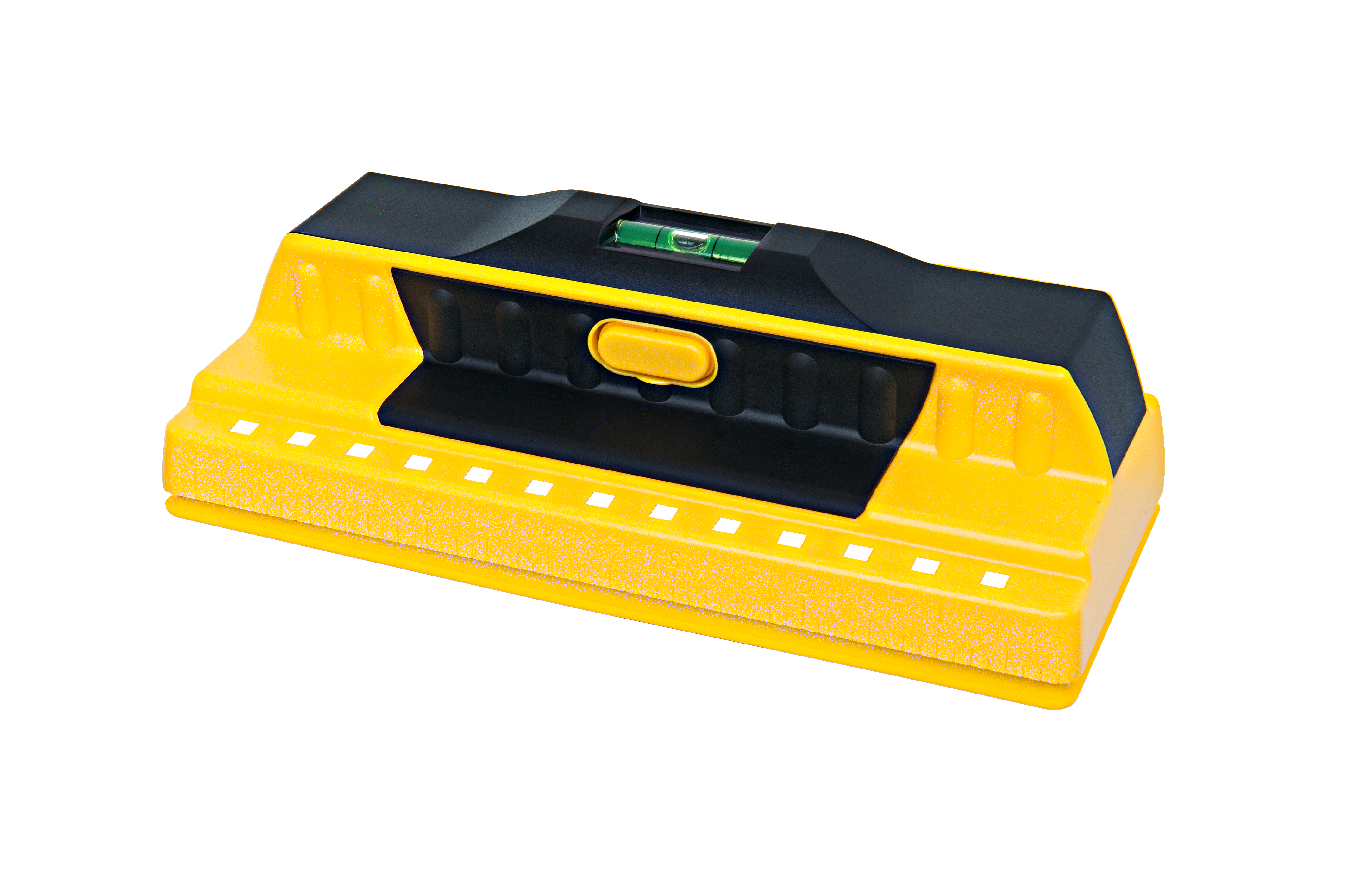
Explore this need in the finder →The Franklin Sensors ProSensor 710+ is a current U.S. electronic stud finder with a clear, model-specific feature split from the plain 710: Franklin lists a built-in bubble level on the 710+ page. The two pages otherwise share the headline 13 sensors, 13 LEDs, ruler and 1.6-inch stated maximum. The 710+ makes the most sense when that integrated level is useful for marking and the modest depth claim fits the wall you can inspect. This is an evidence-based desk assessment from manufacturer material, not a hands-on test or measured comparison.
What the plus adds—and what it does not
The 710+ page names 13 sensors, 13 LEDs, a 1.6-inch detection depth, a built-in bubble level and a ruler. Its official comparison graphic describes a six-inch display width, a full-width center-and-edge pattern, and indicators for single studs, double studs and multiple objects. These are manufacturer descriptions of the display; they are not independent measurements of accuracy or a guarantee that every wall will produce a clean pattern. A broad set of LEDs can show how a density response spreads across the detector, but it cannot identify whether the cause is wood, a pipe, a wire, a patch or a change in wall material.
Compared with the plain ProSensor 710, the 710+ is the one whose current product page explicitly includes a bubble level. The two individual pages state the same 1.6-inch maximum and list the same sensor count, LED count and ruler. The shared manual likewise names both models at 1.6 inches. So the plus is not a deeper-rated version in the evidence reviewed here. If a level makes it easier to keep a layout mark horizontal, it is a useful convenience; it does not improve the scan, center a stud more reliably, or certify that a screw location is clear.
Center and edge lights still need interpretation
The current family instructions identify the 710+ as one of the models in the no-calibration scanning group. They say the LEDs track stud center and edges simultaneously and that scanning can begin with the unit positioned on or off the wall. Keep a firm, repeatable contact and follow the manual’s handle and button instructions rather than trying to infer the target from one bright light. The manufacturer comparison chart also claims that this broad display can show single- and double-stud width and the width of multiple objects. That is a reason to compare the pattern, not proof that every wide response is a stud or a double member.
One separate cue remains unverified for this exact model. The 710+ page repeats the maker’s general statement that the middle LED turns green on “certain models,” but neither that page nor the shared manual identifies the 710+ as one of them. Do not assume a green center light based on the word “center” or on a photograph. The documented center-and-edge indication is sufficient to describe its pattern; its center-light color is not established.
Read 1.6 inches as an upper comparison, not a promise
The model page’s stated maximum is 1.6 inches. In the shared manual’s lath-and-plaster section, Franklin says the 710+ can see through most such walls up to that depth. The same paragraph says detection is not guaranteed when plaster thickness or construction variation exceeds the range and warns that metal-mesh reinforcement may defeat detection. That gives a conditional plaster use case, not a universal rating for old walls. If the backing or thickness is uncertain, identify the assembly before treating the model as a fit.
The instructions prefer a clean, dry surface and say recently applied paint or wallpaper should dry completely. Foil-backed insulation may cause inconsistent readings; metallic wallpaper can block the signal. Franklin does not recommend the ProSensor for tile, flooring, roofing or exterior materials because their densities vary. Although the comparison graphic describes the 710+ against conventional finders, those general claims cannot be used to override the exact manual’s cautions about unusual finishes and reinforcement.
Operation and verification are part of the decision
The manual calls for two AA batteries and specifies 1.5-volt alkaline cells. It warns against rechargeable cells, mixing battery types and mixing old and new cells. Neither the product page nor instructions reviewed here establish that a particular seller includes batteries, so check the offer rather than assuming the package is ready to use. Before scanning, keep the tool clean and dry, allow it to adjust after a significant temperature change, hold it by the handle and keep fingers away from the detector area. Press and hold the button through the scan. The manual says no calibration is required.
When the LEDs respond, continue to scan vertically and compare whether the pattern persists. A stable band can be more consistent with a stud than a brief irregularity, but that is a procedure for evaluating a signal, not object identification. Pipes, wires and other density changes may light the display; an undetected wire or other object can also remain behind the surface. The manual advises using other information, such as plans, visible service entry points and nearby switches or outlets, and warns not to rely on the finder alone.
Who should compare it—and what to check
The 710+ is a reasonable candidate for dry interior drywall when its broad center-and-edge pattern and integrated bubble level suit a simple layout task, and 1.6 inches is an adequate published comparison limit. The bubble vial is its clearest documented advantage over the plain 710, but the scan-depth headline is shared. The T13 also lists a bubble level and ruler and states 1.7 inches; the M210 and X2100 have their own higher 1.7-inch claims and documented live-wire meters, while the MAX uses separate modes and requires mode-specific interpretation. Those are published feature distinctions, not evidence that one performs better on an untested wall.
Before choosing a seller, confirm that the listing is for ProSensor 710+ rather than the plain 710, T11, T13 or another nearby model. The reviewed page and instructions do not publish a separate retail SKU, an exact seller package, included batteries or a dedicated live-wire meter. They also do not identify the 710+ as a green-center model. Use the actual manual and wall condition, repeat and cross-check a likely stud, and turn off utilities before penetrating any surface. A built-in bubble level is convenient; it is not a safety feature.
Key specifications
Key details at a glance
| Sensing points | 13 |
|---|---|
| Indicator lights | 13 |
| Maximum stated stud depth | 1.6 in |
| Depth qualification | The exact 710+ page states a 1.6-inch maximum. Its shared manual describes this as a limit for most lath-and-plaster walls subject to thickness variation and metal mesh; it is not a guaranteed reading through every wall. |
| Center and edge indication | Yes |
| Built-in bubble level | Yes |
| Battery requirement | 2 AA; use 1.5-volt alkaline batteries and do not mix old/new or battery types |
| Built-in ruler | Yes |
Use the exact model’s instructions for operating limits, supplied equipment and version differences.
Sources for this review
Sources for this assessment
- ProSensor 710+ — official U.S. model page
- Franklin Sensors ProSensor T11/T13/M132/710/710+/X1100 Operating/Safety Instructions (11/25)
- Franklin Sensors U.S. product directory
- Franklin Sensors instructions and quick-start index
- Franklin Sensors ProSensor 710+ comparison matrix (manufacturer page image)
- ProSensor 710 — official adjacent-model page

Check this model against your wall
Use the finder to compare documented surface limits, center/edge indications and other requirements. A match is not a safety certification.