
Your needs, this model
Does it fit your priorities?
What wall surface does the StudMark 7310 support?
Calculated Industries describes the exact model for sheetrock and drywall, and explicitly says it is not recommended for plaster because wall thickness varies. The reviewed sources do not establish tile, exterior or metal-mesh use.
Explore this need in the finder →Do the 7310's magnets identify a stud edge or center?
No dedicated edge or center indication is documented. The two magnets catch a likely nail or screw head, while the removable markers preserve points the user has already found; that is not an electronic boundary or center reading.
Explore this need in the finder →What numeric depth should be used for the 7310?
The exact manufacturer page and package image reviewed here do not state a stud-detection depth in inches. Keep that field unknown; the 7310 cannot satisfy a numeric minimum-depth requirement by inference.
Explore this need in the finder →Does the 7310 provide a separate AC or live-wire warning?
No separate live-wire meter, AC-warning mode or drilling-safety clearance function is documented in the exact manufacturer sources reviewed. A magnetic fastener catch does not say whether an electrical conductor is present or absent.
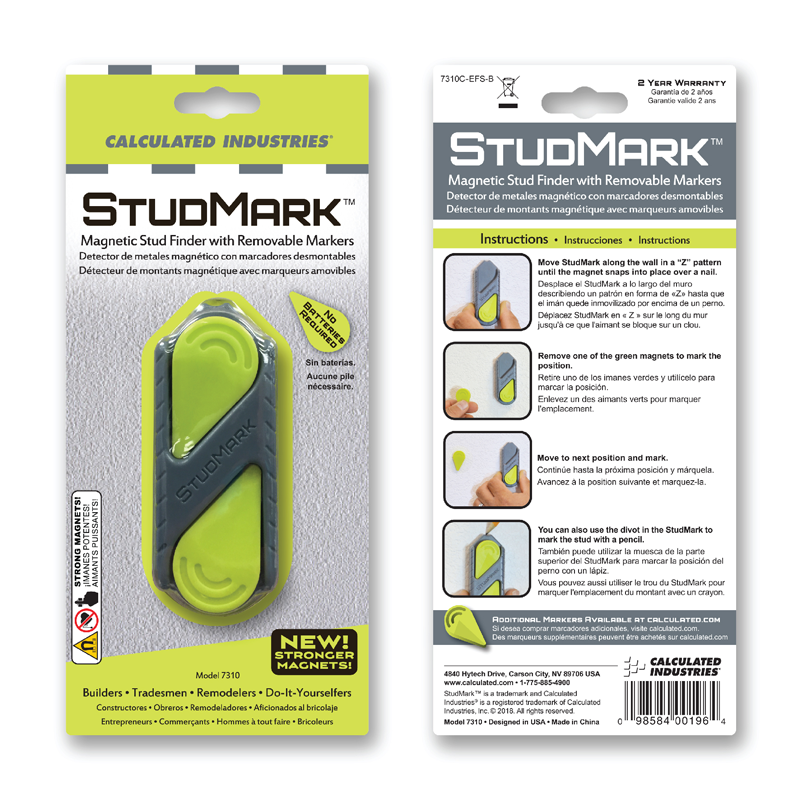
Explore this need in the finder →The Calculated Industries StudMark model 7310 is a small, battery-free magnetic finder for a particular kind of clue: a ferrous nail or screw fastening drywall to a stud. Its maker describes a slow “Z” pattern across drywall until one of the tool’s rare-earth magnets catches a fastener. That is a different job from electronically scanning for a density boundary. The 7310 reports a likely fastening point; it does not measure wood, show a complete stud-width display, or provide a numeric depth specification.
A fastener point is not a stud map
The main practical distinction is what the magnet responds to. The maker says the 7310 finds nail or screw heads holding sheetrock to wood or metal framing. The underlying detection cue is therefore a metal fastener, not the framing material itself. A strong catch can mark a useful place to investigate, but it does not reveal the stud’s full left and right boundaries, identify the fastener’s purpose, or guarantee that a second nearby metal object is part of the same stud.
For a layout task, several plausible fastener points in a consistent vertical line may be more useful than a single catch. Treat that pattern as a clue to verify rather than proof of a centerline. This cautious reading matters especially when a visitor is planning to anchor something heavy: a magnetic response is not a load rating, a structural assessment, or permission to drill.
The 7310 has two magnets in its base and two separate removable magnetic markers. According to the product page, the body can hold at a detected fastener while the markers preserve other points; the maker describes marking up to three stud locations at a time. The pointed divot on the body is another way to make a pencil mark. These markers make a multi-point layout easier to keep visible, but they do not add sensing range or turn the device into an electronic center indicator.
Where the maker draws the surface line
The exact 7310 page repeatedly describes drywall or sheetrock use, including the fastener-finding procedure. It also explicitly says the tool is not recommended for plaster because wall thickness varies. That is a meaningful limit, not a minor footnote: a fastener in a thicker or layered finish can be farther from the magnet, while lath-and-plaster construction can differ substantially from the drywall use described by the maker. The sources reviewed do not establish a lath-and-plaster, tile, exterior or metal-mesh operating plan, so this assessment does not extend the drywall claim to those surfaces.
Nor does the manufacturer publish a maximum stud-detection depth for the 7310 in the product information reviewed. The lack of a number is not evidence of a particular short or long reach. It means a numeric minimum-depth request cannot be checked against a supported figure for this model. If depth is essential, select a tool whose own instructions state a limit for the target and operating mode you intend to use, and still treat that limit as a comparison point rather than a guaranteed result through every finish.
What setup looks like—and what is not documented
The product is powered by its magnets rather than a battery. There is no electronic startup display to read or calibration routine listed on the exact product page. The maker’s illustrated package directions show the core routine: hold the tool lightly, move it in a “Z” pattern, wait for a magnet to catch a nail or screw, then use a removable marker or the body’s divot to mark the point. There is no separately listed 7310 user-guide PDF in the current manufacturer guide index we checked; the exact product page and its model-labelled package image are the sources for this basic procedure.
The reviewed 7310 sources do not document a live-wire meter, AC-warning mode, or any electrical-clearance function. Do not use the absence of a magnetic catch as a safety check. Before drilling, use appropriate plans and independent utility checks; even an electronic live-wire warning is not proof that a wall is clear.
How it differs from another magnetic approach
The C.H. Hanson 3040 is another battery-free magnet-based option, but its exact maker page documents a rotating vial level as part of the layout tool. The 7310’s distinctive supplied workflow instead emphasizes two removable magnetic markers for keeping several detected fastener points visible. Neither basic magnet mechanism creates the edge-and-center behavior of a density-scanning display, and the 7310’s own sources state no numeric depth. Compare those functions only when they match the task: use a dedicated level if line alignment is important, and choose an electronically indicated model if you need documented edges, center cues, or a depth threshold.
The 7310 is most defensible as a compact, low-maintenance locator for drywall where fasteners are present and marking more than one candidate point is useful. It is a poor fit for a shopper who requires a published depth number, an edge or center signal, plaster support, or a live-wire meter. These are source-based limits, not results from hands-on testing; no detection accuracy, likelihood of success, or wall-specific performance is asserted here.
Check the exact package before choosing
Calculated Industries lists model 7310 and says its package includes two removable markers. Confirm the exact model number and whether the offer is the standalone finder or an additional marker accessory; the separate 7356 marker set is not a finder and cannot scan by itself. Check current seller terms and the package contents before ordering, because a manufacturer listing is not a guarantee that every reseller offer is identical. No current price, stock level or customer-experience claim is made in this assessment.
Key specifications
Key details at a glance
| Depth qualification | The exact manufacturer product page, current user-guides index and model-labelled package image reviewed here state no numeric stud-detection depth. Unknown stays unknown; no threshold is borrowed from another model or retailer. |
|---|---|
| Documented scan modes | ['Manual light-grip Z-pattern search for drywall fastener heads'] |
| Center and edge indication | No |
| Battery requirement | None required; magnetic operation |
Use the exact model’s instructions for operating limits, supplied equipment and version differences.
Sources for this review
Sources for this assessment

Check this model against your wall
Use the finder to compare documented surface limits, center/edge indications and other requirements. A match is not a safety certification.