
Your needs, this model
Does it fit your priorities?
What depth can I compare for GMS120-27 drywall wood scanning?
The exact manual gives 30 mm (about 1.18 inches) for a 54 mm-wide wooden beam behind 30 mm-thick plasterboard. The 50 mm live-wire, 100 mm steel and 120 mm copper figures describe separate targets; they do not increase the wood-beam figure. Wall construction and target size affect results.
Explore this need in the finder →Does the GMS120-27 show both stud edges and center?
Bosch documents an object-center indicator and a color-changing ring. The manual describes tracing object boundaries as the ring changes, but the reviewed material does not document a separate stud-edge indicator; this assessment therefore treats it as a center-cue model, not a both-center-and-edge match.
Explore this need in the finder →Can the GMS120-27 live-wire indicator prove a wall is clear?
No. The manual's live-cable classification depends on a 50–60 Hz energized signal, grounding and conditions that let the signal reach the tool; it warns about humidity above 50%, conductive surfaces, foil, moisture and multi-phase cables. Treat the indication as an extra warning only and check other sources before penetrating a wall.
Explore this need in the finder →Bosch's GMS120-27 is a separate model from the older GMS 120, and its drywall wood-beam figure is lower. The exact GMS 120-27 manual lists 30 mm—about 1.18 inches—for a 54 mm-wide wooden beam behind 30 mm-thick plasterboard. This review uses the GMS120-27 U.S. page and Bosch's model-specific instructions; it does not transfer the older model's 38 mm ceiling or claim hands-on use.
Keep the model and depth boundary exact
The current U.S. product page identifies GMS120-27 SKU 0601081710. Its wording says the scanner detects wood and steel studs, metals and live wires behind drywall. The manual's table distinguishes 30 mm for wooden beams in dry walls, 50 mm for energized 100–230 V cables, 100 mm for ferrous metal and 120 mm for copper. Its footnote qualifies the wood figure for a beam 54 mm wide behind 30 mm-thick plasterboard. These target figures are not interchangeable: the wire and metal numbers cannot be used to satisfy a requested stud depth.
The difference from the older GMS 120 matters. That product has its own U.S. SKU and linked manual, which state 38 mm for wood substructures. GMS120-27 is a new identifier with a different manual and 30 mm wood-beam number. A familiar family name, a deeper live-wire range or a seller's abbreviated title does not bridge those specifications. Before ordering, match the model suffix and U.S. SKU on the tool and package.
Wood detection is a specific drywall setting
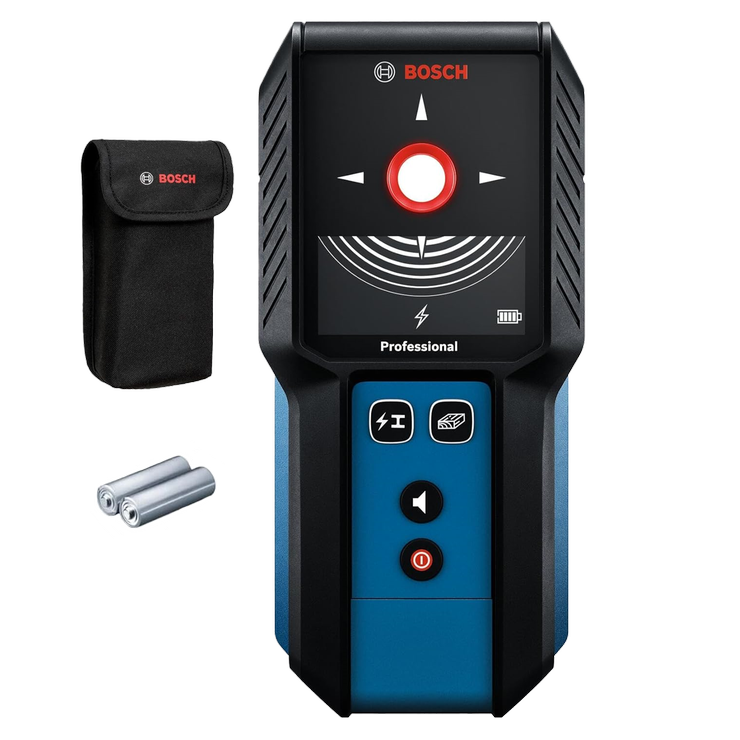
The GMS120-27 automatically searches for metal and live 50–60 Hz cables; the Wood button adds a separate wood-detection function. Bosch says to switch wood detection on only when looking for wood in dry walls with a wooden substructure, because results on other surfaces may be impaired. The page describes a center indication, material-identification LEDs and a color-coded illuminated ring. The manual explains the object-center indicator at the maximum signal and how to continue until the ring is no longer red to trace an object's boundaries.
That boundary method is not the same as a separately documented stud-edge indicator. For the matcher, this assessment records a center cue, not the paired center-and-edge display requested by a buyer who needs both. Nor does a center reading identify a wooden stud: Bosch warns that water-filled plastic pipes, power cables or gas lines may sometimes appear as non-metallic objects in wood mode, and nails or screws can make wood beams look metallic. Repeated passes and independent wall information are still needed.
Live-cable detection has its own conditions
The wire feature is independent of the 30 mm wood-beam ceiling. The manual lists 50 mm for energized 100–230 V cables and says that non-live wires have less detection depth. For the signal to reach the tool, it describes requirements involving a 50–60 Hz cable signal and proper contact with the ground; insulating footwear or a ladder can impair grounding. Above 50% relative humidity, behind metal foil or in wet walls, a cable may not be found. Conductive tiles can stop a live-wire indication or produce a broad red area, and multi-phase cables may not be classified as live.
Those limits make a positive cue useful as an extra warning, not as a complete cable map. An absent signal is not proof of absence. Bosch instructs users to switch off power consumers and verify cables are de-energized before drilling, sawing or milling, and to consult other information before penetrating a wall. Do not treat a stud scan as a safety check.
Power, package and jobsite details
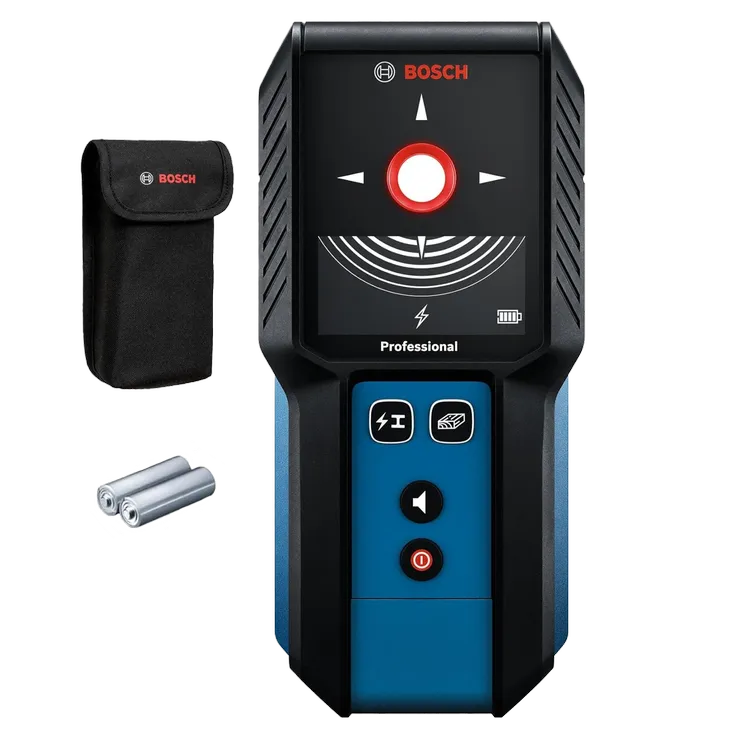
The exact U.S. product page lists two AA batteries and a soft pouch. The manual allows two alkaline-manganese or NiMH AA cells, or the BA 3.7V 1.0Ah A lithium-ion pack; Bosch states that Li-ion accessory is sold separately. That power choice can reduce interruptions for someone already equipped with the compatible pack, but it should not be counted as included when comparing offers. The page also gives IP54 protection and shock-absorbing rubber casing. The manual's environmental notes remain relevant: moisture, nearby electromagnetic sources, stickers or metal on the sensor area, and a temperature change can affect measurement or operation.
Where it fits beside other Bosch scanners
GMS120-27 is a compact choice when the work is a dry drywall beam behind the manual's described plasterboard thickness, a center cue is sufficient, and automatic metal/live-cable detection is useful. It is not the choice for a 1.5-inch stud threshold: 30 mm is about 1.18 inches, so a 1.1-inch screen can include it while 1.2 inches cannot. By contrast, D-TECT120 lists 60 mm in Drywall mode and D-TECT200C lists 38 mm for wooden beams in drywalls with object-edge and center views but a professional-use and UWB restriction. The older GMS 120 also differs in its own 38 mm wood-substructure figure, three-mode descriptions and exact package. Compare each exact manual rather than choosing by largest overall depth or similar product name.
The GMS120-27's practical tradeoffs are modest drywall depth, center-first feedback rather than a dedicated edge display, and a live-wire feature that depends on grounding and wall conditions. It makes sense when those boundaries fit the job; for plaster, tile, metal-mesh or deeper stud requirements, the reviewed documentation does not justify stretching its drywall figure or wood mode to a different surface.
Sources and verification
Primary evidence: Bosch's GMS120-27 U.S. product page for retail SKU, included AA cells and pouch, and Bosch's original GMS 120-27 instructions, edition 1 609 92A A0S (2024.10) for the separate 30 mm wood-beam figure, operating procedure, power options and detection limits.
Key specifications
Key details at a glance
| Maximum stated stud depth | 1.18 in |
|---|---|
| Depth qualification | The exact manual lists 30 mm for a 54 mm-wide wooden beam behind 30 mm-thick plasterboard. This is about 1.18 inches and depends on material, target size and substrate. The 50 mm energized-wire, 100 mm ferrous-metal and 120 mm copper figures are different targets; they are not stud depth. |
| Documented scan modes | ['Automatic metal/electricity detection', 'Wood-beam detection selected for dry walls'] |
| Center and edge indication | No |
| Live-wire meter | Yes |
| Battery requirement | Two AA alkaline-manganese or NiMH cells, or optional Bosch BA 3.7V 1.0Ah A lithium-ion pack; the exact U.S. page lists two AA batteries in the package and says the lithium-ion pack is sold separately. |
Use the exact model’s instructions for operating limits, supplied equipment and version differences.
Sources for this review
Sources for this assessment
Check this model against your wall
Use the finder to compare documented surface limits, center/edge indications and other requirements. A match is not a safety certification.